
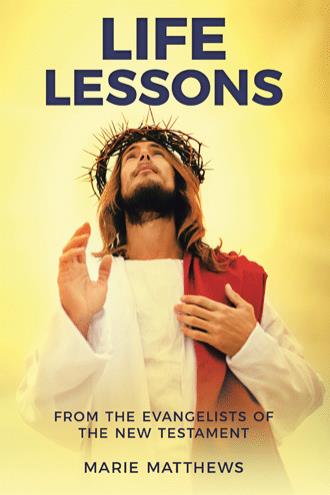
LIFE LESSONS
FROM THE EVANGELISTS OF THE NEW TESTAMENT
by
Book Cover & Preview Text
Life lessons from Chariots of Fire Paul used running a race as a metaphor for living the life of faith in the New Testament: “Don’t you realize that in a race everyone runs, but only one person gets the prize? So run to win! All athletes are disciplined in their training. They do it to win a prize that will fade away, but we do it for an eternal prize. So I run with purpose in every step” (1 Corinthians 9:24-26). “Therefore, since we are surrounded by such a huge crowd of witnesses to the life of faith, let us strip off every weight that slows us down, especially the sin that so easily trips us up. And let us run with endurance the race God has set before us. We do this by keeping our eyes on Jesus, the champion who initiates and perfects our faith” (Hebrews 12:1-2). Paul’s ideas of running the race can be linked to one of most notable British films ever produced, the award-winning Chariots of Fire (1981), directed by Hugh Hudson. Set in the early 1920s, it was based on the true story of two athletes: Harold Abrahams and Eric Liddell, who were ambitious enough to become the fastest runners in Great Britian at that time. Liddell was born in China to Scottish missionary parents. At the beginning of the film, he is seen with his family in Scotland and training on the beach with his brother. Abrahams is of Jewish descent and keenly senses his ethnicity. He is portrayed as a self-driven, determined man; when he hires a professional trainer, his professors believe him to be motivated to “win at all costs”. Both men push themselves to their limits, showing their strong perseverance and commitment to become the best. Both Abrahams and Liddell win a place to run in the 1924 Olympic Games, held in Paris, France. En route, the British team learn that some of the heats are to be held on a Sunday. After reflection, Liddell refuses to run, because observing the Sabbath is fundamental to his faith; to do so would go against his Christian values. A brief scene shows that the British runners who do enter the heats that Sunday, including Abrahams, are defeated in their attempts to win a place. Meanwhile, Liddell preaches at the Church of Scotland in Paris, on a theme from Isaiah 40: 28-31. When the Lords of the British Olympic Committee meet, some are unhappy with Liddell’s Christian ethics and the moral stand he takes. Liddell “…is pressured to abandon his religious convictions for the sake of national glory. His refusal demonstrates the strength of his faith and the importance of staying true to one’s principles, even in the face of immense pressure.” The committee is then persuaded by Lord Lindsay that Liddell should take his place in the 400-metre event, to give Liddell the chance to run. At the climax of the film, the 400m race is about to start. As the men limber up, Jackson Shultz (the American favourite), shares with another American runner that he knows Liddell has “something to prove, something personal, something that guys like us wouldn’t understand”. Shultz then passes Liddel a pencil written note which reads, “Mr. Liddell, It says in the old book, He who honours me, I will honour. Good luck, Jackson Shultz.” Liddell clasps the note in his hand as he kneels in the starting blocks. View the scene from Chariots of Fire “He who honours God” online. This verse is from 1 Samuel 2:30: “Those who honour me, I will honour”. These words are echoed by Jesus in John 12:26, when He stated: “Anyone who wants to serve me must follow me, because my servants must be where I am. And the Father will honour anyone who serves me.” A major theme of the film is that Liddell’s faith is the force which leads to his victory. It comes from his power of conviction that God has made him fast, and that when he runs, he “feels His pleasure”. When Liddell runs the race of his life, his head is held high. His voice over says, “So where does the power come from, to see the race to its end? From within.” Running is a form of worship for him; it is Liddell’s way of honouring the gift God has given him. Chariots of Fire celebrates the human spirit, showing the characters’ power of dedication, the strength of their personal conviction and the importance of pursuing one’s goals. It demonstrates that victory is not just about winning the race, but the importance of doing so with integrity and honour. Group discussion and self-reflection questions: 1. What impressed you the most about Eric Liddell and his exemplary faith? 2. What do you think of Abrahams’ drive and ambition, to “win at all costs”? How does that contrast with Liddell’s determination and commitment to God? 3. How should we interpret the verse from 1 Samuel 2:30, “Those who honour me, I will honour”? 4. What does Paul mean when he states, “we do it for an eternal prize”? How does this apply to your life? 5. Consider the verses from Hebrews 12:1-2 above. What does Paul mean when he writes, “let us run with endurance the race God has set before us”? What type of race are you running?
Formats

Book Details
About the Book
Life Lessons from the Evangelists of the New Testament features the main evangelists of the New Testament, and the life lessons that we can learn from them. The first chapter is on a film of faith, Chariots of Fire, because it introduces the apostle Paul’s concept of running a race. Each subsequent chapter is written to focus on the life lessons from the significant Bible figures of the New Testament: John the Baptist, Jesus, the gospel writers Mark, Matthew, Luke and John, and Peter and Paul. At the end of each chapter, the higher order thinking questions are designed for self-reflection and group discussion. The writer of the book of Hebrews wrote: “Faith shows the reality of what we hope for; it is the evidence of things we cannot see…All these people earned a good reputation because of their faith, yet none of them received all that God had promised. For God had something better in mind for us, so that they would not reach perfection without us” (Hebrews 11:1, 39-40, emphasis mine). The final verse is prophetic. Apart from Jesus, the other Biblical figures were human. God intended that we learn from their lives and the way He demonstrated His power, love, mercy and grace towards them. Each Bible Study includes: • An introduction to the lesson • Selected Bible Reading • Insights into the text • Life Lessons • Self-reflection and group discussion questions
About the Author
Marie has worked in full-time Christian ministry and education. Having devised many study workbooks, God inspired Marie to make up new resources for Bible Study groups.