
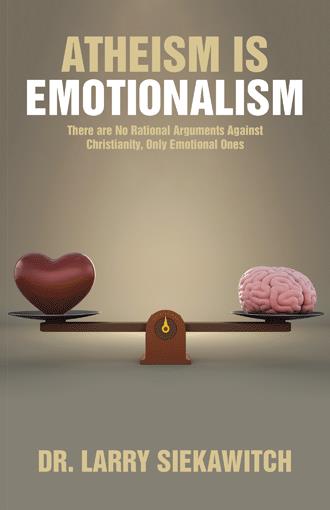
Atheism is Emotionalism
There are No Rational Arguments Against Christianity, Only Emotional Ones
by
Book Cover & Preview Text
Usually, the first problem atheists bring up with Christianity is the problem of evil and suffering. How can an all-powerful, all-knowing, all-loving God allow evil and suffering in the world? To many, it seems illogical. But is it illogical? What rule of logic does this “problem” break? If we want to remain philosophers, we need to calm down and think about this subject rationally. Remember chapter one on philosophy. The first and most important rule of logic is: It cannot be both “A” and “non-A” at the same time and in the same manner. How does the existence of evil and suffering for a time and an eternal God who is infinite in power, knowledge, and love break this rule? Simple answer: it doesn’t. God could have a reason for allowing evil and suffering in His world for a time (a short time if we are comparing it to eternity), and He doesn’t even need to tell us what His reason is. We might not like it, but it is not irrational. The problem is an emotional one. People don’t like to suffer and rightly speak out against evil. Both evil and suffering bother us and get us emotionally uptight. If God caused evil, there would be a problem, because then we would have a God creating evil and telling us we are bad for creating evil. If evil was a substance, this would make sense, but the movie Time Bandits is incorrect in its theology – evil is not a substance. Evil is a choice to go against God’s commands. Obviously, God wouldn’t make people go against His commands and then punish them for doing so. Jesus said in Luke 17:2, “It would be better for him if a millstone were hung around his neck and he were thrown into the sea than for him to cause one of these little ones to stumble.” This would apply to God as well as humans; what’s good for the goose is good for the gander (what is a gander?). The word for “cause” used in the previous quote means to influence heavily, not force, because if someone forced someone else to sin, the sinner would have no culpability. But God doesn’t cause, force, or influence anyone to sin. The Puritans developed an important and Biblical principle of two types of will in God’s plan. Allow me to quote Stephen Charnock: But as God sees things possible in the glass of his own power, so he sees things future in the glass of his own will: in his effecting will, if he has decreed to produce them; in his permitting will, as he has decreed to suffer them and dispose of them. Nothing can pass out of the rank of things merely possible into the order of things future before some act of God’s will has passed for its futurition. I hope you love the way the Puritans wrote, even if you don’t like what they say – futurition, what a word! There is the active will, what Charnock called the effecting will, and there is the permissive or permitting will in God. God permits evil; He doesn’t cause it. Charnock brings up the truth that God knows the entire future, because He is in control, which bothers some, but His omniscience (His knowledge of all events including future ones) doesn’t mean He caused it any more than someone knowing past events means they caused those events. He could have stopped the future event, but it doesn’t mean He caused it. We just don’t like some of the events He allowed; once again, this is an emotional dislike rather than a rational argument. Let me give you a really important truth that is very logical: Humans don’t know everything, and therefore we should be humble when we don’t understand something. King David wrote an incredible song that is highly logical in Psalm 131: LORD, my heart is not proud; my eyes are not haughty. I do not get involved with things too great or too wonderous for me. Instead, I have calmed and quieted my soul like a weaned child with its mother; my soul is like a weaned child. Israel, put your hope in the LORD, both now and forever. This song doesn’t mean we shouldn’t try to understand things that are difficult. The Psalmist in Psalm 73 wrestles with the problem of the prosperity of the wicked. Job seeks to understand why he suffered though he was righteous. Ecclesiastes discusses the inequities of life when viewed from an “under the sun” perspective. The Bible covers both conventional or practical wisdom and speculative or reflective wisdom. It doesn’t shy away from the tough questions of life. But Psalm 131 gives us perspective. Job was ignorant of what was going on in the grand scheme of things and should have remained humble. When we don’t understand something, especially the seeming injustices of life, we should remain calm and continue to trust the Creator who does understand everything. Deuteronomy 29:29 tell us: “The hidden things belong to the LORD our God, but the revealed things belong to us and our children forever, so that we may follow all the words of this law.” God doesn’t tell us everything. We would have to be omniscient in order to comprehend everything, and God can’t make us God. God is God and we don’t get to be God; this last statement is one of the real reasons people reject God; they want to be God. If we are not God, then there are hidden things we don’t understand. By the way, if you could fully comprehend God, you would be God; for an atheist this would be a problem, because then they would be God and, at the same time, deny God. Logically, God keeps things from us, either because we are too small or we just don’t need to know right now. Psalm 139:6 is true: “This wondrous knowledge is beyond me. It is lofty; I am unable to reach it.”
Formats

Book Details
About the Book
This book addresses the tough questions atheists and agnostics ask but with a twist. Most people today who have been convinced by the atheist arguments have been persuaded by emotional appeals rather than logical argumentation. The appeal sounds rational, but it is only emotionalism disguised as reasoning. In this book we examine the common arguments used today to disprove Christianity and reveal that the arguments are actually emotional rather than rational. After revealing the emotional influence, we then look at good rational answers to the questions. In this book you will learn the proper use of logic and reasoning, a mini course on philosophy, and see why it is intelligent to be a Christian. Many prodigals have left the faith only to find a dead end in their secular adventure. This is a great book to woo you back to a more satisfying relationship with God and humanity. The author uses reasoning as well as humor to present his case that Atheism is Emotionalism: There are No Rational Arguments Against Christianity, Only Emotional Ones. What is philosophy? Is radical individualism the way? Is there a problem with evil and suffering? What about the poor Canaanites? Did God sanction slavery? What about hell? Why doesn’t God talk louder? If you have ever been asked these questions or asked them yourself, you will benefit from this book. Dig in and enjoy!
About the Author
Larry Siekawitch is a professor at the University of Northwestern and teaches apologetics, theology, Bible, and philosophy. He has written two other books addressing evidence for Christianity, namely The Uniqueness of the Bible and Beyond a Reasonable Doubt. Dr. Siekawitch uses his books to evangelize skeptics and prodigals, seeing many come to faith. Dr. Siekawitch is also a pastor and has the unique ability to blend scholarship with practical methods of teaching – a pastor theologian.