
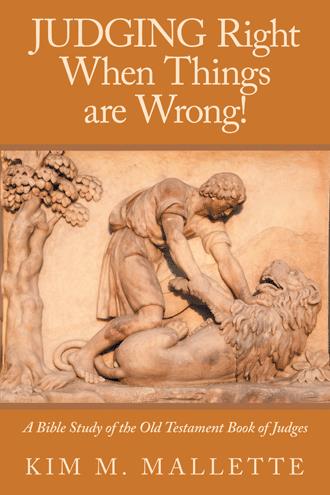
JUDGING Right When Things are Wrong!
A Bible Study of the Old Testament Book of Judges
by
Book Cover & Preview Text
God’s Watchman Must Engage in the Crusade Against Covenant Passivity In Numbers 16 there is an incredulous account. Four Israelites named Korah, Dathan, Abiram, and On, rose up in rebellion against Moses and his leadership. They influenced an additional 250 Israelite leaders to join them in grumbling against Moses. Moses points out to them that their rebellion was not against him but against God. Moses proposes a test that involved each man taking censers filled with incense. They were to assemble at the Tabernacle and the Lord’s presence. When they assembled the next day, God instructs Moses and Aaron to “move back” because He was ready to annihilate all of Israel. But Moses and Aaron prayed for God’s mercy. God responds to their intercessory prayer and instructs that everyone move away from the tents of the rebel rousers. God opens up the earth and the households of the rebellious ringleaders disappear into the earth to their deaths. God then sent fire to consume the 250 men that had followed Korah, Dathan, Abiram, and On. Remarkably, though Israel witnessed the rebellion of these men and their ensuing punishment, the following day, the entire assembly grumbles against Moses and Aaron. God, again, vows to wipe out the entire nation of Israel and he sends a plague. Aaron does something outlandishly notable. He takes a censer from the Tabernacle, puts incense into it, lights the incense, and then races to make atonement for the people. Aaron runs right into the midst of the assembly, between the approaching plague and the people. He offers the incense as an atonement for the people’s sins. Numbers 16:48 says this: “He (Aaron) stood between the living and the dead, and the plague stopped.” Aaron “stood in the gap,” and crusaded on behalf of a people who had become passive about their walks with God. His actions saved the majority of Israel from certain death. Tolerance has become a byword for many today, including Christians. “Loving your neighbor” has come to mean not just accepting others BUT also accepting their sins. Speaking out against sin is a taboo in many circles. The Kingdom of God needs more present-day Aaron’s who will choose to stand between the living and the dead. It also needs Christian judges who would follow the exemplary crusades of Bible heroes like: • Phinehas (Numbers 25) the priest, and Aaron’s grandson, who confronted sexual sin by slaying an Israelite man and a Midianite woman who were engaging in sexual relations. His actions halted another plague sent by God. • Elijah (1 Kings 18), the prophet to the Northern Kingdom of Israel, who took on wicked King Ahab and his 850 prophets of Baal and Asherah by himself. What he did led to the deaths of all the false prophets and the eventual death of Ahab. • Jeremiah (Jeremiah 7), the prophet to the Southern Kingdom of Judah. He preached righteousness and condemned the wickedness and idolatry of the people who claimed to be God’s people. • Paul (1 Corinthians 5), the apostle. He publicly called out an unrepentant man in the Corinthian church because of his immoral relationship with his stepmother. Paul’s actions led to the man repenting, ending the sinful relationship, and returning to Christ. There is a tremendous need for Christians to serve in this capacity to a faithless world. The most pressing need is within our own family—and with our neighbor. Why is it easier for some to crusade by going on a short-term mission trip with their church group, than it is engage their neighbor whom they wave at every day? Why are we more willing to hop on social media and speak out against sin, but refuse to have a loving, howbeit hard, conversation with our child who is making ungodly choices? Tolerance is still being indulged. We’re just pickier about whose sins of which we are more tolerant. Why is that? • Are we tolerant, and therefore passive, towards the sins of those closest to us, because of fear? Yes, some Jesus followers have bought into the false narrative that we cannot be loving and at the same time take a stance against the godlessness of our loved one. Supposedly, we cannot love them and still stand against their rejection of Christ. The word still used against Christians who refuse to practice tolerance is “judgmental.” It is necessary in order to respond to God’s call to us to be His judges, we must practice and exhibit “discernment.” Still, hypocritical judging (Matthew 7:1ff) has no place in our lives. Also, we do not have to resort to being unloving and unkind. Proverbs 16:24 says: “Gracious words are a honeycomb, sweet to the soul and healing to the bones.” We must put aside the fears we may feel when we are talking to others about their need for Jesus. We should not be afraid when we tell them of their need to be repentant, and to forsake sin and follow Him. Israel somehow dropped the ball on this. Otherwise, an entire generation would not have grown up without knowing God. Fear can paralyze us and cause inaction. Our mediocrity can turn into a malignancy for those who mean the most to us.
Formats

Book Details
About the Book
History is not exactly everyone’s cup of tea. Yet, it is invaluable to the human soul. The Bible is a treatise that spans around 4,500 years of human history. It provides for us a progression of man’s fall, his attempt to save himself, and the plan God devised to save us through Jesus Christ and His grace. It would be foolish for us to not learn from history. One of the most eye-opening books in the Old Testament is the book of Judges. Much of the book reflects the mindset of those living in the twenty-first century. The premise of the book is that Israel refused to allow God to be their King. Therefore, Israel did what they saw fit in their own eyes. Amorality. Abominations. Idolatry. Passivity. Difficulties. Battling. Temptation. Heartache. Consequences. These are all themes of Judges. These are also themes of the world we live in today. A redemptive God was not content to turn a blind eye to His children. So He raised up judges. Through them, God introduced His desire for Israel. Repentance. Boldness. Leadership. Servanthood. Trust. Deliverance. Salvation. Peace. Grace. These are still God’s will for humanity today. We live in a world which largely rejects Jesus as King. Jesus is calling His disciples to be His judges today. He needs you and me to step up, speak up, and show up. He needs us to JUDGE right when things are wrong. Will you answer His call?
About the Author
Kim Mallette grew up in the small rural village of Newtown, Missouri. After attending college at Central Bible University (formerly Central Christian College of the Bible) in Moberly, Missouri, he served the located ministry for over twenty-five years in Iowa, Missouri, and Texas. He is now retired having also spent twenty-three years in the public workforce. Kim and his wife, Angela, have lived in Ft. Worth, Texas, for thirty-four years. They are blessed to have three adult children, Amanda and her husband, Paul; Caleb, and his wife, Sandra; and Gracie, and her husband, Nkere. They have been doubly blessed with seven grandchildren. He loves teaching and mentoring, attending his grandchildren’s activities, and is a big fan of the St. Louis Cardinals and the Dallas Mavericks. His greatest joy is sharing the love of Jesus with everyone he meets! Kim is also the author of Ha-Hallelujah, The Grace Embrace, and Happy “New Birth” Day!