
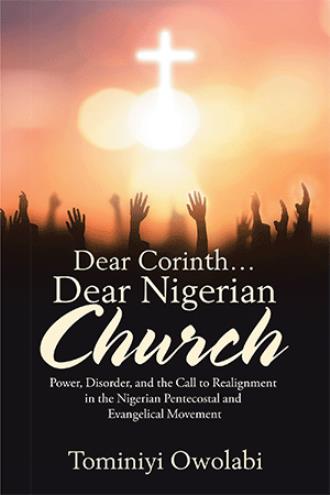
Dear Corinth…Dear Nigerian Church
Power, Disorder, and the Call to Realignment in the Nigerian Pentecostal and Evangelical Movement A Call from the Letters to the Corinthians
by
Book Cover & Preview Text
Chapter 1: When Preaching Becomes Performance A Scene We All Recognise It is a Friday night in Lagos. Traffic is heavy, but people are determined. The banners have been up for weeks. “Prophetic Encounter.” “Apostolic Fire.” “Seven Nights of Glory.” The guest minister has flown in. The hall is full. Overflow seating outside, screens mounted, ushers in branded jackets moving briskly. The music begins. It is excellent, tight, rehearsed and emotionally precise. The mood lights swirl around the hall. There is smoke filling the stage. The atmosphere builds in layers. The crowd responds. Phones are out. Clips are already circulating. By the time the preacher takes the stage, the room is ready. He is articulate. Confident. Measured. Every line lands. The crowd laughs where it should laugh, leans in where it should lean in, erupts when it should erupt. There are quotable lines, sharp, memorable, perfectly framed for social media. “Write this down.” “Don’t miss this.” By the end, the room is on its feet. “Amazing word.” “Deep.” “Powerful.” The service ends. People linger. Some take pictures. Others post clips before they even get home. By Monday morning, another conference has begun somewhere else. By Wednesday, another teaching is trending online. By the weekend, another flyer is circulating. Church everywhere. Conferences everywhere. Teaching everywhere. And yet, if we are honest, something does not quite match. Our cities are not changing at the pace of our sermons. Our moral climate is not shifting in proportion to our conferences. Our homes are not consistently reflecting the depth of what we hear. We seem to have become desensitised to the very things we hear. The language of faith has become so woven into our day-to-day vocabulary that it now functions more as social currency than as evidence of genuine conviction. Our political leaders occupy front rows at church meetings, receive public endorsements from senior ministers, and are celebrated within these spaces. Yet they consistently display conduct that has nothing to do with the faith they profess. They ascribe their electoral victories to God and return to the same platforms to sing praises after winning. Meanwhile, nothing in their public life reflects any connection with Christ. There is movement. There is energy. There is excitement. But there is also a quiet question: with all this preaching, why is there not more transformation? The Question We Avoid It is easier to celebrate activity than to examine outcomes. It is easier to say, “God is moving,” than to ask, “What exactly is changing?” We are not short of words. We are not short of teaching. We are not short of access. But Paul, writing to a church not unlike ours, vibrant, expressive, spiritually alive, raises a concern that should arrest us: “…not with wisdom of words, lest the cross of Christ should be made of none effect.” (1 Corinthians 1:17) He is saying something deeply unsettling: it is possible to preach Christ and yet empty His Cross of its power. Not by rejecting it. Not by denying it. But by the way it is presented. Understanding Corinth: Why This Mattered So Much Corinth was not a quiet religious town. It was a thriving, sophisticated, competitive city, wealthy, influential, and culturally alive. It sat at a strategic commercial crossroads, drawing people, ideas, and influences from across the Roman world. But more importantly, Corinth loved performance. Public speaking was not just communication, it was spectacle. Travelling teachers and philosophers known as sophists would gather crowds and display their skill. They were evaluated by their eloquence, their originality, their ability to hold attention and win admiration. People aligned themselves with speakers the way modern audiences align with brands or personalities. A good speaker could build a following. A great speaker could command loyalty. In that world, truth was often judged not by its substance, but by its presentation. And into that environment, Paul comes, not as a poor communicator, but as a deliberate non-performer. He refuses to compete on those terms. He refuses to package the gospel to match the expectations of the culture. And that refusal would have looked, to many, like weakness. Paul’s Radical Position “For Christ sent me not to baptize, but to preach the gospel: not with wisdom of words…” (1 Corinthians 1:17) Paul is not saying he lacks the ability to speak well. He is saying he refuses to depend on it. Because he understands something we are in danger of forgetting: if people are won by your ability, they will remain dependent on it. And if faith is built on what is impressive, it will always need to be impressed again. The Nigerian Reality We must be honest about where we are. Nigeria is one of the most spiritually active nations in the world. There is no shortage of prayer, preaching, or participation. But we must also ask difficult questions. Why do patterns of dishonesty persist among people who hear the Word regularly? Why does integrity remain inconsistent in environments saturated with teaching? Why do believers struggle with the same issues for years without visible progress? This is not a lack of exposure. It is a gap between hearing and becoming.
Formats

Book Details
About the Book
Nigeria has one of the largest, most vibrant Christian populations in the world. Its churches are full. Its preachers are celebrated. Its conferences fill stadiums. Its faith is loud, expressive, and impossible to ignore. And yet something is wrong. The moral climate is not shifting in proportion to the conferences. Believers are inspired every Sunday and largely unchanged by Monday. Drawing on Apostle Paul’s letters to the church at Corinth, Nigerian pastor Dr. Tominiyi Owolabi brings forty years of insider experience to a chapter-by-chapter examination of nineteen specific disorders in the contemporary Nigerian Pentecostal and Evangelical movement. Calling the Church back to the Word and to Christ, he addresses the misalignments and shifts of the church that include performance driven preaching, ministerial celebrity culture, the prosperity gospel’s distortion of the Christian life, the loss of moral courage, the silence on heaven, hell, and eternity, the manipulation of giving, the quiet erosion of sexual conviction, and the idols the church no longer recognizes as idols.
Dear Corinth … Dear Nigerian Church is both a diagnosis and a summons. A call for the Nigerian Church to recover biblical order, spiritual integrity and the centrality of Christ.
About the Author
Dr. Tominiyi Owolabi is an ordained minister in the Redeemed Christian Church of God, Lagos, where he leads Bible teaching and discipleship. Alongside his ministry, he practises law. He is married to Abimbola, and they have three children.