
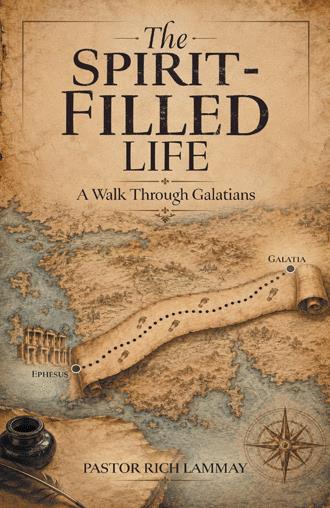
The Spirit-Filled Life
A Walk Through Galatians
by
Book Cover & Preview Text
Chapter 1 True Freedom, the Gospel, Galatians 1:1–11 The apostle Paul began writing to the Galatians with powerful words about freedom. In America, we are the freest of all peoples on earth. We have our freedom because brave men and women stood for freedom, establishing a constitution that guarantees it. We are free because courageous men and women have fought to keep us free. We are free to gather for worship, free to travel without seeking government approval, free from tyranny, and free because we are innocent until proven guilty. Other nations, even westernized nations, do not enjoy the freedom we enjoy in the United States. Yet there are people right here in the USA who are not free. Sure, they enjoy freedom of speech and all our constitutional guarantees, yet they find themselves enslaved to something more powerful than any government. They are not enslaved in a physical sense, but they are slaves to sin. Being a slave to sin doesn’t mean someone is just as awful as they can be, but it does mean they are not free to worship God because the god of this world rules them. Their lord is, and their flesh masters them. But Jesus came to give us absolute freedom. [Jesus said,] “So if the Son sets you free, you will be free indeed.” (John 8:36) There’s freedom beyond the freedoms we enjoy in our nation—freedom of the soul. Still, many people, even religious people, do not enjoy this freedom. The epistle to the Galatians is all about freedom. In Galatians, we find freedom from the things that keep people in bondage: freedom from sin and freedom from rules, regulations, and rituals. The Galatians had left their old lives behind; they’d become new creatures in Christ and were free from their past and from the burdens of religious rules. But with their new freedom came people who didn’t like it. One group was “the Judaizers,” so called because they advocated keeping the Jewish law to worship Christ. They tried to convince the Galatians that you could only worship God if you followed their rules. One rule they emphasized was circumcision, the Jewish rite of cutting away the flesh to show you belong to God. But the gospel is not about what you do but about what God has done. The book of Romans addresses what true circumcision entails. But a Jew is one inwardly, and circumcision is a matter of the heart, by the Spirit, not by the letter. His praise is not from man but from God. (Romans 2:29) Circumcision, Sabbath days, and festivals were all pictures of God’s plan in sending Jesus. Circumcision is the cutting away of the flesh as a sign of being set apart for God. For Christians, that work is complete because Jesus was crucified for sin. All who trust in Jesus have their hearts circumcised through grace and by faith. That’s the heart of the gospel: freedom to know God, freedom to serve God, and, being a child of God, the freedom to love God. The late Dr. D. J. Kennedy said, “The gospel is the greatest story ever told, about the greatest offer ever made, by the greatest person who ever lived.” The book of Galatians is God’s most decisive word against legalism. Legalism refers to religious-sounding rules that are supposed to bring you to God. People love to do religious things, such as celebrate holy days, practice rituals, or deny their bodies, all in an attempt to earn favor with God. However, when anyone attempts to mix law and grace, it inevitably leads away from freedom and into confusion and bondage. Today, people often boast about their religious activities; and in doing so, they attempt to contribute to their salvation, which comes only by grace. Some might add to grace by saying the Sabbath must be kept. Others boast that because they have a priesthood, they are more spiritual. Still others speak of the holy garments that set them apart. Those are similar to the rules that were beginning to infiltrate the Galatian churches, and that’s what Paul was confronting. Since religious rules are still in place today, Galatians remains as contemporary and meaningful now as it was in the first century. There are three things to consider from the first eleven verses of Galatians chapter 1. The Call of the Gospel (vv. 1–5) Paul, an apostle—not from men nor through man, but through Jesus Christ and God the Father, who raised him from the dead—and all the brothers who are with me, To the churches of Galatia: grace to you and peace from God our Father and the Lord Jesus Christ, who gave himself for our sins to deliver us from the present evil age, according to the will of our God and Father, to whom be the glory forever and ever. Amen. (Galatians 1:1–5) Paul’s authority was questioned by religious people. That is what religious people do; they question freedom and ask about authority. They questioned John the Baptist, “By what authority do you baptize people?” They questioned Jesus, “Where did you get your authority?” And the Judaizers questioned Paul’s right to preach the good news. That’s why Paul, in his salutation, dealt with his authority and his calling. Paul’s call and authority were not from any person or organization but from God the Father and through Jesus Christ, but the brothers in Christ also recognized his authority. God’s calling to ministry is a personal experience. While churches ordain pastors and groups send out missionaries, ordination is, at best, people recognizing what God is doing. Ordination is from God, and the call to serve is from the Holy Spirit. Ministry is not a job or a vocation but a calling from the Lord. After establishing his authority, Paul laid out the basics of the gospel and outlined four key points. 1. Grace and Peace (v. 3) It’s been said, “When you understand grace, you will live in peace.”
Formats

Book Details
About the Book
The Spirit-Filled Life (A Walk Through Galatians) takes you on a personal journey through the practical application of the Apostle Paul’s teaching to the Galatians. If you want more of the Holy Spirit working in your life, more fruit, and more power to live a godly life, you may find important principles in this book. Pastor Rich Lammay uses real-life events, a bit of humor, and biblical knowledge to help us navigate our faith in a world that is often opposed to those who trust in Jesus Christ as Lord.
About the Author
Pastor Rich Lammay and his wife, Suzanne, came to faith during the 1970s Jesus Movement. He serves as Senior Pastor of High Sierra Fellowship in Gardnerville, Nevada. He is the Author of another book, “Principles of Ministry & Faith,” and holds a Master’s in Theology from Omega Theological Seminary (www.omega.edu).