
Benjamin Before
by
Book Cover & Preview Text
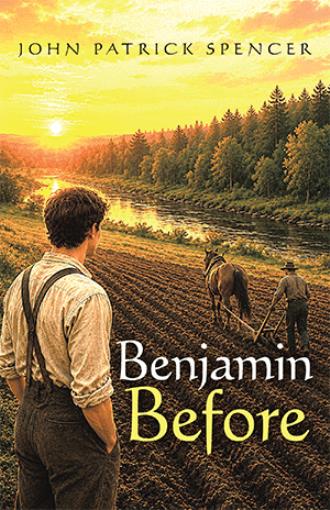
Chapter 1 Turkeyfoot Township, Pennsylvania, April 14, 1802 It was the smell. Benjamin Spencer knew something was wrong before he opened his eyes. He smelled woodsmoke and pine needles. Wait a minute. Was that a chicken he heard? This was not his apartment. Where was the constant little hum from his electric heater? Where was the slight citrus smell from his bathroom cleaning products? Instead, he smelled farm animals, damp earth, and manure. He lay still, not quite awake but not sure what dream state he was leaving. He was caught between sleep and something far stranger as he listened to the low creak of timber and the distant, impatient clatter of voices, which did not belong to any place he knew. He rolled over and then winced. Where was his pillow in the soft cotton pillowcase? The pillow beneath his head was coarse and stuffed unevenly, and the blanket scratched like burlap. Cold—why was it so cold? It was really cold—the kind that found its way through the blanket to his bones. For a moment he thought, Power outage, and then, Camping trip? Then with a slow, rising unease, he returned to his first thought—This isn’t right. When he finally opened his eyes, the ceiling was wrong. Rough-sawn boards ran overhead, darkened by time, edges uneven, and chinked with some crude mixture that had cracked in places. There was no drywall, no light fixture, but only a faint gray daylight leaking through a small, dim window. As Ben stared, his thoughts lagged behind his senses as though his mind refused to catch up with what his eyes already knew. Someone spiked my Diet Coke. But this was too real—the cold, the smell, and the silence. There was no way this was a dream, fake experience, or hallucination. There was no traffic. No phone buzzed on a nightstand, and Lucy didn’t text, “U up?” with that half-teasing impatience he’d learned to ignore. Where is my phone, anyway? Lucy—she was an anchor to a different existence and something solid but fading, like trying to remember a dream after waking up. He sat up on the edge of his bed, and even that motion felt off. He was lighter somehow and a little uncoordinated, as though he was unfamiliar with his own body. But was this his body? His arms were larger, hands were rougher, and shoulders were broader. “What on earth,” he muttered, but even his voice sounded wrong—lower and edged with a rural cadence he had never known. He heard a rap on his door and a man’s voice, irritated and loud, “Ben! You aim to sleep through the whole planting season? Pa’s already hitching up the mule.” Another man’s voice, younger but no less annoyed, cut in. “He’s been lazin’ near every morn this week. Pa’ll have his hide if he don’t git movin’.” Ben’s head began to swim, and his heart wanted to leap from his chest. This just did not seem like 2019. Ben and not Benjamin in the easy, modern way his friends said it. They said Ben like this name belonged and had always belonged here. As he stood up, his bare feet hit cold, uneven planks. The room tilted for a moment, and he steadied himself against the wall, feeling the grooves of the logs beneath his palm. This wasn’t possible. It couldn’t be. The last thing he remembered, clear and sharp, was December at San Diego State University and the man in the white suit. Oh, no. He remembered that he had ducked out on Lucy. Then there was nothing. Now, there was this. A burst of laughter came from outside, followed by a woman’s voice—warm but edged with exasperation. “Leave him be, Jesse. He was up late mending, same as the rest of you.” “Late or no, he’s late now,” the first voice—Jesse apparently—shot back. “Sun’s near up, and the field won’t wait on his dreams. Let’s go, William.” Dreams. If this was one, it was the most convincing one he’d ever had—and the least forgiving. He pulled on his pants. What in the world are these pants made of? He crossed the small room and pushed the door open while throwing his arms into his shirt. The main space of the bunkhouse revealed itself in a rush of detail that made his head spin. A wide hearth dominated one wall. Its fire burned low but still glowed, sending up a steady ribbon of smoke that escaped imperfectly through a crude chimney. A rough table stood at the center, scarred with years of use. One other door stood open across the common space, revealing more bunks that were somehow more feminine. Pegs along the walls held coats and tools. Everything was handmade, mismatched, functional, and crowded. Five figures turned toward him almost at once. The tallest—a broad-shouldered man with a stern face and dark hair—must have been Jesse. His expression shifted from irritation to something sharper and appraising. “About time,” he said. “Thought you’d taken ill or worse.” Beside him stood another man, who was a bit younger, lighter in build, but no less watchful. William, Ben guessed. He crossed his arms with brow furrowed. “You don’t look right,” he said bluntly. “You hit your head?” Before Ben could answer—before he even knew what answer to give—three women moved in closer. The oldest of the three had a steady, assessing gaze. Her hands were already dusted with flour. “He’s pale,” she said quietly. “Ben, you feel unwell?” The young woman closest to his own age hovered just behind her with worry plain on her face while the youngest peered at him with open curiosity, as though trying to puzzle him out. “Where am I, and who in blazes are you people?” Ben asked.
Formats

Book Details
About the Book
Ben was coasting through life until he woke up two-hundred-and seventeen years in the past. He was living an easy, noncommittal college existence when he is transported to a very different, difficult time. He now inhabits the body of his distant relative named Benjamin and is sorely unprepared for the life within which he is now trapped.
The period in history that Ben finds himself is demanding and dangerous and he must navigate an existence unlike anything he has ever experienced before. Not only does Ben harvest a field of wheat and face a raging crop fire, but he unexpectedly falls in love, and travels down the Ohio River by flatboat. Surprisingly, Ben’s experiences in the past teach him the importance of living in the present and help him commit to what is essential.
Forced into a seriously uncomfortable situation, Ben learns the importance of hard work, family, character, and faith in God. The lessons he learns apply to his modern circumstances, as well, if he can just find a way back home. During his strange journey, Ben becomes an adult with valuable experience that he gains from the “Benjamin Before.”
About the Author
John Patrick Spencer is a Christian author writing historical fiction. He graduated from both the United States Naval Academy and Massachusetts Institute of Technology and served for twenty years as an officer in the United States Navy. John was a licensed Mechanical Engineer in the State of California and lives in San Diego.