
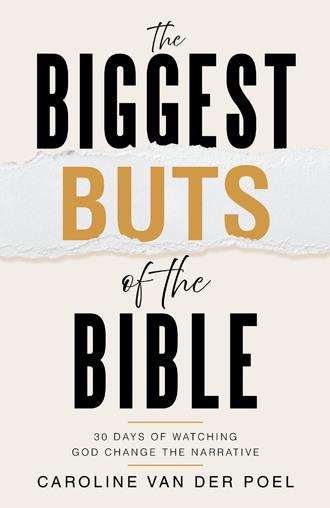
The Biggest Buts of the Bible
30 Days of Watching God Change the Narrative
by
Book Cover & Preview Text
There is a word in Scripture that has the power to turn funerals into celebrations, slaves into sons, deserts into doorways, and endings into beginnings. It is not loud or complicated. It is only three letters long.
But.
You may overlook it as something small or insignificant. In our everyday language, the word “but” often signals hesitation or limitation. It sounds like a pause in progress—an excuse, a delay, or a contradiction. But in God’s language, it carries a very different weight. It signals intervention. It marks the moment where what looked final is interrupted by what God is still doing.
Scripture is filled with these holy reversals. Joseph looks at the brothers who betrayed him and declares, “You meant evil against me, but God meant it for good. ” That is not just ancient history—it is what it feels like when betrayal, disappointment, or delay tries to define your story, but God redefines the outcome. The psalmist writes, “My flesh may fail, but God is my strength.” That speaks to the moments when you feel physically tired, emotionally drained, or mentally overwhelmed—but something deeper in you refuses to collapse. Paul reminds believers that we were dead in our trespasses—but God, being rich in mercy, made us alive together with Christ.
Again and again, heaven interrupts earth with that single word. And in your own life, those interruptions may not always look dramatic at first. It may look like a closed door that later reveals protection. Circumstances, pain, and fear may speak loudly—but God always has the final authority.
This book is an invitation to spend thirty days inside that divine interruption.
For thirty days, we will sit with the places in Scripture where "but" shifts the atmosphere—where despair meets promise, weakness meets power, and human limitation encounters divine sufficiency. These are not motivational pivots; they are theological ones. They reveal a God who does not deny reality, but refuses to be constrained by it.
Every day holds a tension. Scripture never pretends the pit isn’t deep or the valley isn’t dark. It never minimizes the weight of what people actually endured. But woven into every story is a pivot—a moment when God steps into the narrative and rewrites what seemed inevitable. That is the gift of but. It does not erase hardship; it reframes it in the light of who God is.
Over these thirty days, you will begin to see your own story shift—not because your circumstances instantly change, but because your perspective does. When we learn to look for God’s but, we begin to expect His involvement. We stop reading our lives as closed systems and start seeing them as open invitations for divine movement.
Maybe your sentence feels unfinished right now—the diagnosis is real, the grief is heavy, the door is closed, the prayer feels unanswered, or the future is unclear. Faith does not deny these realities; it trusts that God is present in the middle of them. Faith is often born in the space between present reality and promised redemption. And that space—the waiting, uncertain, in-between place—is exactly where but lives.
This is not a thirty-day challenge to cultivate surface-level optimism. It is a thirty-day journey toward deeper awareness—a daily practice of noticing where God interrupts despair with hope, rebellion with mercy, emptiness with fruitfulness, and death with life. As we immerse ourselves in these sacred turning points, we will begin to recognize that the same God who intervened then is present now—in our stories, in our seasons, and in the sentences we are still living through.
By the end of these thirty days, my prayer is that you will begin to hear that holy word in your own life—in your prayers, in your disappointments, and in your seasons of waiting. Not as a denial of pain, but as a declaration of possibility.
The story is not over. The sentence is not finished. There is still a “but God” to be spoken over your story.
Formats

Book Details
About the Book
Life says, “This is how the story ends.” Scripture says, “But God.” When the odds were impossible, when the situation was messy, and when there was no way forward, God stepped in and changed everything. The Biggest Buts of the Bible presents a thirty-day reminder that God is still writing better stories. It shares thirty biblical narratives that show what happens when God gets the final word. Each day, you’ll dive into a real story from Scripture—tales of ordinary people in impossible places who encountered the ultimate plot twist: God. Through short readings, reflection, and simple challenges, you’ll be encouraged to look for your own “but God” moments and trust Him to change the narrative in your life too. This thirty-day devotional invites you to remember that no situation is so far gone that God cannot redeem it, restore it, or rewrite it completely.
About the Author
Caroline van der Poel is passionate about helping people see that God is still actively at work in their stories—even when it doesn’t feel like it. She lives in Salisbury, North Carolina, with her family, where life is full, a little busy, and mostly about showing up for the people she loves. She’ll tell you this every chance she gets: God isn’t done yet—and He’s especially not done with you.