
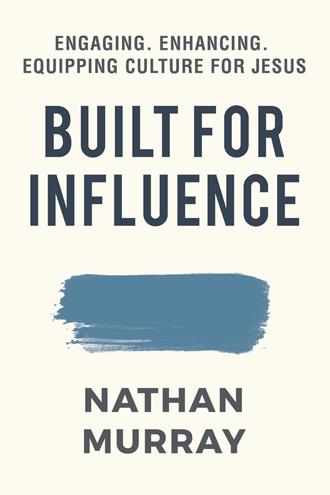
Built For Influence
Engaging. Enhancing. Equipping Culture For Jesus
by
Book Cover & Preview Text
FLAVOR DETERMINES INFLUENCE “You are the salt of the earth; but if the salt loses its flavor, how shall it be seasoned? It is then good for nothing but to be thrown out and trampled underfoot by men.” —Matthew 5:13, NKJV The Greek word Jesus uses for “loses its flavor” is morainō, from which we get the English word moron. It means: to become flat, to become foolish, to become tasteless, to become ineffective. Why is that important? Because Jesus wasn’t just talking about flavor—He was talking about function. In the ancient world, when salt was used as a fertilizer, the key ingredients that enriched the soil were magnesium and potassium. These minerals strengthened the ground, increased yield, and produced a healthier, longer-lasting harvest. So when Jesus calls His disciples “the salt of the earth,” He’s saying: “Your presence should produce a better harvest. Your life should strengthen the soil around you. Where you are planted, growth should increase.” But here’s the warning. Salt was a valuable commodity, and if someone was careless with it, if they left it uncovered, exposed to rain, moisture, or damp conditions—the salt would become diluted. The magnesium and potassium would leach out, and what remained was mostly sodium. And pure sodium, without the balancing minerals, is destructive to soil. So if a farmer took that diluted salt and spread it on his fields, it would be foolish—morainō. It wouldn’t enrich the soil. It wouldn’t strengthen the harvest. It would actually burn the crops. Too much sodium sterilizes the ground. It stops growth. This is why Jesus uses such strong language. A life diluted, compromised, contaminated, inconsistent, does not help the harvest. It harms it. But a life filled with purity, integrity, and devotion enriches everything it touches. Guarding Against a Diluted Gospel So what does all of this mean for you and me—and for the church as a whole? It means we must guard against becoming diluted. Just as ancient salt could lose its effectiveness through moisture, carelessness, or contamination, the church loses its influence when it spreads a watered-down gospel. We are not called to offer a comfortable gospel, a partial gospel, or a selectively edited gospel. We are called to declare the whole counsel of God—just as Paul said near the end of his life: “For I have not shunned to declare to you the whole counsel of God.” —Acts 20:27 NKJV Not some of the counsel. Not the easy parts. The whole counsel. For more than forty years, a seeker-friendly movement has swept through much of the church. Its intentions were good—reach people, make church accessible—but its effect has often been disastrous. In many places, essential biblical truths have been softened, minimized, or removed altogether. Repentance. Sin. The blood of Jesus. The reality of hell. Holy living. The fear of the Lord. Yet Scripture says these are foundational principles of the Christian faith (Hebrews 6:1–2). You cannot build a strong life—or a strong church—on a weak foundation. A diluted gospel produces a diluted church. A diluted church produces a diluted witness. And a diluted witness produces no harvest. But when the church keeps its salt strong—its message pure, its convictions clear, its doctrine anchored in truth—it strengthens the soil of the world around it and produces a harvest that lasts. Case Study: The Seeker-Sensitive Movement In 2007, nearly thirty years after the “seeker friendly or seeker sensitive” movement started, the leader of the movement decided to do a study on the results and this was their findings. “the results of a multi-year study (the REVEAL study) that found their seeker-sensitive model was highly effective at attracting people to the church but failed to produce mature, "fully devoted followers of Christ". The founder described the findings as a "wake-up call" and a “mistake". This reflection was a candid admission that the long-term results regarding discipleship were "a bust," prompting a re-evaluation of their approach to focus more aggressively on personal spiritual practices and biblical teaching.” You can compare this directly to salt that has lost its most important ingredients. When the magnesium and potassium were washed out, the salt looked the same—but it had no power to produce a harvest. In the same way, when the church removes the essential truths of Scripture, it may still look like Christianity on the surface, but it loses its ability to form true disciples. The result is predictable: There will be no growth. There will be no depth. There will be no lasting transformation. People may come to church, but their foundation is built on sand—not on the whole counsel of God’s Word. And as soon as their faith is tested, they crumble under pressure. Why? Because they were never rooted in truth. They were offered inspiration, but not repentance. Encouragement, but not surrender. Motivation, but not discipleship. It is foolish not to declare the whole counsel of God. Anything less creates false hope, not the true gospel. It produces crowds, not converts. Emotion, not endurance. Activity, not authenticity. That is salt that has lost its flavor—salt that cannot season the soil, strengthen the soul, or sustain the harvest.
Formats

Book Details
About the Book
In uence is unavoidable. Every word we speak, every post we share, every decision we make leaves an impact on the people around us. Whether we realize it or not, we are constantly shaping others—and being shaped ourselves. In a world fi lled with competing voices, distorted truth, and cultural pressure, many believers struggle to understand what it truly means to infl uence others for Jesus Christ. Yet Scripture makes it clear: we are called to be lights in the darkness, trees of life in a dying world, and ambassadors of God’s Kingdom in every sphere of society. In Built for Infl uence, readers will discover how spiritual infl uence works, how the enemy uses culture and deception to shape hearts and minds, and how the Holy Spirit empowers believers to stand out with wisdom, boldness, purity, and love. Through biblical teaching, practical insight, and powerful truth, this book challenges Christians to stop passively blending into the culture and begin intentionally impacting it. Divided into three sections—Introducing Infl uence, The Holy Spirit and His Gifts, and Maintaining Infl uence—this book serves as both a wake-up call and a guide for believers who desire to live with purpose and represent Jesus effectively in today’s world. More than anything, this book is a reminder that infl uence is not about fame, popularity, or perfection. It is about being available to God and living in such a way that others can see Jesus through your life.
About the Author
Nathan Murray has been a dedicated Christian and has served in various capacities, including teaching, and has over a decade of experience in full-time ministry as an Associate Pastor. He also worked as a producer in radio/televison and fi lm. Nathan lives with his wife and three boys in Northwest Indiana.