
The Devil In Bethel
How to Discern Satan’s Demonic Teachers, Prophets, Idols, and Tools in God’s Church
by
Book Cover & Preview Text
Can False Prophets Perform Miracles? Yes! But some “miracles” can of course be faked. Some modern “prophets” who use data mining (scrolling through social media of strangers) to provide “words of knowledge” or “secrets of the heart” come to mind. In such cases, readers can no doubt definitively claim such “prophets” are false.
And even if the miracles are “true” (not humanly generated), merely performing such miraculous works doesn’t guarantee anything about the status of the prophet who performs them either.140 Such a “prophet” could lead people into idol worship! And remember, there are many forms of idol worship (See Chapter 5). Moreover, their ability to perform signs and wonders can even be accomplished through demonic power 434 435 or “dark arts” as was the case for Pharaoh’s sorcerers.154 In any such case, if one were able to discern such an evil partnership or intent, the title of false prophet is once again entirely appropriate.
Can False Prophets Forecast The Future? Yes! But accurately forecasting a future event doesn’t guarantee anything either, because such an ability may be aided through the help of demonic power,116 as observed by the woman who was given the power to tell people's fortunes through a demon. In fact, both St Thomas Aquinas and John Chrysostom address how demons, who know more than humans but know far less than God, wow their listeners when they prophesy things accurately.D10 G8
Moreover, if the self-described “prophet” uses the momentum generated to then lead people to a false god/idolatry, they should be considered a false prophet (see chapter 5 for idolatry examples). Of course, if they claim declaratively something will happen, and they fail to accurately forecast the event as prophesied, then they qualify as a false prophet as well.141 That is unless the prophetic utterance included a conditional “if-then” framework.
Can They Look Godly (Bear Fruit)? Yes! But just because someone looks like a “lamb” (appearing to be Godly) doesn’t guarantee anything. Afterall, such a person could still speak like a dragon.434
Words matter! Readers can no doubt see that the apostles advocated for the testing of prophetic words,019 055 making sure that the scriptures were consulted117 to verify the veracity of any prophetic word received. Recall that the false “old prophet” from Bethel claimed to have received a different message than previously received by the true prophet.040 If a revelation is publicly declared to the body of believers, it better be aligned with God's truth as established in His Spirit-inspired word.079 090
Moreover, Jesus says that bad trees (false prophets) cannot produce good fruits.346 What fruits was he referring to? Fruits can allude to either the fruits of the Spirit178 or fruits of repentance.335 But Jesus also acknowledges that false prophets are wolves in sheep’s clothes.346 His apostles also acknowledge that these people can appear to be “servants of righteousness,” implying an outward appearance of holiness or piety, but ultimately being like Satan himself.074 The question is not whether there is fruit, but whether such fruits are genuine or just an act. Jesus is, afterall, no stranger to seeing Satan’s pawns do the “right things” but for ulterior motives.382
Do They Have To Have A Message? Yes. If someone claims to be a “prophet” they need to have at bare minimum a message to deliver on behalf of God. The reason for this test being used is because the individual being assessed claims prophetic status which requires a message from a god or, preferably, the God. Such a message, if not about the future, would likely be a personal revelation about another person.
The next question is whether their revelation or message corresponds with scripture and apostolic teachings. If the “revelation” or “message” doesn't have a basis in truth backed by scripture, then the prophetic message (and messenger) is false. Full stop.
Is Malice Required To Be A False Prophet? No! The readers may notice that the provided flowchart does not ask whether an individual is maliciously or intentionally trying to deceive others. This is by design. There is no need to add such a test to the assessment tool because, as far as the author can tell, there is no difference between intentionally falsely prophesying and accidentally falsely prophesying.
The Maliciously Intentional. For example, the false prophet of Bethel intentionally (with malice and forethought) lied when claiming to be a prophet with a contradictory revelation.040 And of course the false prophet of Bethel was not the only false prophet that intentionally deceived others.
The Incidental But Unintentional. But there are also those false prophets who prophesied in a delusional state.216 When someone is delusional, they truly believe something that they don’t know to be false. And the Bible confirms as much!085 In fact, 450 “prophets” fervently called upon their god (Baal) trying to summon him by going so far as to cut themselves in desperation.041 The false prophets’s behavior suggest that they honestly believed what they professed to be their god and their faith.
Delusion-inspired “prophets,” while the author has more sympathy for them compared to their intentionally deceptive counterparts, do not get a free-pass from being categorically deemed “false.” The pathway to hell, as previously mentioned, is often paved with good intention but the destination is the same.
To summarize, a delusional false prophet truly believes the lies they tell people. Thus, while malicious intent is not present for all cases of false prophets, they are nevertheless still deemed “false.” A deceived person (a victim) can deceive others (victimize) and still be labeled “evil” according to scripture.089
Likewise, an intentionally deceptive false prophet conjures up lies to tell people, and they too are deemed “false.” Therefore, intent to deceive does not matter! Not one test of false prophecy for the New or Old Testament includes the level of intent or malice exhibited by the “prophet” in question.
Formats

Book Details
About the Book
If knowing the truth is enough to avoid lies, then why was Eve deceived?
This is the question that Christians have been wondering for generations. Why is it that false teachers go unnoticed for so long? How is it that false prophets lead God’s people astray? Why are there so many “Christs” when there should only be one? And lastly, how are Christians supposed to spot all of these lies and liars?
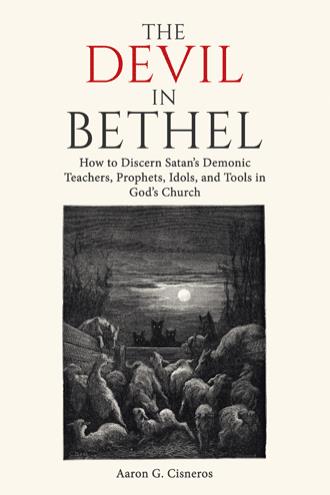
The Devil In Bethel will help Christians to understand not only the mind of Satan, but how to spot his image bearing spiritual children today. Readers will learn what Biblical and early church tests exist for diagnosing these satanic agents, including a thorough assessment for false prophets who seek to harm the flock.
The sheep may indeed have a shepherd, but the wolves will never stop trying to ravage them.
About the Author
Aaron Cisneros is a Christian clinical counselor who has dedicated his studies to understanding false teachings in the church today, and has paid careful attention to the so-called “prophetic” movement booming in the global church as of late. Aaron regularly consults with church congregants who want to know how to discern truth from lies.
Contact the Author
Email: aaroncisneros28@gmail.com
Instagram: aaron_g_cisneros