
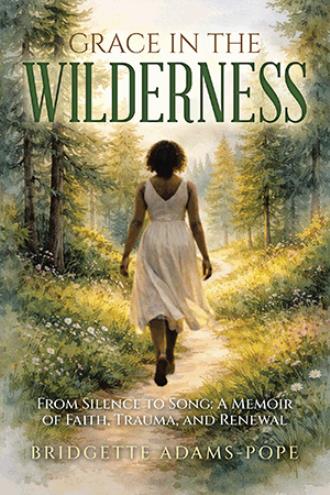
GRACE IN THE WILDERNESS
From Silence to Song: A Memoir of Faith, Trauma, and Renewal
by
Book Cover & Preview Text
Born in the Aftermath** I was born in the aftermath of a storm. Hurricane Carla had just finished tearing through Texas, leaving behind broken porches, twisted street signs, and a sky that looked bruised from crying. My mother liked to say I arrived when the winds were finally learning how to rest. For a brief moment she considered naming me Carla, after the storm that announced my coming. But my sister Mary chose Bridgette instead, which in some cultures means strength, and somehow that name fit a baby who would spend much of her life learning how to stand after being shaken. I have never seen a picture of myself as an infant. Mama once paid a photographer to take portraits, but he ran off with the money and the film. That small loss stuck with me, providing proof that even memories can be stolen before they have time to form. What I do remember is my mother. We called her Mommy. She was fair-skinned with hazel eyes and a laugh that could soften any room. The world had given her more than her share of sorrow, but she carried it quietly, like a purse no one was allowed to open. Faith was the only thing she held in plain sight. Her name was Winnie Beatrice Shepherd before marriages changed it again and again. She was born to Mattie, a biracial woman from Grapeland, Texas, and to Joe Shepherd, a Black man who had seventeen children before her. Mama grew up between two worlds—country dust and city noise, Caucasian roots and Black resilience. She learned early how to survive without asking permission. By the time she became a mother, she already knew how to stretch pennies, how to hide worry behind a song, how to make a small house feel like enough. Our house in the Third Ward was tired but alive. Screens hung from the windows like loose teeth. The refrigerator hummed louder than the radio. In the summer our air-conditioning was a block of ice in a metal tub with a fan blowing across it. The whole room smelled of wet, cold, and hope. We were a big family—seven children already, and one more who would never make it home from the hospital. Mama stretched welfare boxes the way other women stretched dough. Powdered milk, government cheese, thick cans of juice—we ate what she placed before us and thanked God there was something to eat at all. One of my favorite rituals was helping her paste S&H Green Stamps into little booklets. She saved them like promises and redeemed them for Christmas toys. I learned early that generosity often grows out of scarcity. Most of my childhood fit inside three places: home, school, and church. Church was the brightest of the three. Women wore hats like crowns and gloves like blessings. Each Sunday, the choir marched in robes that changed with the seasons. They marched to the tune of “Soon and Very Soon We are Going to See the King.” A song about dying and going to heaven. Everyone would stand on their feet and sing joyfully. I loved the order of it, the way sorrow and joy could share the same pew. Mama and I stayed all day—Sunday school at nine, worship at eleven, and afternoon service at three. The older women of the church would prepare dinner in the church kitchen. It was a wonderful time of fellowship. My father never understood it. He would sit on the porch shaking his head, saying: “There are more devils hiding in the church than any other place.” Before Daddy, there were other men in Mama’s story—chapters I learned in pieces. She married young, trying to build a life with materials too thin to hold. From those unions came my older siblings, each with their own map of longing. Dorothy Dorothy was the firstborn. She was given away as a baby to be raised by our mother’s sister. No one asked what she wanted. She didn’t pack a bag or say goodbye. She left before she was old enough to remember. By the time she started to wonder about it, the story was already something no one talked about. She grew up in Grapeland, Texas, in a home with steady routines and clear expectations. She went to college, something none of the rest of us had the chance to do right away. She became a nurse. Married well, made a good home, and lived a prosperous life with her family. From the outside, her life looked like an answered prayer. Inside, she carried a question no one spoke aloud: Why not me? Mary Mary, only a year younger than Dorothy, became the sister who stayed close. As a child, I thought she was the most beautiful woman in the world, not only because of her face but because of the way she moved through life. She laughed easily and spoke to strangers as if she had known them for years. Mary’s Life was not always as smooth as it seemed. At sixteen, she fell hard for a man twice her age—a Third Ward legend for all the wrong reasons. He was charming and dangerous, the kind mothers warn their daughters about in whispers. No warning reached her. Love sounded louder than fear. She slipped out at night to meet him, convinced she knew better than the adults who trembled for her. Finally, Mama did what only a praying woman would do—she went straight to the source. “Please,” Mama said, standing in a place no mother ever wants to stand. “That’s my child. Please don’t ruin her life.” For a long moment, the music between them seemed to breathe. Then something in that man shifted. He found Mary and walked her to the porch like a borrowed thing being returned. Mary sobbed behind her bedroom door that night, certain her heart was broken. She did not know then that heartbreak can be a kind of mercy. She never went back. Kenneth Kenneth was thunder wrapped in music. Six feet four inches of laughter and trouble, he filled any room simply by walking into it. We used to harmonize in the living room while the radio played “Tell It Like It Is.” I would forget my line just listening to him. Life did not treat him gently. A bullet once entered his mouth and kept traveling toward his brain. He refused to go to the Hospital. We drove to Cleveland, TX, Mary behind the wheel, Mama praying without pause, her voice filling the car. I sat in the back seat, biting my fingernails, watching the dark stretch ahead of us. There he was, sitting stubbornly on the porch, mouth bleeding and swollen. “I ain’t going to no hospital, I’m gonna get him for this.” We got him to the hospital just in time to interrupt death. Grace sometimes looks like minutes.
Formats

Book Details
About the Book
When the places that mold you also hurt you, what do you do? Through her book, Grace in the Wilderness, Bridgette Adams-Pope shares her story of being poor, facing family issues, being quiet, and growing spiritually. Bridgette was born in Houston the year Hurricane Carla hit. She grew up in a home full of strength and suffering. Her mother kept the family together through evictions, court cases, and the hard parts of having six kids. She was a woman of strong faith and quiet bravery. Behind the scenes, Bridgette was having her own hard times, with fear, worry, and pain that she couldn't talk about. Bridgette has struggled with the same question that many Christians have: "Where is God when life feels uncertain?" This question has been with her from her youth in the church pews to the difficulties of being a young married woman and an adult. What happens when you lose faith? How does kindness show up in places we least expect it? In Grace in the Wilderness, Bridgette's journey from silence to speaking out, from broken trust to renewed faith, is told through clear stories and honest reflections. She learns that God's presence is often stronger at the worst times of life, when everything she knows is gone and she can only trust. Bridgette discovers a deeper truth when she returns to teach in the same community that caused her problems as a child: the problems that made her feel out of place were quietly shaping her purpose. Her story shows how strong we can be, how we can be forgiven, and how grace can change even the worst parts of our lives.
About the Author
Bridgette Adams Pope is an educator, wife, mother, and grandmother whose life has been shaped by faith, resilience, and grace. She holds a master’s degree in education and a master’s degree in Christian Ministry. Her greatest joy is encouraging others to find their worth and voice in Christ