
The Bible Bias Test
Raising the Veil on Opinions Versus Truth
by
Book Cover & Preview Text
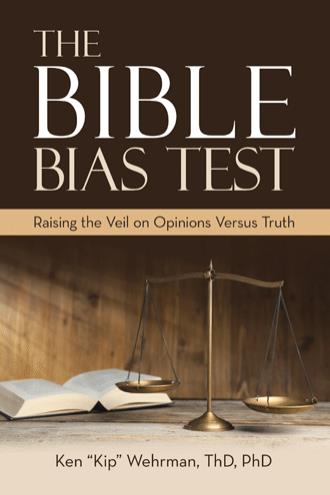
The objective of this book is to develop a methodology for addressing questions about doctrines, traditions, and Bible interpretations. The perspectives on doctrines, traditions, and interpretations will also be referred to as a viewpoint. This book is not meant to determine the validity of any specific overarching doctrine such as; Calvinism, Dispensationalism, Arminianism, Provisionalism, or any other. Nor is this book intended to determine the validity of any denominational doctrine or church tradition. Instead, the intent of this book is to provide a balanced format for evaluating alternative viewpoints to identify the presuppositions and bias within each specific doctrine, tradition, or interpretation. Additionally, the methodology will attempt to identify the origins of a given viewpoint and the number and type of assumptions used, which is why the methodology is called the Bible Bias Test. The Bible Bias Test is modeled after common debating techniques, where an individual “user” is asked to argue for and against a given viewpoint irrespective of their personal beliefs. “It is the mark of an educated mind to entertain a thought without accepting it.” This is often cited as a quote from Aristotle, but many contest its true origins. One notable source of this quote is from Lowell Bennion’s book Religion and the Pursuit of Truth. It is often assumed to have been translated from Aristotle’s Nicomachean Ethics, 1. Aristotle’s point appears to be that we should be able to honestly look at arguments from different perspectives without worrying that we will be swayed by those arguments. We have nothing to fear from looking at the criticisms of our perspectives. University of Southern Cal philosophy professor and Christian teacher, Dallas Willard was famously quoted as saying, “that is what I think, do you have something better.” I am unsure of the exact quote, but this is a disarming approach to theology and doctrine. The principle is to test everything honestly, intelligently, and faithfully, then let the Holy Spirit guide. We must resist our pride and arrogance when studying the Bible. Past thoughts are not always true thoughts. Those that came before us were very smart but that does not excuse them from error, any more than it does us. We must own our faith by examining and testing all viewpoints thoroughly, in order to have confidence in our positions and faith. As Christians, we must always be on a quest for truth not simply a pursuit of support for our opinions. Another term for perspective is vantagepoint. According to the Oxford dictionary, vantagepoint is a place or position affording a good view of something. The Bible Bias Test attempts to do this task by asking questions about a specific viewpoint from three distinct vantagepoints; partisan, skeptic, and neutral. Asking questions from these vantagepoints helps to identify bias, hominem, and presuppositions within each viewpoint and each critique of the individual viewpoint assumptions. The Bible Bias Test will use the term “assumption” for a potential bias and presupposition. Assumptions generally fall into two categories: evidential and non-evidential. The amount and type of assumptions will be directly related to the overall plausibility of the viewpoint. Plausibility will ultimately be determined by how a neutral vantagepoint perceives the critiques of the viewpoint’s assumptions. This book has two parts. The first part will focus on the development of the Bible Bias Test methodology. The methodology development will include the introduction of each Bible Pillars, which serve as the basis and guiderails for the Bible Bias Test. The five (5) Bible Pillars include Bible canon, Bible reliability, Bible inerrancy, Bible interpretation, and Bible context. The second part of this book will provide a demonstration of the Bible Bias Test by testing several commonly held viewpoints of specific Bible passages including Isaiah 14:12 (Lucifer), Jude 9 (Archangel), and Ezekiel 37:1-14 (Dry Bones). Reason for the Bible Bias Test I am a scientist and engineer as well as a theologian and philosopher. Many view these disciples as opposite ends of the spectrum, but I view them as parts of a whole. One cannot truly understand God without understanding at least in part the many aspects of our existence through the lenses of science, philosophy, and religion. I also believe understanding is more than just knowledge of these areas, but rather the application of this knowledge which leads to wisdom. My engineering background has provided me with many tools and techniques for taking a concept and putting application to it. True wisdom is putting our knowledge to work in the form of livable applications. My scientific research and engineering began in the 1980’s as an undergraduate engineering student research assistant at the University of Nebraska. My formal education in engineering spanned a decade culminating in a PhD in Chemical Engineering from Auburn University in the 1990’s. My professional career has resulted in traveling all over the world on projects which have spanned every continent and ocean. I have conducted and contributed to more than 700 projects and facilities worldwide. As a scientist and engineer, I have been perplexed with the lack of integration of techniques and analysis tools used in most industries within the Christian sphere. For lack of a better way to say, it appears philosophers, theologians and ministry types do not speak the same language as science and engineering. While I recognize some obvious reasons for this, the question still persists. Why? Why don’t we use these “tried and true” techniques of science in evaluating theological issues and perspectives. This question was the launching point for the Bible Bias Test. The objective was to adapt common decision-making tools and techniques into a methodology for identifying, quantifying, and evaluating the bias, hominem and presuppositions built into our many varying and often conflicting Bible interpretations. Therefore, the Bible Bias Test is attempting to separate opinion from truth in an effort to expose the underlying bias in Bible interpretations.
Formats

Book Details
About the Book
One of the most dangerous things we can say is “This is what I’ve been told.” We must own our faith. God will reveal His truth to us if we only keep looking. Seek and you will find; keep knocking and the door will be opened. Keep asking and the truth will be revealed. God will be faithful and show us the truth. We just must be open to hear the truth honestly The Bible Bias Test does not seek to determine the validity of any church tradition, doctrine, or biblical interpretation. The objective of this study is to offer a methodology for testing biblical viewpoints in a logical and consistent way that identifies bias, hominem, and the presuppositions required to support each viewpoint. This guide describes Bible pillars used to provide a consistent basis for the application of the Bible Bias Test—canon, reliability, inerrancy, interpretation, and truth. Tools like this Bible Bias Test are essential to separating human teachings from God’s truth or, at the very least, helping us identify when we should study deeper and more intensely for ourselves. We should pray for wisdom on a specific topic. We should ask God to reveal the truth and help us to view the Scripture without our bias and preconceived ideas.
About the Author
Ken “Kip” Wehrman, ThD, PhD, is a scientist and engineer who holds a PhD in chemical engineering and a professional engineering license in the state of Texas. He is also a theologian, philosopher, and Bible scholar, holding an MA and ThD in Christian apologetics. The managing director of PUNLA Christian Ministries since 2015 and the host of the PUNLACoffeeTable podcast since 2021, he is also the senior pastor of Brazos Bend Baptist Church in Texas.