
Pray Without Ceasing
A Walk with Jesus and Mary Through the Mysteries of the Rosary
by
Book Cover & Preview Text

When pondering the words from Scripture that tell us to “pray without ceasing,” I wondered how to put that into practice. Some ideas seemed too overwhelming. How can I pray constantly—who can? Does it have to be formal supplication, or can it be a spontaneous appeal? Is a heart crying out in isolation prayer? Do brief acknowledgments—“Thanks be to God”—qualify as prayer?
My hope and desire for you, dear reader, is that praying without ceasing will become a reality for you, even when you may be unaware of what that truly means; even when it seems impossible. Remember, with God all things are possible.
The Second Sorrowful Mystery — The Scourging of Jesus:
24 When Pilate saw that he was getting nowhere and that a riot was about to occur, he took some water and washed his hands in full view of the crowd, saying, “I am innocent of this man’s blood. It is your responsibility.” 25 With one voice the entire crowd cried out, “Let his blood be on us and on our children!”
—Matthew 27:24–25 (NCB)
I recently considered the statement by the Jewish leaders: “Let his blood be on us and on our children!” Little did they know that Jesus’ blood would indeed be poured out to cover them and their children. His death would become the open door to God the Father. Through the shedding of His blood, Jesus would mercifully cleanse from sin all who call on His name. This is one of Scripture’s clearest examples of how God brings good from what is meant for evil. There was betrayal, conviction, and death—but God did not stop with the sacrifice. Jesus returned to life. He was resurrected and thus wrought the justification of mankind. We are redeemed by His life, death, and resurrection.
Prayer: Dearest Jesus, let me never think of the approval of man before the approval of God. May I never seek to be exalted at the cost of my own soul or the well-‑being of another person. Help me to fully appreciate that this life and the accolades of man are only temporary. Let me seek to make reparation for the sins that separate the world’s brothers and sisters from the Almighty. Amen.
As you pray this Mystery, feel your heart beating within you. Think of ways to make reparation to Jesus’ Sacred Heart. Could a well ‑timed smile make a difference in someone’s life? Could sitting with someone in crisis be a balm to their suffering? How can your surrender—and the offering of your own suffering—be united with Christ’s?
A poem from the Sorrowful Mysteries:
Her Pierced Heart -
Once we walked
Together
Holding hands
Laughing
Now I can only
Follow
Watching You struggle
Fall
Wanting to make them
Stop
I can no longer
Protect
Feeling the pain
Foretold
The Fifth Luminous Mystery — The Institution of the Eucharist:
26 While they were eating, Jesus took bread, and after he had pronounced the blessing, he broke it and gave it to his disciples, saying, “Take this and eat; this is my body.” 27 Then he took a cup, and after offering thanks he gave it to them, saying, “Drink from this, all of you. 28 For this is my blood of the new covenant, which will be shed on behalf of many for the forgiveness of sins.” —Matthew 26:26–28 (NCB)
At their final Paschal feast with the Messiah, the disciples didn’t fully comprehend what Jesus was doing or saying. But as a Roman Catholic Christian today, my understanding of the Eucharist overwhelms me. It is the reason scores of people have come to the fullness of faith. It is the Gospel the Apostles proclaimed to people living in darkness. Along with the boldness of the Holy Spirit, the Blessed Sacrament—instituted by Jesus Christ—is the reason millions have come to know the truth that has set them free.
On that solemn day in Jerusalem, and every day in every place where a priest celebrates the Mass, we meet our Savior. The consecrated Host is at once Victim and Redeemer, the source and summit of our faith. God the Father wanted to show us, in a tangible way, something we could somehow grasp in our finite selves.
Contemplative questions:You are at the table of the Last Supper. What are you thinking as you hear the Messiah’s words? What is the mood of the disciples? Are they understanding Him—and if so, to what extent? Does placing yourself in that room, hearing His words of institution, change your view of the Eucharist?
Reflection: May Christ be praised, and may you always receive Him with a heart that sees—not with physical eyes, but with the spirit that transcends this temporal world.
At the Mass we are with Jesus as He gives His Body and Blood; we are at Golgotha as He dies; we are at the empty tomb as He rises to conquer death and the devil. On the mountain, we watch Him ascend to the right hand of the Father. Alleluia—He is risen; He is risen indeed!
We are on earth and in the heavenly realm with the angels and saints singing, Sanctus, Sanctus, Sanctus, Dominus Deus Sabaoth. Can you see Him—the Lamb of God who takes away the sins of the world?
Jesus waits for us in every tabernacle. He is present on every altar. He abides in every loving, believing heart. He is your Savior; He is my Savior; He is the Salvation of God offered to the whole world.
Come to Him. He is calling you. His mother—our mother—is pointing the way. As the angel said long ago: “Fear not, I bring you good tidings of great joy.”
Formats

Book Details
About the Book
Pray Without Ceasing beckons you to linger in the quiet recesses of the Rosary, where Scripture breathes, where love not only suffers but redeems, and where the lives of Jesus and Mary unfold like sacred poetry. Each meditation draws you gently into the heart of the Mysteries, asking you not only to remember them, but to enter them — to journey alongside Mother and Son, to feel the pulse of their joys, their sorrows, their surrender to the Divine Will. Rooted in the ancient practice of Lectio Divina, these reflections open doorways into grace. They invite you to listen with the ear of the heart, to let the scenes of salvation history rise around you, and to discover how deeply Christ’s love reaches into the hidden recesses of your own life. Woven through these meditations are original poems that bring life to unexpected witnesses of the Gospel. One voice speaks from the crown of thorns itself: “I am a crown crafted for torture. I see His Precious Blood gush from the gaping wounds I inflict. I cry because of the excruciating pain He experiences…but no one hears me… no one seems to care.” Through such intimate perspectives, the familiar mysteries shimmer with new light — tender, aching, and restorative. Whether you come to the Rosary with longing, with questions, or with weary hope, Pray Without Ceasing becomes a companion for your pilgrimage. It invites you to pray not only with your lips, but with imagination, compassion, and your whole heart.
About the Author
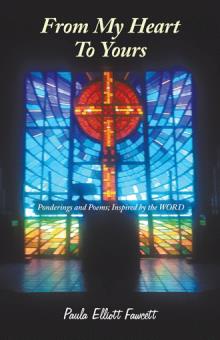
Paula Elliott Fawcett, a retired educator, devotes her time to family, writing, and serving in her parish. Guided by the Holy Spirit and a deep love for Scripture, the Rosary, and prayer, she writes to inspire faith. Paula authored From My Heart to Yours and now offers Pray Without Ceasing.