
Forming Visible Christians
A Novel Approach to the Method and Practice of Faith Formation
by
Book Cover & Preview Text
This section presents personal evidence I have obtained from teaching FF to teenagers and adults for twenty-seven years. 2.1 A Comparison of Hours of Education to Prepare for a Career and for a Life of Faith I normally start each FF class year with a discussion of our body as a physical being and our soul as a spiritual being. From this foundation, I discuss what is needed to sustain and grow both “beings.” On the physical side, I discuss nourishment of the body, such as sleep, school, exercise, and food. On the spiritual side, I discuss nourishment of the soul as the sacraments, prayer, works of mercy, knowledge from FF classes, as well as parental and family guidance. This table compares the “success” criteria and duration of the education dimension of both. Area Physical Being Spiritual Being Success criteria High School Diploma Confirmation (De facto) Years of education 12 9 (Kindergarten–8th grade) Hours per year 1,080 (Average in the United States) 36 (1 hour/week for 36 weeks) Total hours of education 12,960 324 (this assumes a student attends 36 classes a year, which rarely happens) Expecting a child or teenager to absorb the content of our Christian faith based on sporadic education over nine years is unrealistic. Formal FF classes are only one component of a child’s FF. Our Church has a tradition that parents are the primary teachers of our faith to their children. Children learn what they live. If, however, the parent(s) have not learned the content of our faith, they cannot augment what is taught in FF classes. Unfortunately, after confirmation, our church offers very few opportunities for teens, young adults, adults, and even “old-timers” to continue to grow in our faith. This phenomenon is not new to this current generation. It has existed for decades—and perhaps longer—compounding the problem of lack of knowledge. The gap is wide. 2.2 Decentralization of FF Content While there is a directory for catechesis and formal guidance from the USCCB, there is no central curriculum for what should be taught in FF programs. Critical decisions in FF, therefore, default to content publishers who are free to develop and market FF materials based on their preferences. From a formal education perspective, FF programs should start with the identification of desired outcomes and continue with resources to produce those outcomes. Within each diocese, the pastor of each parish is empowered to select a publisher or develop his own curriculum based on his perspective. It does not matter if the books or weekly handouts have been used in the parish for years, even decades; a new pastor can mandate a switch. Bishops are not generally involved in this process. We live in a mobile society. This decentralization of the FF curriculum at the parish level almost guarantees a student will experience different FF content throughout their potentially nine years of FF. 2.3 Current FF Programs are Sacrament-Based Although not intended, most parents treat FF as a path to meet traditional sacrament milestones of first Communion and confirmation. Attendance at FF classes normally drops after second grade (first Communion) and picks up during the year of confirmation, which varies from diocese to diocese. Recently, the Archdiocese of Baltimore lowered the confirmation age to nine. To mitigate this lack of knowledge, some dioceses have implemented a two-year confirmation program titled confirmation 1 and confirmation 2 (equivalent in many dioceses to seventh and eighth grade). To be confirmed, the candidate for confirmation must attend the two years of class. This attendance requirement is frequently labeled as “mandatory,” but does not define how many classes can be missed before the year does not qualify for confirmation credit. In addition, there is no standard curriculum for the two years—it is left to the pastor to decide what is taught in their parish. Apparently, the content of the curriculum is not as important as requiring two years of class attendance. 2.4 Extracurricular Activities, Travel Teams, Sports, and Jobs It is common knowledge among FF professionals that FF is rarely, if ever, one of the top priorities of parents. The more activities in which the child participates, the more weekend classes their children or teenagers have the potential to miss. The family weekend is filled with child-based activities. This is especially true with the expansion of travel sports teams or simply travel teams. These travel teams have moved many children or teenager sports activities from the local community to tournaments and competitions in cities and towns far beyond the local community. Consequently, children or teenagers are not available for many of their Parish FF classes. The effect on FF compounds when multiple children in the family are competing on different travel teams. For teenagers who start working while they attend high school, FF frequently becomes the first activity they drop. “I have to work this Sunday” has become a frequent reason for absence. Also, it is important to note that FF is not the only activity a family drops. Attendance at Sunday Mass also drops based on the family’s weekend work and travel team requirements. 2.5 Parents’ Work Schedules and Transportation The current FF pedagogy is focused on weekend classes. This derives from the traditional model of a forty-hour Monday through Friday workweek. Unfortunately, that model does not reflect today’s work environment, which is especially true in lower-income and single-parent families. Shift work and weekend work mitigate against family attendance at Mass and FF classes. Transportation can also be inconsistent, especially for single-parent families. If a parent needs the only car to go to work, children and teenagers do not have the opportunity to attend Mass or FF class.
Formats

Book Details
About the Book
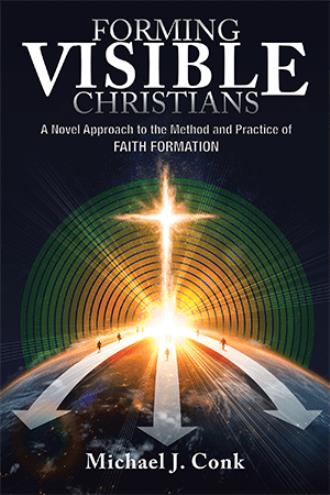
A Christian’s faith is meant to shine naturally through a life shaped by love, peace, mercy, justice, and joy, so that all who encounter us can sense the presence of Christ in our words and actions. Michael Conk provides evidence as to why Christians are leaving the faith and why many faith formation programs are failing. He believes we are at a crossroad. Continuing with the current method and practice of teaching Faith Formation will not result in different outcomes. If we want different outcomes, change is necessary. Continuing to do what we have always done will only lead us where we have already been. This book, then, is an invitation to consider a new way of forming Christians. He relies on his experience as a long-time catechist to presents concepts for a new multidimensional, technology-based approach to faith formation designed to incorporate the challenges of catechesis and evangelization. He then proposes a methodology for the development and implementation of this approach. The challenge is before us. Do we dare to trust the Holy Spirit and embark on a journey to create a future with visible Christians?
About the Author
Michael Conk is an outside-the-box catechist who has twenty-seven years of experience teaching faith formation on the weekends, twenty years of service in the army, and twenty-eight years working in various roles in the corporate world. He resides in Winchester, Virginia.