
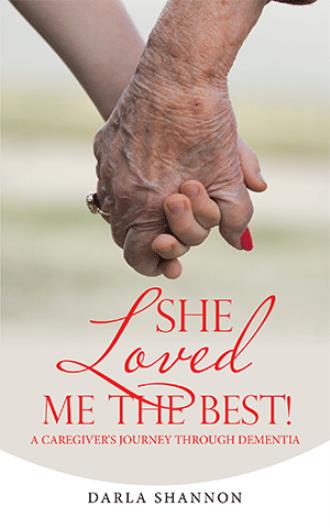
She Loved Me the Best!
A Caregiver’s Journey Through Dementia
by
Book Cover & Preview Text
Preface “Knock, knock. Mom, we’re here to take you to lunch. Are you ready? Oh wait, what’s going on? Why are all your clothes on the table? Is something wrong with your closet?” “I’m moving.” “Where are you moving?” “To your house!” So began our caregiving journey for Frank’s mom in our home. We were not completely stunned, for we had gradually been moving into this role for many years. However, we were in no way prepared for this to happen suddenly. I was employed fulltime as a reading coordinator with a local independent school district, and Frank and our son had recently begun an independent insurance agency. We had three grown and married children with families of their own, and my elderly parents needed occasional help, too. This put us in a scrambling mode, for sure. On most journeys, you at least have time to pack your bags. Not this one. You would also have some sense of a journey’s length before you set out. All this was beyond our control. It was spontaneous and, at times, felt never-ending. As a Christian, I believe all my journeys are God-ordained and meant for growth and development to prepare me for the heavenly kingdom. The Bible says, “A man’s steps are from the Lord, how then can man understand his way?” (Proverbs 20:24). Knowing God ordained our walk does not ensure a smooth and easy path. The rocky cliffs and challenges are often the most productive. God molded my life on this journey of caregiving; therefore, my desire is to give God the glory for what I learned. Finding someone you love on a downhill journey with dementia seems to be a path many are walking today. Recognizing and responding to dementia and Alzheimer’s symptoms are challenging. Crazy thoughts began to run through my head. Should we have done something before this crisis? Why didn’t we know? Why had we been in denial so long? How will we cope? Is living with us what she needs? What options are there? I must work. I’ll need to clear out a room. How will we get her belongings moved? How much do we bring? Who will stay with her? How will we pay for it? Our responses were completely spontaneous, and we were both in total agreement with one thing. We loved her with all our hearts and would do everything we needed to do with God’s help to care for her. This was not only my journey and Frank’s, but it was also his mom’s journey, whom we lovingly called Grandmother. Our journeys began earlier with the creation of a budding love for each other between my mother-in-law and me, similar to the love of the biblical Ruth and Naomi. I will share some of that love with you. You can see how our roles were reversed, from her love and guidance to me as an eighteen-year-old bride to my acceptance of becoming a servant and caregiver for her on her ninety-second birthday. Recognizing signs of dementia in a loved one and knowing what to do about them are difficult issues. Frank’s mom’s symptoms were gradual over a period of about fifteen years before she moved in with us. She coped with them well and covered up many of her difficulties. Grandmother’s independent spirit encouraged our denial. When the time came for a move, though, Grandmother knew it, and so did we. I hope seeing some of the signs we observed will help you. Even though caring for Grandmother was the right step to take, it was not without pitfalls. It was lonely. Within our household, my husband, Frank, and I saw our communication with each other diminish. We had little or no time for socializing with friends, and we had little to guide us through the journey. We were blessed with extended family and a couple from our church who helped us through the difficulties by giving us occasional weekend reprieves. Our church participation was cut in half as we toggled Sundays between church and home with Grandmother. In addition, our private devotional Bible study and prayer time waned due to ever-increasing interruptions and the demands of our caregiver roles. While I found a few books on caregiving, most were geared to meeting the physical needs of the patient more than the emotional and spiritual needs of the patient and the caregiver. The needs are intertwined. I want to encourage and empathize with other caregivers and families and let them know they are not alone. God is with them. Initially, I thought our journey would be short. After about six months, I found and attended a dementia support group on Saturday mornings when Frank could be home with his mom. I also attended a two-day seminar in which the main speaker shared some vital information with me. She said I should consider this a long-term arrangement. This gave me a new perspective. I learned to adapt to the new lifestyle. While this journey in our family’s life ended with Grandmother’s death five and a half years later, we will continue to savor and cherish the memories of her love and be blessed by God’s work in our heart. May you be blessed, too.
Formats

Book Details
About the Book
Darla Shannon was an eighteen-year-old bride in need of guidance. Her mother-in-law, known lovingly as “Grandmother,” supplied wisdom, love, and support. She was there for Darla when she was eighteen; Darla was there for her years later when Grandmother began showing signs of dementia. As the signs increased, Darla and her husband moved Grandmother into their own home to care for her. The four-year journey put physical and emotional strains on the Shannon family; however, God provided strength, hope, and joy to meet the final challenges.
About the Author
Darla Shannon earned BS and MA degrees in education and reading from Texas Wesleyan College, and a PhD in reading from Texas Woman’s University. She is currently retired from Tarrant County College-Southeast where she taught developmental reading courses. She and her husband are active members of Calvary Bible Church in Fort Worth, Texas.