
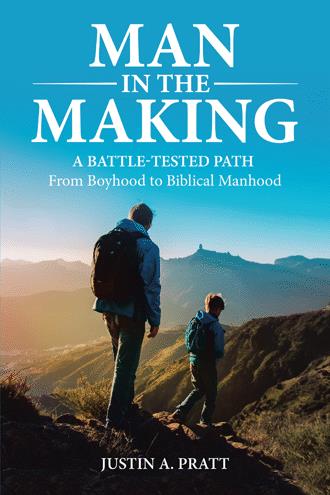
Man in the Making
A Battle-Tested Path From Boyhood to Biblical Manhood
by
Book Cover & Preview Text
Chapter 1: What Defines a Man? “Waste no more time arguing what a good man should be. Be one.” — Marcus Aurelius, Meditations, Book 10, Section 16 My passion for legacy and biblical manhood didn't begin in a classroom, a leadership manual, or a conference. Its initiation was forged in the quiet moments of watching godly men live out their faith with strength, consistency, and humility. It came from seeing my own dad consistently walk with God, watching a grandfather humbly live for Jesus, and watching men stand firm when life pressed them hard. Somewhere along the way, it began to dawn on me that biceps, big wallets, or beautiful women didn't measure true manhood. My vision of the identity of manhood was defined by integrity, sacrifice, surrender to God's purpose, and thinking about the future. This realization lit a fire in me: to not only become that kind of man but to help raise a generation who would carry that same torch—men who don't just live for the moment, but build a legacy that lasts for eternity. Matthias and Me I love all forms of history, but a few years ago, I became especially enamored with my own family lineage. What kind of heritage did I come from that predated what I already knew? I began researching online, visiting ancestral sites, and doing everything I could to learn more about those who paved the way for me. I studied every part of my family, but became particularly interested in the branch that bore my last name: Pratt. That surname is of English origin and dates back to the early medieval period. It comes from the Old English word 'praett' or 'prate', meaning 'cunning', 'canny', or 'trickster'. Over time, it evolved into a name that described someone clever, crafty, and full of tricks. My wife claims that this really does explain a lot! The earliest Pratts left England and settled in colonial America in the early 1600s. In my studies, I found that my direct lineage arrived in America in 1666. That's 110 years before we established our independence as a nation. John Pratt lived and raised his family as a crop owner and farmer in King George County, Virginia, and was my 11th great-grandfather. I was able to obtain his last will as well as his sons, and I was pleased to find they were obviously Christians, leaving first and foremost their "blood purchased soul to the God who has graciously redeemed" them by the blood of His Son, Jesus. Talk about setting your heart on fire! As I tracked my ancestry, I was overwhelmed with the fact that God had blessed me with such a goodly heritage. Almost two centuries down the line, I came across a very intriguing Pratt that has been primarily responsible for the passion I now carry regarding manhood and legacy: Mathias. I had never heard anyone talk about Matthias Wilkerson Pratt, and being born in 1841, I had not, nor have I ever met him. His father, David, was responsible for bringing his family to Tennessee from Virginia along the Cherokee River, now known to Knoxville locals as The Holston. David had settled in an unincorporated community in Knox County called Strawberry Plains, and with his wife, Sarah, were parents to at least five boys and five girls. Two of their sons, Charter and Matthias (my great-great-great-grandfather), were born in the early 1840s. By the time the Civil War reached its height, these two brothers were in their very early twenties, a convenient age for a nation at war, which needed men. The Union Army had put out a call that if a man would enlist and provide their own horse, the United States government would offer them a war stipend at the conclusion of the war. Charter and Matthias saw this as an opportunity and traveled to Camp Nelson in the rolling hills of central Kentucky to enlist. For almost three years, they patrolled railroads between Alabama and Kentucky. When the war was over, these two brothers took their war pensions and, together, bought a piece of property in Strawberry Plains, in a little patch called Briartown, with the desire to have a family burial plot and a church where their children and children's children could know God and worship. That cemetery still exists and is called Pratt's Chapel Cemetery. That piece of ground also has a church, Pratt's Chapel Baptist Church, established years later. Nearly 200 years ago, my great, great, great-grandfather Matthias Wilkerson Pratt looked through the lens of time, not just at what was, but at what could be. He wasn't chasing fortune or fame; he put his life on the line for something he believed in. I didn't know him, but I know he was a man. He was planting seeds of faith, with a prayerful hope that his family would know and worship the living God for generations to come. His dream wasn't just to raise a family, but to build a heritage that was anchored in Christ. That vision didn't stop with him. His son, Samuel Boyd, my great-great-grandfather, would help start the church, and my great-grandfather, Claude, whom I had the honor of knowing until I was 18, would serve as a deacon in that very same church. My Papaw, still with us at 95, found Jesus there, and through his parents' faith, my dad came to know Jesus as well. And now, here I am, reaping the blessings of a man I never met, but who chose to live with eternity in mind. Matthias' desire to leave a legacy didn't just echo through time; it carved out a highway of grace for his children, grandchildren, and great-grandchildren to walk in. That's what a real man does. He builds what he may never see, prays prayers he may never hear answered, and trusts that God will take one small step of obedience and turn it into a legacy that far outlives him. I am living proof that one man's faith-filled vision can impact the course of centuries .....
Formats

Book Details
About the Book
Every boy faces an important question while maturing: What does it mean to become a man? In a world full of blurred examples and eeting de nitions of masculinity, pastor Justin Pratt lights the way to clarity by sharing personal stories, examples from history, and timeless biblical principles that guide young men and their mentors through an inspirational roadmap on how to e ectively navigate the rite of passage that transforms boys into godly men. rough spiritual wisdom and practical insights, men of any age will learn to love Jesus above all else, lead with integrity, love others with strength, protect with courage, embrace their calling, serve with humility, and in uence the next generation with intentionality. Included is a manifesto for biblical manhood to be read, a rmed, and lived.
About the Author
Justin Pratt is the senior pastor at Clear Springs Baptist Church in Corryton, Tennessee. He is described as a Bible-believing, expository preacher with a passion for helping people know and glorify God. He has served as an evangelist, pastor, and a police/sheriff’s chaplain. Justin has a unique way of blending deep biblical truths with practical real-world guidance. His preaching and teaching are known for combining strong doctrine, passionate delivery, and life application, inspiring people of all ages to grow in their walks with Christ. He is deeply committed to men’s ministry and mentoring and encourages men to step into their spiritual and family leadership with courage and faith. His goal is for men of all ages to reach their God-given potential to love and lead those whom they influence. Justin and his wife, Hannah, have three children, Lydia, Lincoln, and Asher, and live in the Knoxville, Tennessee, area, where they embrace the journey of faith together every day.