
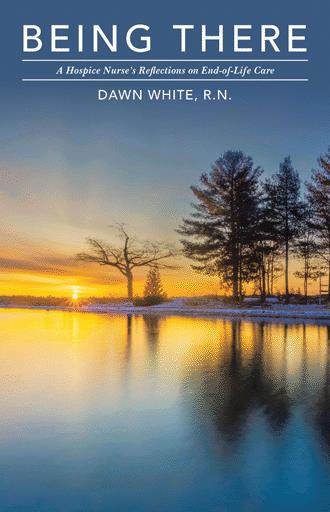
Being There
A Hospice Nurse’s Reflections on End-of-Life Care
by
Book Cover & Preview Text
From the very beginning of my nursing journey, I found myself drawn to the moments that demanded the deepest reserves of compassion, presence, and humanity—those sacred spaces where medicine alone couldn’t reach, where technical skill had to yield to something more fundamental. In those early years as a busy floor nurse, however, compassion often had to compete with an endless stream of demands: beeping monitors that never seemed to quiet, charting that consumed hours, medication schedules that couldn’t wait, and the relentless, exhausting pace of hospital life that left little room for the kind of care I’d envisioned when I first chose nursing. There were days—too many of them—when I went home physically spent but emotionally hollow, carrying a gnawing ache that something essential was missing from my work. I would sit in my car in the parking lot, still wearing my scrubs, and feel the weight of that absence. Nursing is meant to be about healing the whole person, not merely treating the disease. It’s supposed to honor the dignity and story of each individual, to see them as more than a collection of symptoms or a room number on a whiteboard. But I was moving so quickly, juggling so many tasks, that I rarely had time to sit with a patient long enough to truly see them—to look into their eyes and recognize the fear, the hope, the lifetime of experiences that had brought them to that hospital bed. The shift began during my time on the oncology floor. There, amidst the forest of IV poles and the quiet tears that fell in dim hospital rooms, I witnessed a kind of courage I had never seen before. I met patients facing their mortality with remarkable grace—some with humor that defied their circumstances, others with a simple, profound acceptance that seemed to transcend their pain. They became my teachers in ways I hadn’t anticipated. They showed me that healing isn’t always about curing, that sometimes healing looks like peace settling over a troubled heart. Sometimes it’s the quiet comfort of a hand held through the long, dark hours of night when fear feels overwhelming. Sometimes it’s permission to stop fighting and simply rest. When I started sharing my struggles with other nurses—admitting in hushed break room conversations that I felt I was failing my patients somehow, that the work felt increasingly mechanical rather than meaningful—a pattern became clear. Some mentioned hospice nursing as the place where a different kind of care could happen, where the focus shifted from fighting death at all costs to honoring life in whatever time remained. The more I learned about hospice philosophy, the more I felt a deep stirring within me, a sense that this was where I belonged, where I could finally practice nursing the way I’d always believed it should be practice. While hospice is not inherently religious, its values and practices deeply echo the spirit of Jesus’ ministry. Hospice care reflects Jesus’ teaching through: • Compassion • Presence • Care for the vulnerable • Healing that goes beyond curing • Recognizing dignity • Offering Peace • Loving generously The Calling to Hospice Hospice nursing, I soon discovered, isn’t about giving up on patients—it’s about giving meaning to every remaining moment. It’s about honoring the fullness of a person’s life, preserving their dignity when everything else seems to be slipping away, and helping individuals and their families find peace through one of life’s most profound and inevitable transitions. It requires a fundamental shift in perspective: from “How do we extend life?” to “How do we honor the life that remains?” From “What more can we do?” to “What does this person truly need right now?” The decision to transition into hospice work was not an easy one. I worried about whether I had the emotional fortitude for it, whether I could bear witness to so much loss without becoming hardened or broken by it. I worried about saying the wrong thing at the wrong moment, about failing families when they needed me most. But something deeper than my fears kept pulling me forward—a conviction that this work mattered in ways I couldn’t fully articulate – that it was perhaps the most important work I could do. The reality of hospice nursing proved to be both harder and more meaningful than I–had imagined. There were nights I left patients’ homes with tears streaming down my face, carrying the weight of another family’s sorrow in my heart like a stone. There were moments I wished desperately for more time with each patient—to linger a little longer, to offer one more word of comfort, to say something that might bring a measure of peace to a grieving family. The work demanded everything from me: my knowledge, my skill, my emotional reserves, my faith. But even in the exhaustion—perhaps especially in the exhaustion—the work was profoundly, deeply meaningful. Hospice nursing allowed me to practice both the art and the science of nursing at its most human level. It was about being present when it mattered most, about creating space for families to say what needed to be said, about witnessing love at its purest and most selfless form. It was about reminding people, through my presence and care, that they were not alone in the valley of the shadow of death, that their lives had mattered, that their stories deserved to be heard and honored.
Formats

Book Details
About the Book
This tender, honest exploration of what it means to care for someone at the end of life invites readers into the quiet, often unseen moments of dying. Through intimate stories and practical wisdom, it reveals caregiving not merely as an act of duty but as a profound human exchange - where love, grief, resilience, and meaning coexist. Grounding and compassionate, it’s a guide for anyone navigating loss, presence, and the fragile beauty of a final goodbye. The author offers a rare, deeply grounded perspective, shaped by years of work as a hospice registered nurse and by the intimate experience of caring for dying family members. At the bedside, both professionally and personally, she has witnessed the realities of dying in all their complexity: the medical, the emotional, and the profoundly human. This dual lens allows the author to bridge clinical knowledge and lived compassion, offering practical, honest, and deeply empathetic insights rooted in both professional expertise and personal love.
About the Author
Dawn White is a retired hospice nurse (who continues this work as a volunteer), the former clinic manager of a community health clinic, and director of a crisis pregnancy home in San Jose, CA. She is the proud mother of six children and ten grandchildren. She and her husband Steve live in Scottsdale, AZ.