
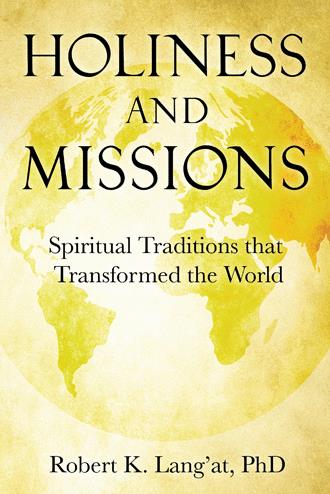
Holiness and Missions
Spiritual Traditions that Transformed the World
by
Book Cover & Preview Text
One of the greatest Christian missions’ historians of the twentieth century, Kenneth Lautourette, stated that there are four eras of great advance in missionary enterprise which form a “circle of ebb and flow.” These four are the first initial advance (upto 500AD), the second advance (950-1350 AD), the third advance (1500-1750 AD) and the fourth advance (1815-1914). The exact dating of these circles could be a subject of missiological debate. According to Lautourette, however, each advance is followed by a period of missionary recession. It is the opinion of this writer that there must be similar factor/s common to these four eras of advance and perhaps explanation also for the periods of missionary recession. The thesis of this book is that the era of advance was marked by a deeper love for God and a deeper love for His people. This deeper love was most exemplified during those four eras by Christians who were spiritually revived and had a commitment to the mission of God beyond the ordinary Christians. A study of the history of holiness revivalism makes it very clear that each of the advance period was marked by a major spiritual renewal within the church. The initial advance was inspired by the Martyrs of the early church, willing to giving up everything, including their own lives. The second era of missions was inspired by the rise of Monastics, withdrawing from the world, into the deserts, in what they understood as ‘voluntary martyrdom,” and being consecrated to prayer and proclamation of the gospel. The third advance was driven by the rise of the Moravian pietism, radical reformers amongst Protestants and the counter-reformation, which saw the religious orders such as the Jesuits advancing missions for the Roman Catholic Church. The fourth advance in the modern era, was resultant to the Methodist and Evangelical revivals whose holiness world view expanded the scope of the grace of God from Christendom to the “heathens” in foreign lands. This writer would add that another fifth advance, which may not have been too clear or ignored during the times of Kenneth Lautourette, that influenced evangelical missions into the 21st century was the rise of Pentecostalism and the attendant Charismatic renewalist movements from the Azusa Street Revivals of 1906.
Missiologist, Ralph Winter, corroborated the above analysis with an excellent and historic interpretive framework which helps to locate missions within the renewal sodalities of the church rather within the still waters of modalistic church structures. He well stated that whether “Christianity takes on Western or Asian form, there will be two basic kinds of structures that will make up the movement.” He identifies the first one as the New Testament church where all believers meet as a biological family. This would be well represented by apostle James who acted as a “bishop” with the elders in Jerusalem. The second is identified as one that demanded a commitment and a second decision beyond the first structure. Paul’s missionary band and the whole cross-cultural missional infrastructure of the Antiochian Christianity is a great representative of this face of the Church. These two faces of the church, later developed into historic diocesan and monastic ecclesiastical structures respectively. Winter traced the development of this second structure in the history of the church and identified that “the monastic tradition in various early forms developed as second structure.” He, therefore, suggested that we avoid the Protestant stereotype of the monks as running away from the world because it was in the monasteries that the dignity of labour as well as world evangelism was restored. Ralph Winter further illustrated that “Celtic monks…did more to reach out to convert Anglo-Saxons than did Augustine’s mission, that the monks contributed more to the evangelization of Western Europe, even Central Europe than any other force.”
It is interesting to note the dilemma that the monks faced was to whether to spread monastic or diocesan/modalistic forms of Christianity. This is tension that would be faced by all historic phases of renewalist movements as they faced crisis of obedience to ecclesiastical structures even when they were too weak to support missions. This tension would always be source of conflicts between missional sodalities and diocesan modalities. Where the polemics got too intense in church history, the sodalities broke into new ecclesial structures which began a new circle of redefining what it means to be a church and what it means to be in missions. That is why a number of churches would emerge in history that bear the name missionary—Christian and Missionary Alliance Church, The Missionary Church, are a few examples coming out of the 19th century holiness movement. When Augustine was sent to England, the intentions were not to establish monastic but diocesan Christianity. This tension is also clear in the nineteenth century revivalism. The struggle was always how to turn the revival fires into settled ecclesiastical bodies.
But outside these rivalries, the Catholic orders/sodalities/monasteries were always “the source of inspiration and renewal which overflowed into the papacy [diocesan modality] and created the reform movements which blessed diocesan Christianity from time to time.” Winter placed along these lines groups such as the Waldensians, started by Peter Waldo and the Anabaptists that developed as a midway between modalities (involving full families) and sodalities. These, he understood as “typified the desire for a pure church” and they were “renewal movements.” Missions arose out of these groups because of “the foundational well-springs of Biblical study and radical obedience represented by various sodalities.” Winter rightly points out that the greatest weakness of the Protestant reformation was that it “did not in a comparable sense readopt the sodalities, the Catholic orders, that had been prominent in the Roman tradition.” That is why, while for nearly 300 years, Roman Catholic Religious orders were doing well in missions abroad, Protestant movement was still engaged in theological wars and nationalistic controversies. On a number of occasions Catholic Church adherents would brand Protestant churches, because of inadequate missional identity of their ecclesia, as “non-church.” It was the Pietists from Bohemia and radical reformers that gave the Protestant movement the face of “a true church,” using missions’ yardsticks for ecclesial veracity. They were influenced by an earlier Christian martyr; John Huss and they influenced the emerging Pietism in German Christianity. 100 years of prayers and revival, in Herrnhut, Germany, took place based on the theme of Numbers 6:13 that- “Fire shall be kept burning on the altar continually; it shall not go out.” In 1727, this yielded radical responses of two young men: Johann Leonhard Dober and David Nitschmann. They accepted to sell themselves as slaves in Danish West Indies in order to reach the Africans slaves with the gospel. Their last words, with raised fists on board a ship to West Indies, were “may the lamb that was slain receive reward for His suffering” (words that exemplified lives of earlier Christian martyrs) (Excerpt from the first chapter)
Formats

Book Details
About the Book
The theme of missions is always rather explicit or implicit every time there is the purest experience of God in biblical holiness. This book makes a case that as God sanctified or set apart His people, in every biblical and historical instance, He had in mind an objective of self-giving life of reaching out to one’s neighbors, whether afar or nearby. This book is the most comprehensive trace of interconnection between holiness and missions through scripture- Old and New Testaments- and through Church history. A case is made that the doctrine of sanctification essentially conveys the very utmost Christian consecration to the transforming holiness of God and logically connects that to the dynamic outworking of this same consecration in utmost outworking of trinitarian love. It is found when we study and do thorough scrutiny of lives and practices of what Richard J. Foster has identified as “streams of living water” or “Great Traditions of Christian Faith.” These streams run deep in scriptures, both Old and New Testaments. The themes are found in the life of Christ and in the ministration of the Holy Spirit during Pentecost. It is pervasive in Pauline literature and missionary engagements, and are identifiable throughout the history of Christian thought. The language of holiness changed over time but the essential resultant life of missions remained a clear product of a sanctified life. In church history, this book traces this among the Martyrs, the Monks, the Mystics, the Moravians, the Methodists, and among the Holiness-Pentecostal Movements.
About the Author
Robert K. Lang’at, PhD from Drew University, renown scholar and researcher on the interface of holiness revivalism, missions and the trinity. He is the Bishop of Africa Gospel Church Kenya, Chancellor of Kenya Highlands University and Member of Council at Kabarak University. He has published extensively in international journals. He also serves on the Board of World Gospel Mission and Evangelical Alliance of Kenya.