
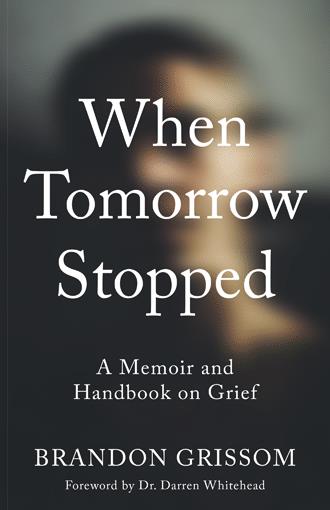
WHEN TOMORROW STOPPED
A Memoir and Handbook on Grief
by
Book Cover & Preview Text
It was one of those warm July nights in the southern suburbs of Denver, Colorado—the kind where the air feels soft, like it’s wrapping you in a gentle hug. I’m sprawled out in bed, propped up on a couple pillows, a book cracked open in my hands. Upstairs, our bedroom has this killer view of the Rocky Mountains stretching out like a postcard. I can see Long’s Peak standing tall in the distance, the last orange glow of a golden hour sunset spilling behind it, painting the sky in hues that make you pause and soak it in. I’d gotten into making tea lately, something about the ritual calmed me down after a long day. That night, I’m sipping on cinnamon tea, the warm spice curling up my nose, mingling with the words on the page. We’d just put in a window-unit air conditioner upstairs—not the fanciest setup, but man, it was a game-changer. It’s humming away, blowing cool air across the room, and that steady white noise is lulling me, tugging my eyelids down like it’s whispering, “Time to crash, buddy.” Then Beki slips into the room. She’d been downstairs washing dishes, because that’s her. My wife can’t sit still unless the house is spotless; it’s just how she’s wired. She’s got this thing about order, like it’s her way of keeping the chaos of life at bay. Most nights, we’d have this little routine: climb into bed, pray together, maybe fire up the TV for a rewind of “Parks and Rec” or “New Girl.” Those shows were our comfort food, winding down the day side by side. But this night’s different. She slides in beside me, and I catch her eyes. There’s a flicker of something off, a tinge of fear I don’t see often. “Honey,” she says, her voice shaky, “something’s wrong. I can’t move my arm.” I drop the book, sit up fast, and look at her left arm hanging there, limp like it’s forgotten how to work. “Try squeezing my hand,” I say, holding mine out.Nothing—not even a twitch. Then I glance at her face, and my gut twists—the left side goes slack, drooping like it’s melting right in front of me. I know it instantly. She’s having a stroke. My heart’s hammering as I grab my phone and punch 911, words tumbling out to the operator while I try to keep my cool for her. Our thirteen-year-old son, Ezra, is in the next room—probably gaming or scrolling on his phone, typical teenager stuff. He hears the commotion, walks over, and just stands there in his doorway, silent as a statue, watching the ambulance roll up. Lights flash red and blue through the windows, paramedics barrel in, boots thumping on our hardwood, and they’re whisking Beki out faster than I can process. Ezra and I pile into my truck, trailing that screaming siren to the hospital. I’m gripping the wheel, trying not to lose it—my eyes are burning, but I’m holding the tears back. Ezra’s not so lucky; he’s in the passenger seat, choking out sobs. “Dad,” he says, voice cracking, “why does this keep happening to us?” That question—it’s a dagger. We’d lost my mom to cancer a couple years back, only 59, her fight over too soon. Before that, my dad went in a freak accident, gone in a blink, leaving us reeling. Ezra’s barely a teenager, and he’s already hauling this load of grief, years of it spilling out now as we chase his mom’s ambulance. I reach over, squeeze his shoulder, but I’ve got no answers—just a lump in my throat and a prayer I can’t even form. Beki’s 43 years old. She’s vibrant and fit, the healthiest eater in our crew. She’s the one shoving kale chips and oatmilk at us while me and the kids sneak pizza in the basement. We knew about the brain tumor—found it three years ago—but she’d been a powerhouse, outpacing us all with her energy. That night, though, it all unraveled. My brother meets me at the hospital, and we set up camp by her ICU bed—those stiff chairs, the beep of machines, the sterile smell stinging your nose. Hours drag by, and around 6 a.m., it gets worse—way worse. Beki stops breathing. Alarms screech, a swarm of doctors floods in, yelling orders over each other. My ears start ringing—this high-pitched whine that drowns everything else, like my head’s a busted radio stuck between stations. A doctor tosses me scrubs and says, “You can stay if you want, but we’ve gotta move fast.” I fumble with the mask, tying it around my face, hands shaking. My brother steps out—I don’t know if he’s giving me space or if it’s just too much for him to watch. Either way, I’m alone in this chaos, the ringing swallowing every sound, making me feel like I’m floating outside my body, watching it all unfold like a nightmare I can’t escape. They intubate her—shove a breathing tube down her throat. She’s still, not even flinching, and I’m praying she doesn’t feel it. Beki’s always hated the idea of that—tubes, machines—it freaked her out. I’m begging God she’s out enough not to know, but alive enough to come back. The doctors explain her brain’s bleeding. The tumor we’ve known about for three years has turned traitor, hemorrhaging hard. Three years back, we’d found it—a shadow on a scan after some headaches she couldn’t shake. It was scary, sure, but she’d powered through, still our rock. Now, it’s gushing, and I can’t catch what the doctor’s saying—his words are garbled mush through the ringing. My life, my lady, my love—my Beki—is lying there, unconscious, hooked to machines, and I’m helpless. They say they need to relieve the pressure in her skull, and I’m stuck on how young everyone looks. These docs and nurses, barely out of med school, it seems—faces tight with tension. They’re kids working on my wife, and I see it in their eyes: this is not routine. One guy pulls out a tool—a hand-cranked drill, like something you’d dig out of your garage toolbox, not a hospital. A nurse starts shaving a patch on Beki’s head—quick, messy, clumps of her dark hair hitting the floor. I want to yell, “Can’t we do this gentler? She’d hate this!”—but I hold it back. Emergency trumps everything. She’s not breathing. Her brain’s drowning in blood. My ears won’t quit ringing. The doctor cranks that drill—slow, deliberate—and I watch, gut churning, as it bites into her skull. Blood and bile ooze out, a sickening sight, and they slide a tube in to drain the pressure. It’s surreal—liquid pouring from her head, machines screaming, my world tilting. Then, a shift—the room exhales. The beeps steady, her intubation’s working, heart rate’s holding, pressure’s easing. She’s breathing again—barely, but there. The staff huddles, hugging, consoling each other—this was traumatic for them too, not just me. “Beki’s stable for now,” the doctor says, voice heavy, “but you need to prepare yourself. There’s nothing else we can do.” That lands like a punch—I nod, ears still ringing, dizzy, clinging to the hope she’ll hang on, knowing deep down this might be the start of the end. My love’s fighting, but it’s out of my hands.
Formats

Book Details
About the Book
In the shadow of a warm July night, Brandon’s world shattered when his vibrant wife suffered a devastating stroke from a brain tumor. What followed was a raw odyssey of hospital vigils, fleeting recoveries, and heartbreaking decline, leaving Brandon to navigate profound grief while raising their teenagers. When Tomorrow Stopped is more than a memoir of loss—it’s a faith-fueled handbook challenging the myth that “there’s no wrong way to grieve.” Drawing from Job’s unyielding devotion, Grissom weaves intimate stories with transformative lessons: combating lies and fear, abiding in Christ, building unshakable foundations, worshiping amid suffering, embracing pain, cultivating gratitude, offering life as sacrifice, maintaining eternal perspective, and choosing joy even in the ashes. Through tears and trials, discover how grief becomes a sacred offering to God, pruning us for unexpected growth and forging in us an unshakeable hope.
About the Author
Brandon Grissom is a pastor, singer/songwriter & worship leader. He serves as Elder over Worship as one of the pastors of Revolution Church which has five locations across three countries. Brandon is married to Angela and they have five kids.