
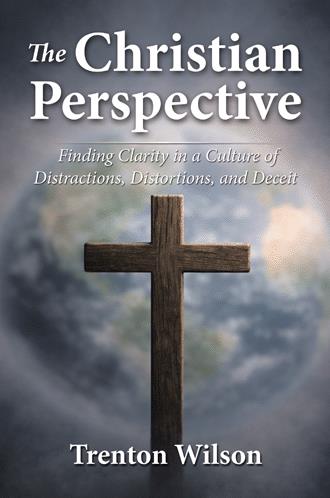
The Christian Perspective
Finding Clarity in a Culture of Distractions, Distortions, and Deceit
by
Book Cover & Preview Text
Our perspective is the result of many different factors including family, education, religious beliefs, experiences, emotions, and more. Each factor affects the individual in varying degrees of intensity. Families often provide us with our first perspective of life. I recall when my daughters would spend the day at a friend's house, they would comment on all of the “weird” things their friend’s family does. It was “weird” to my daughters, because they had a narrow perspective of how families do things. As people gain more knowledge about the world, their perspective will naturally adapt to their new understanding. Because religion plays such a large role in how we view right and wrong or good and evil, those beliefs will often play a large role in a person’s perspective. Experience is often the best teacher and much of our knowledge comes from our experiences. When I was younger, my older brother asked me to help him check the spark plug on the lawn mower by holding it while he pulled the cord. Lesson learned! When I am on an airplane and there is a baby crying, I recall my own experience as a parent in that situation and have much more grace for those poor parents. Emotions can also influence perspective– albeit temporary. Anger, joy, sadness, grief, contentment, and other feelings will play a role in how we initially see things–often distorting the realities of situations.
Perspective often combines all of these factors to create a single vision. I liken it to determining your prescription for eye glasses. If you wear corrective glasses or contacts you will know what I mean. The doctor will start with one eye and ask if you see better with two different lenses. They will continue this process until they finally get it right. And then they move to your other eye and go through the same process. Perspective is similar in the sense that we are using different lenses to develop a clear picture.
Perspectives also contain a certain amount of rigidness. In other words, some perspectives are less malleable than others. Perspectives borne out of traumatic experiences are especially rigid. For example, I have known a number of people who grew up with alcoholic parents and their view toward alcohol is very firm and hardline. Similarly, perspectives that are connected to our identity or sense of self can also be difficult to change. Things like political ideology, occupation, social class, or ethnicity/nationality can be so ingrained into us that it becomes nearly impossible to see the world from outside of our constructed identity.
The roles we have or occupy are also critical to our perspective. As we change roles, our perspective often changes with them. I always tell people that I was the best parent until I became a parent. The same went for when I became a teacher, coach, and administrator. Prior to occupying those roles, I thought I knew pretty much everything about those roles. Sadly and unsurprisingly, I did not. My perspective changed as my roles changed. I got to see things from a different point of view. There is a reason the idiom “The shoe’s on the other foot” exists.
Perspective, point of view, attitude, state of mind, or whatever you want to call it, is the most important aspect of who we are, especially as Christians– at least from my perspective (pun intended). It is the determining factor for all that we do and who we are. But it is not just my perspective or opinion. In fact, my argument is that the importance of perspective is a Biblical truth. In the Sermon on the Mount, Jesus expresses this sentiment and is the basis for the entire book:
“The eye is the lamp of the body. If your eyes are healthy, your whole body will be full of light. But if your eyes are unhealthy, your whole body will be full of darkness. If then the light within you is darkness, how great is that darkness!” – Matthew 6:22-23
Jesus is not referring to one's physical eyes or their ability to see the world in a biological sense. Instead, He is speaking about the lens through which we interpret life—our attitude toward good and evil, and our beliefs about God and righteousness. This statement comes between two well-known passages: 'Where your treasure is, there your heart will be also,' and 'You cannot serve two masters.' In context, Jesus is emphasizing that our perspective is shaped by what we value most. What we value, tends to be the impetus for much of who we are.
Formats

Book Details
About the Book
Social media, artificial intelligence, political turmoil, and cultural conflict are just a few of the many distractions and distortions that are causing confusion in today’s world and, more importantly, presenting a significant challenge for both Christians and the church.
In an invitation for believers to see the world, scripture, and themselves through a more spiritually-focused lens, Trenton Wilson draws on personal stories, biblical truths, and cultural insights to challenge Christians to develop a Christ-centered view of life rooted in truth, love, hope, and discernment. Framed through four distinct lenses—black & white, panoramic, telescopic, and 3D—he offers practical wisdom for navigating faith in a world clouded by confusion, compromise, and distraction as well as a fresh vision anchored in the unchanging Word of God for anyone wrestling with doubt, seeking clarity, or simply longing for a deeper walk with God.
The Christian Perspective offers personal stories and practical theology that encourage Christians to see life more clearly through a biblical lens.
About the Author
Trenton Wilson is a lifelong Christian who has faithfully served his local congregation in a variety of roles, including teacher, deacon and elder. He has dedicated more than twenty years to public education as a teacher, coach and administrator. Trenton has been married to his wife for twenty-five years, and together they are blessed with three amazing daughters.