
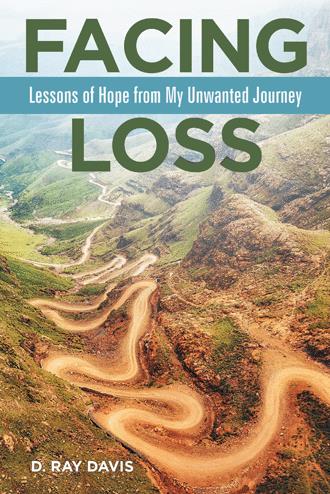
Facing Loss
Lessons of Hope from My Unwanted Journey
by
Book Cover & Preview Text
My Story of Staggering Loss On February 18, 2019, I received a text message at 12:48 PM from Leigh Ann Fort, Kim’s best friend, while I was in a lunch meeting with a friend. Three simple words began to unfold my unwanted journey. “Come home immediately.” We had finished lunch and were about to get a cup of coffee... Concerned, I told him I needed to call Leigh Ann. Leigh Ann answered, and she was crying. She forced out the news that Kim had collapsed and paramedics were at my house. She told me to come home. My friend prayed for me, and I rushed home. The full weight and severity of what I was facing did not cave in on me. God protected me. There was a sense of alarm, of course, and there was a heavy weight to the moment. I had to get home and now. I drove in silence for the next twenty-plus minutes. I did not know what to think and, in fact, I was prevented from thinking much. A loving, caring God—in protective grace—put a bubble of protection around me. I remember two fleeting thoughts that passed quickly through my mind. Neither lodged. The first was about what sort of long-term care was going to be needed for my wife if something serious was wrong with her. The second thought was pushed aside: “Why haven’t they called me to tell me where they are taking her?” “Trust in him at all times…pour out your heart…God is a refuge...” Psalm 62:8 I arrived at my house to be escorted to my den and immediately to my couch. Leigh Ann sat to my left. Without any delay, a police officer announced to me, “We are sorry to have to inform you that your wife has passed away.” I fell on Leigh Ann’s shoulder and began to cry in disbelief. After some minutes—I have no idea how long—I sat up. Everyone else had left the room, and Leigh Ann told me later that I exclaimed out loud, “Is this real?” A journey had begun. It was unwanted, but it was unavoidable. I made difficult calls to my children. I cannot believe I had to make calls to inform my children that we lost their mom. I called Kim’s parents, another horrible call to make. No parent should lose a child, definitely not two. Harry and Katrena have lost their two eldest children prematurely. It’s just not natural. I made the decision—with my children and with Kim’s parents—to ask for an autopsy. This was a difficult decision. But it was the right thing to do. We needed to know as much as possible about the cause of Kim’s death. It was necessary. However, it was a decision no man should have to make about the body of his beloved wife. Excruciatingly painful. The next week was a steady stream of friends and family paying their respects and offering their support. ______ How Grief Resembles Amputation Living with someone for so long gives birth to habits, reactions, and responses that are second nature. So, when loss occurs, you must learn to endure phantom impulses. These impulses are painful reminders of the habits born of oneness. “For God is not a God of confusion but of peace.” 1 Corinthians 14:33 I’ll never forget the first time I travelled following Kim’s death. In a hotel room after an evening meeting, I reached for my phone to call her. Phantom impulse and response. There are many such impulses. You hear a voice that reminds you of your loved one. Mothers who have lost babies have reported feeling the baby move in their abdomen after the stillbirth delivery. A chance encounter in a crowded place with someone who looks like your spouse from a distance. You take a step in their direction only to stop yourself. These phantom impulses evoke a response. As you start to respond you catch yourself and correct course. You put the phone back in your pocket. You convince yourself you’re not feeling the baby kick. You realize, on closer inspection, the person doesn’t look at all like your loved one. "Catastrophic loss is like undergoing an amputation of our identity." Jerry Sittser, A Grace Disguised: How the Soul Grows Through Loss Grief is often compared to amputation. It’s an effective comparison. Amputations can heal, but you never get your limb back. Mourners can heal, but they never get their loved one back. Minor injuries that do not involve amputation heal and everything returns to normal. Full use returns. Not with amputations. “He heals the brokenhearted and binds up their wounds.” Psalm 147:3 Amputations, I’m told, give rise to strange sensations. The amputee feels the missing limb at times as if it were still attached. These sensations arise from impulses in the brain. The previously repeated use of a limb created automated responses. These phantom sensations are confusing. Imagine feeling a twinge, a need to scratch an itch, or a tickle. However, it’s coming from the amputated limb. Confusing. Frustrating. Even maddening. “Two years have passed…grief has remained the salient fact of my existence.” Sheldon Vanauken, A Severe Mercy I’ve found as time marches on—when I’m distracted by normalcy—I am more prone to experience phantom impulses. The normalcy lures me away from the immediate context of my grief. And I reach for my phone. An old habit seeps through the barricade of my new reality. The busy-ness and distraction lower my guard. And an old memory has time to travel the path of the nerve all the way to a limb that no longer exists. Painful. Confusing. Jolting. These phantom impulses are unavoidable. They are inevitable. They must be faced courageously and endured diligently. It’s a part of healing, but it’s also a reminder that healing still involves loss that will never be reversed. Denial surrenders slowly. Grief resembles amputation. “The sacrifices of God are a broken spirit...” Psalm 51:17
Formats

Book Details
About the Book
Facing Loss: Lessons of Hope from My Unwanted Journey shares a personal story about facing the pain and agony of devastating loss with the healing balm of Gospel hope. D. Ray Davis did not seek to diminish the sudden loss of his wife, Kim. Instead, he faced it transparently, honestly, and courageously. He journaled his unfiltered feelings, thoughts, and emotions. Reeling from loss, he wrestled with God’s Word, God’s character, and God’s goodness. He took his feelings, thoughts, and emotions to a loving God, and he discovered lessons of hope from his unwanted journey. Facing Loss can be a companion to lead you to Gospel hope on your grief journey. “Davis guides readers on a journey through his pain. But he does more: He invites us as readers to reflect deeply on our own. I would choose him as a guide any day.” Jerry Sittser, author, A Grace Disguised: How the Soul Grows Through Loss “For anyone walking an unwanted road of sorrow, these pages will feel less like a lecture and more like a friend who understands.” Erik Reed, author, Uncommon Trust: Learning to Trust God When Life Doesn’t Make Sense
About the Author
D. Ray Davis served as a missionary in South Africa and Zimbabwe and then spent twenty-four years helping pastors and churches find their place in the Great Commission—inspiring and equipping them to pray, give, go, and send—through the International Mission Board. He is retired now and enjoys spending time with his children, playing with his grandchildren, and cycling with Amanda in Fairhope, Alabama.