
THE APOSTLE MATTHEW FROM ORIGINAL GREEK
A Study Guide
by
Book Cover & Preview Text
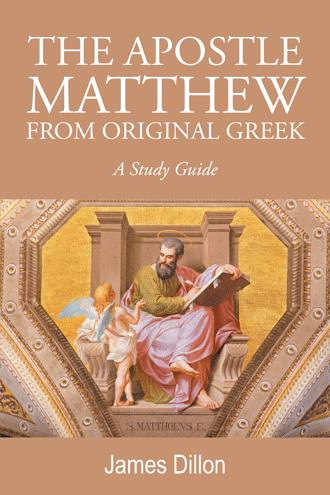
Imagine an attorney turned lobbyist who spends spare time clubbing orphan baby seals to death. This may approach the rage that the Apostle Matthew likely faced as a tax collector employed by the Roman government to collect money from his fellow Hebrews. Backed by Roman soldiers, Mathew and others collected taxes for Caesar, and any extra they saw fit to keep for themselves. They were rich to be sure. But, not allowed at synagogue or in greater Israelite society. Period. That was until one day a travelling Rabbi came by. As Matthew later recorded in his gospel: “And Jesus, passing away from that place, saw a man called Matthew sitting at the tax collector’s place of business. ‘Accompany me,’ he said to him, and having stood up, he followed Him.” And the rest – at least as Matthew recorded – is history. Specifically, the organization of a tax collector comes out through the organization of Matthew’s sharing of the good news about Jesus. He begins, in chapters 1-4 with an introduction of sorts to present Jesus as a continuation of the Old Testament teachings. Matthew does this through a variety of means. Most clearly, he opens his gospel with a genealogy “…Perez begat Hezron, Hezron begat Ram…” that likely begat many headaches over time. But, it was vital in defining Jesus as the descendent of Abraham and David through which the Old Covenant promises flowed. A description of Jesus’ birth follows, to hit Matthew’s theme of Jesus as God Among Us; what we encapsulate in the name “Emmanuel.” Matthew also opens with Jesus described as a continuation of Moses – presenter of the Old Covenant tenets – by noting how Jesus also came out of Egypt at one point, was in the desert for a period of 40 (days rather than Moses’ years) and also went to a mountaintop to lay out a Covenant (in what is often called the “Sermon on the Mount.”). Throughout all of this, Matthew makes many detailed callbacks to Old Testament writings to show how Jesus fulfilled various messianic prophesies. Matthew then follows this introduction with five sections of narrative. In the first, from chapters 5-7, Matthew records the “Sermon on the Mount” where Jesus describes the nature of the New Covenant which any would have found completely counter-intuitive. The downtrodden are to be envied. Thought matters more than action. Matthew records Jesus doing this most directly by noting “You have heard it said that…truly, I tell you…” With minds appropriately scrambled, chapters 8-10 begin to apply this New Covenant to daily lives. Through nine specific encounters with the aforementioned downtrodden, Matthew records Jesus performing miracles such as healings and other interactions with those he meets. And interspersed between each block of three encounters, Matthew records the ultimate ask of Jesus’ ministry: “Accompany me.” Chapters 11-13 turn to reactions of various groups to Jesus’ overall message with some positive, others neutral, and some downright hostile. Here, too, Matthew begins to record some of the famous parables meant to reinforce these various reactions such as the sower of seeds producing different yields. By chapters 14-20, Matthew becomes poignant as the focus turns to the different expectations of the Hebrew Messiah. For centuries, the Hebrews had come to expect a conquering hero, bending the physical world to their will. Matthew, instead, records a Messiah focused upon spiritual, not physical, power and on suffering and serving others such as at a dinner that famously fed over 5,000 people. At one point in this block, Matthew even records Jesus directly asking His pupils “Who do you think I am?” A full explanation of who Jesus said He was follows. In the next of the five chapters, 21-25, the conflict of ideas turns into a more literal conflict with Jesus and His followers facing Israel’s religious and political elite. As captured during the last Passover week of Jesus’ earthly ministry, the former is recorded as provoking while entering Jerusalem on a donkey and overturning tables in the main Temple with the latter plotting and seeking to trap Jesus in ways that could lead to capital punishment. Matthew records one last set of Jesus’ teachings centered upon these conflicts and their expected result. The climax and conclusion of Matthew’s Gospel comes in chapters 26-28. Beginning at what is known as the “Last Supper,” – actually a meal meant to celebrate the Hebrew’s Passover holiday – Matthew begins to tie the good news of Jesus as the ultimate Passover sacrifice. The writing then continues through the crucifixion and resurrection of Jesus, with Matthew returning to frequent quotes of Old Testament prophesy to assure readers that all was planned rather than a surprise. And finally, in recording Jesus’ last command to his pupils, Matthew ends his Gospel with a reminder of Jesus as Emmanuel: “And behold, I am with you every kind of, to the end of the age.”
Formats

Book Details
About the Book
As described in the Old Testament, God promises Hebrews eternal bliss if they follow ten commandments and associated rules. The New overhauls the Old, defining the way to Heaven via the heart rather than the hand. These promises became known as “covenants” over time. And like in any contractual engagement, anyone signing onto such agreement is best served by fully understanding both the terms and parties involved. We rarely do, however. Yet, when our eternal life is on the line, is a little more study of people and promises advised? The quandary becomes where to look. Entire sections of box stores provide a litany of learned commentary. We could, instead, read the Bible for ourselves. But which translation captures the essence of THE Author? Enter this guide. It simply seeks to follow the original Greek language in which it was drafted as closely as possible. It provides fuller explanations behind certain words. And, it supplements words with notes on archeology, geography and various other sciences, where appropriate. It purposefully lacks one thing: opinion. For that is to come from you. God seeks for you to have a relationship directly with Him, not with yet another author of yet another book. Your opinions leading to your understanding is what He desires. So, the purpose of this guide is to present His words in the clearest, original manner as possible to help you find meaning He intended specifically for you when sitting Matthew down to write an account of good news.
About the Author
***NO AUTHOR BIO AS INSTRUCTED BY AUTHOR***