
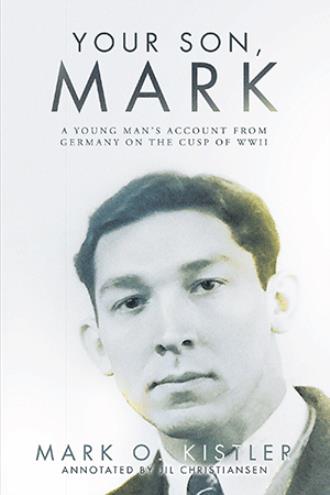
Your Son, Mark
A Young Man’s Account From Germany on the Cusp of WWII
by
Book Cover & Preview Text
Dresden March 20, 1939 Dear mother, We arrived in Dresden last evening after a two days bike ride from Prague. The youth hostel here is large and has a central-heating system, so it is quite comfortable. I suppose you read all about Prague in the newspapers. We were in the midst of the excitement. On Tuesday night we saw many street riots between Czechs and Germans - some being knocked unconscious. The next morning we were in the old Town Hall when we heard a lot of noise. We looked out of the window and there were the German troops riding by on motorcycles, trucks, horses, tanks, and private cars. At first the Czechs started singing their national song, blocking the streets, and shaking their fists, but when they saw all the troops pouring in, they saw their cause was hopeless and went about their business again. Prag is very cheap just now. I lived there six days and spent only five dollars, including six lodgings, meals, museum admissions, two American movie tickets, pictures of the city, and a purse which I bought as a present to take along to America. The Czechs are nice people. They treated us very nicely and made us feel at home. We got to know a Czech restaurant keeper quite well and ate most of our meals there. They eat a kind of dumpling as a substitute for potatoes. As a drink they depend on Pilsen beer. The Germans discontinued all train service from Prag (sic) to the frontier. Everybody had to stay in Prague till further notice. However, we ran out of money so we hopped on our bikes. When we came to the border the German officials were in doubt what they should do with us, but finally they let us go. I think we were the first people, outside of soldiers, to get out of former Czechoslovakia. We had our mail forwarded to Dresden, Hauptpostlagend, so this morning much mail was waiting for me. The letters from America came from you, Aleta, N.Y.U., Harvard, the Institute of International Education, and I also received mail from Seydlitz, a Greek boy I met in Berlin, and from Frankfurt. I plan to stay here about four days and then go to the farm, if all plans work out. We almost died yesterday crossing the Sudeten mountains. They are very high. We had to push our bikes with luggage and all for 10 kilometers. The mountains are still covered with snow, although the road was fairly clear. Three trucks had upset along the way. The Bulgarian boy wrote and said he received the first two copies of the Saturday Evening Post. I will send him the bill one of these days. Many people - Czechs and Germans - envy us. They would give almost anything they had, if they could obtain American passports. The Elbe from the Sudetenland to Dresden is very pretty. It winds through the mountains and has high cliffs on both sides. It rises in Czechoslovakia and its mouth is near Hamburg. The weather was rather frigid when we left Prague and I caught a cold. However, today I'm spending most of my time in the Youth Hostel, and it is getting better. Dresden had been the capital of Saxony and the Saxon kings lived here. We plan to see their castles tomorrow. In May all American exchange students are the guests of the Carl Schurz organization. They take us on a two-weeks bus trip and pay every penny - even the trainfare from Frankfurt to Berlin, where the trip begins. I will be able to visit Frau Liebenow then, and the other people I got to know in Berlin. By the sound of Aleta's letters, it seems that Americans fear a war in Europe. We are not worrying. Your son, Mark Editor’s Note: Carl Schurz was a Civil War general, a U.S. Ambassador to Spain, a Missouri Senator, and a Secretary of the Interior under Rutherford B. Hayes. Schurz was born in Germany in 1829 and was educated at the University of Bonn. After participating in the Revolutions of 1848 he was forced to leave Europe and immigrated to the U.S.
Formats

Book Details
About the Book
In this unabridged first-person account of life in Berlin and Frankfurt in 1938-9, Mark Kistler, a Pennsylvania Dutch farmer and Dickinson College graduate, writes his widowed mother letters from Germany during his year studying abroad in the months leading up to WWII. He witnesses Kristallnacht (the night Jewish businesses and synogogues are attacked) and is in Prague on spring break when Hitler's troops enter the city. His friends from both the U.S. and Germany will soon enter war as enemies, and his experiences will mark him for the rest of his life but never diminish his love for the people or the language.
About the Author
Dr. Mark O. Kistler grew up on a farm in eastern Pennsylvania. After his year in Germany he earned his Ph.D. in German literature from the University of Illinois. He taught German language and literature at Michigan State University for forty years.