
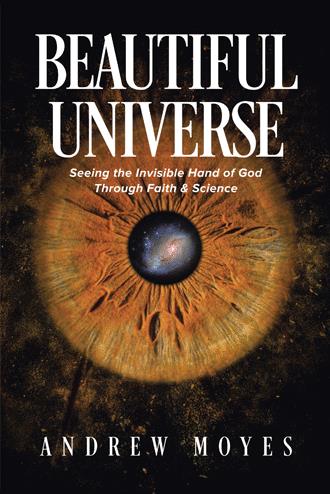
Beautiful Universe
Seeing the Invisible Hand of God Through Faith & Science
by
Book Cover & Preview Text
Chapter 1
What Is Truth and How Can We Know It?
What is truth?
—Pontius Pilate
Who am I? Where did I come from? Why am I here? Where am I going? These are life’s big questions.
At one time or another, life’s big questions haunt all of us. We inevitably ponder how we got here, and whether we have a purpose. The fact that we ask these questions is part of what it means to be human.
Historically, humanity sought insight from religious clerics and philosophers whose forerunners have contemplated these questions for millennia. Yet in the last century or so, some scientists—especially astronomers—have cloaked themselves with sacred, metaphysical* vestments and taken the pulpit to proclaim their insights to life’s big questions. They have positioned themselves as the priests of the new age, albeit typically as atheistic clerics.
For instance, Neil deGrasse Tyson and James Trefil proposed astronomical answers to the big questions of life in their book, Cosmic Queries: Star Talk’s Guide to Who We Are, How We Got Here, and Where We’re Going. They offered the premise that life does have big questions, and the authors felt they should posit these questions to the most profound entity they could recognize.
They concluded that the universe is the largest and longest-lasting entity of all time, and as such the universe’s information would be the most helpful in developing answers to the big questions of life.2 So, they ask, “What does the universe have to say about our existence and purpose?”
To find out, they peered through telescopes and saw the distant past filled with awe-evoking order. The consistency of how stars and galaxies were birthed led them to deduce that the universe has consistent physical laws. From knowing these laws and having seen cosmos forming events, they attempt to predict the future. But beyond even that, Tyson and Trefil have proposed scientific answers as to who we are.
OK, that sounds interesting. But are their presumptions and therefore their conclusions valid? Not entirely.
You see, they hold fast to the premise that what we observe in the universe can only be understood through natural means. They exclude all supernatural explanations of events. So when Tyson and Trefil metaphorically look to a natural entity, the universe, to give them answers to life’s biggest questions, they see only all natural—and not exactly in an organically pure sense—answers. By definition, materialistic scientists give no consideration of a transcendent source, meaning, or destiny for life.
In other words, from this type of scientific perspective, anything beyond what we can observe in nature must be excluded from consideration. Naturalistic science claims there are no supernatural answers because science allows only natural answers. If that sounds like circular reasoning to you, that’s because it is. (Logic Alert: Circular reasoning is not always invalid. But be careful. We need to examine our assumptions before allowing the circle to spin into the foundational web of our worldview.)
So, what answers did Tyson and Trefil find when they queried the universe about who we are and where we came from? My synopsis of their conclusions is the following:
● Who am I? You are lucky, DIY (self-organizing) space dust. Enjoy the ride. It won’t last forever.
● Why am I here? Who the heck knows, but you probably need to concentrate on space travel, because you’re going to destroy planet Earth one way or another.
● Where am I going? Nowhere, essentially, but take heart—you’ll make new space dust for the cosmic circle of life. Don’t worry too much, because the universe will collapse on itself (or explode) in about 10 billion years. But that’s OK. Nothing to worry about. Our sun will burn out first.
● How should I live? You should eat, drink, and be merry because tomorrow you will die. The most you lucky space dust can expect from your material existence is hedonism (seeking pleasure as a primary life pursuit) and fatalism (life as you know it will crash, and you can’t do anything about it).
Carl Sagan began his populist book, Cosmos,3 and his PBS television show of the same name, with his taunting mantra: “The Cosmos is all that is or was or ever will be.” In the preface to the most recent edition of Cosmos, deGrasse Tyson and the late Sagan’s wife, Ann Druyan, confirmed that Sagan intentionally used this quasi-religious language to describe the cosmos. He mirrored the biblical words that the apostle John used to describe the eternal (out of this world) Christ: “‘I am the Alpha and the Omega,’ says the Lord God, ‘who is, and who was, and who is to come, the Almighty’” (Revelation 1:8).
That raises these questions: Who is right—Carl or John? Is the cosmos all there ever is, was, or ever will be? Or is there something/someone beyond the cosmos? Is there a transcendent Creator who designed, created, and sustains the cosmos?
If Sagan is right, the implications are clear. Welcome to the lucky space-dust world. Eat, drink, and make merry because tomorrow your dust will recycle into a pine needle, penguin feather or someone else’s nose hair. But if John correctly recorded a glimpse of Heaven, and God truly is, was, and always will be, the implications for our existence take a profound twist. Such a reality would change everything.
So, to live life well, it’s not sufficient to answer these questions with, “I don’t know” or “I don’t care.” We owe it to ourselves (and those around us) to carefully consider these questions and the various answers presented by different worldviews. In fact, I can’t think of anything more worthwhile of our time and attention. The truth we discover will shape every aspect of our lives.
Formats

Book Details
About the Book
In Beautiful Universe, Dr. Andrew Moyes takes us on a journey through science and faith topics with intellectual honesty and gracious curiosity. The book explores the “Big Five” intersections of science and Scripture: - Is the Big Bang consistent with the Genesis beginning? - Why are the particles and forces of the universe so finely tuned? - Did life arise spontaneously from a prebiotic soup? - Does the fossil record support Darwinian evolution? - Are humans evolved primates, or are we exceptional? In addressing these questions, Dr. Moyes reveals how scientific evidence points to a powerful, intelligent, and loving Creator. His book is perfect for: - College and high school students navigating science-faith questions - Friends and family of those asking hard questions about origins and purpose - Those who have set aside faith in favor of non-belief but remain curious - Anyone seeking faith that's intellectually honest and biblically sound - Those who want to more clearly see the work of God’s invisible hand through his creation (Romans 1:20) Real faith doesn’t ask you to check your brain at the church door. It asks you to love the Lord with all your mind and discover what becomes clear when you look at the world simultaneously through lenses of faith and science.
About the Author
Andrew Moyes, MD is an ophthalmic surgeon with degrees in chemistry and medicine from the University of Kansas, and a master’s degree in biblical and theological studies from Dallas Theological Seminary. Over his career, Dr. Moyes has also traveled to Haiti and Jamaica many times to perform sight-restoring surgeries. His professional motto is, “Jesus washed feet. We clean eyeballs.”
Known for his warmth, humor, and respect for differing viewpoints, Dr. Moyes has a passion for helping young adults reconcile scientific inquiry with Christian faith. He lives in Parkville, Missouri, and Alpine, Colorado with his wife, Cathryn. They have eight children: four originals and their four spouses. When not performing surgery or writing, he enjoys traveling, mountain climbing, and birdwatching.