
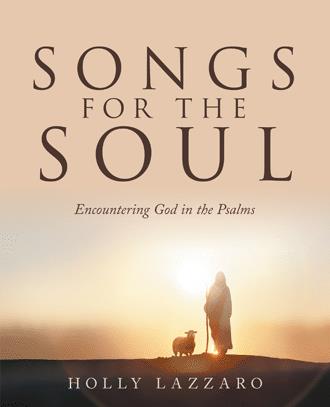
Songs for the Soul
Encountering God in the Psalms
by
Book Cover & Preview Text
From Songs for the Soul: Encountering God in the Psalms Week One, Day 1: The Psalms as the Prayer Book of the Bible Read: Psalm 1 The Psalms hold a unique place within Scripture. They are not just hymns or prayers; they also reflect the heart of God's people in relation to their Creator. Often called the prayer book of the Bible, the Psalms guide us in every aspect of prayer: praise, lament, thanksgiving, petition, and everything in between. These sacred texts were written to help God's people worship, mourn, express joy, and confess sin. To better understand the significance of the Psalms, we must explore the historical and cultural context of the nation of Israel. The Psalms were composed over several centuries, spanning the time of the early monarchy (think David and Solomon), the exile (think about Daniel and his friends managing a foreign king, even Esther and her trials as queen of a non-Jewish country), and the post-exilic period (think Nehemiah coming back to rebuild the temple). They reflect Israel's spiritual journey, and each Psalm contains covenantal and theological depth. As a theocratic nation, Israel expressed its religious devotion through worship, much of which was centered on the Psalms. These were not just personal prayers; they were meant to be sung in the community of believers, often in the temple or at festivals. So, while the Psalms do contain personal petitions, many also carry a corporate dimension, speaking not only to individual faith but to the faith of the nation. Psalm 1 sets the tone for the rest of the book. It functions as an introduction to the entire Psalter by emphasizing the importance of meditating on God's law. This Psalm presents the image of two contrasting paths: the righteous and the wicked. The righteous person delights in the law of the Lord, meditating on it day and night. The wicked, by contrast, are described as being like chaff — worthless, blown away by the wind. This stark contrast between righteousness and wickedness is a theological principle: it underscores the covenantal blessings promised to those who remain faithful to God's Word. The Psalmist is rooting the concept of righteousness in the very covenant God made with Israel. Meditating on God's law is not a merely individualistic or intellectual exercise. It is a way of life, a way of walking in the world as part of the community of faith that God has set apart. The law, the Torah, for Israel was not just a moral code but a covenantal document, embodying God's promises, instructions, and expectations. To meditate on it was to engage with God Himself and to align one's life with the purposes of His kingdom. Psalm 1 teaches us something profound about the nature of true righteousness. According to the Psalmist, righteousness is not just about outward compliance with laws but about a heart that delights in God's Word. This is essential to our understanding of the doctrine of sanctification. Righteousness is imputed to us through faith in Christ, but true righteousness manifests itself in our lives as we delight in God's Word and seek to live according to His will. Psalm 1 highlights that this righteousness is a fruit of the regenerated heart. A regenerated heart is inclined to meditate on God's law as a way of life. Jesus came to fulfill the Law (Matthew 5:17), and through Him, we are enabled to live out the righteousness that the Psalms anticipate. Jesus' fulfillment of the Law does not negate its relevance; rather, it transforms our relationship with it. Through Christ, we no longer need to depend on our own ability to uphold the law perfectly but can rest in His perfect obedience. And yet, the call to meditate on God's Word and to live righteously remains, for Christ does not abolish the moral law but fulfills it. Theological analysis also reveals that Psalm 1 reflects God's broader redemptive plan. In the New Testament, the apostle Paul identifies the law's role as a tutor leading us to Christ (Galatians 3:24). Psalm 1 takes on even greater significance in this light. The law that the righteous delight in is a means of knowing God, of understanding His will, and ultimately pointing to Christ who is the fulfillment of the law.
Formats

Book Details
About the Book
The Psalms have been the prayer book of God’s people for thousands of years. They contain every emotion the human heart can hold: grief, joy, fear, longing, praise, and doubt. They are honest in ways that much of our Christian vocabulary has forgotten. Songs for the Soul: Encountering God in the Psalms is an eight-week study that takes participants through the full range of Psalm types, from lament and wisdom to the Psalms of Ascent and the Messianic Psalms that point directly to Jesus. Each week builds a richer theological framework, and each day invites personal reflection through questions designed to move from the text to the heart. This study will give participants the language they have been missing for the seasons of faith that are hardest to name. It is theologically serious and personally accessible, and it was written for people who are ready to encounter God in the full depth of his Word.
About the Author
Holly Lazzaro is the founder and lead teacher of Study With Friends Ministries, a Bible study ministry reaching people across the world through weekly studies, podcasts, and regional in-person retreats. What began as a small gathering around Scripture has grown into a thriving community where people encounter God’s Word together, week after week. Holly holds a Master of Biblical and Theological Studies from Knox Seminary and serves as an elder at Langhorne Presbyterian Church in Langhorne, Pennsylvania. Her teaching is rooted in the Reformed tradition and shaped by years of close attention to Scripture in community. She writes and teaches with the conviction that the Bible is not simply information to be consumed but a living Word meant to form us from the inside out. Holly lives in the Philadelphia area with her family.