
Jesus’ Last Supper Cookbook
The What, Why, and How-To Guide to Host a Christian Passover Seder
by
Book Cover & Preview Text
2 Chronicles 29 – 31:1 Hezekiah’s Passover
Many kings, some good and some bad, ruled over the nation Israel that God brought out of Egypt. The Passover was not kept for years at a stretch. The people had forgotten how to observe the day. The tribes were scattered far north and south of Jerusalem where The Passover lambs were to be sacrificed in the Temple.
About 700 years prior to Messiah Jesus, Hezekiah became King over Israelites who had defiled the Temple sanctuary and did evil in the sight of the Lord.
2 Chronicles 29 describes King Hezekiah, who became King at age 25, as a man who (v. 2) “did what was right in the eyes of the Lord, just as his father David had done.
In the first year, first month of his reign, King Hezekiah tells the Levite tribe and priests to consecrate themselves, and the Lord’s house, and remove uncleanness. It takes them sixteen days to cleanse the temple. Even so, it was not done perfectly. What was commendable was that it quickly established the required sacrifices. Accompanying the sacrifices was singing, musical instruments, and trumpets.
Hezekiah and his officials decided to celebrate Passover and Feast of Unleavened Bread in the second month because the people had not yet consecrated themselves and they had not yet come to Jerusalem in the first month of his reign. He wanted the entire nation to participate and encouraged them to return to God, “For the Lord your God is gracious and compassionate. He will not turn his face from you if you return to him.” (2 Chronicles 30:9b)
2 Chronicles 30:15-21: Then they slaughtered the Passover lambs on the fourteenth of the second month. And the priests and Levites were ashamed of themselves, and consecrated themselves and brought burnt offerings to the house of the Lord. 16 They stood at their stations after their custom, according to the law of Moses the man of God; the priests sprinkled the blood which they received from the hand of the Levites. 17 For there were many in the assembly who had not consecrated themselves; therefore, the Levites were over the slaughter of the Passover lambs for everyone who was unclean, in order to consecrate them to the Lord. 18 For a multitude of the people, even many from Ephraim and Manasseh, Issachar and Zebulun, had not purified themselves, yet they ate the Passover otherwise than prescribed. For Hezekiah prayed for them, saying, “May the good Lord pardon 19 everyone who prepares his heart to seek God, the Lord God of his fathers, though not according to the purification rules of the sanctuary.” 20 So the Lord heard Hezekiah and healed the people. 21 The sons of Israel present in Jerusalem celebrated the Feast of Unleavened Bread for seven days with great joy, and the Levites and the priests praised the Lord, day after day, with loud instruments to the Lord.
Notice in verse 15 that the lamb in this Chronicles passage is slaughtered on 14th. Here is an example from Scripture of using interchangeable terms Passover and Unleavened Bread as an eight-day festival like Josephus did. The first night’s Passover (Paschal) lamb was slaughtered on 13th in the afternoon. The second night of Passover/first night of Unleavened Bread lambs (Chagigah) were slaughtered on the morning of 14th. The lamb in 2 Chronicles 30:15 was a Chagigah (Festive) lamb slaughtered on the 14th. Take note that the Levites slaughtered the lambs for those who were ‘unclean,’ that is, temporarily ritually impure from such things as contact with a dead body or certain bodily emissions. It was mandatory that for one to sacrifice a Chagigah lamb, he must be in a state of ritual purity.
Are you confused? Chapter Four, “What Happened During Jesus’ Last Week.” explains Jewish timekeeping for days, weeks, and months. Chapter Seven, “Why Were Old Testament Sacrifices Necessary?” explains in greater detail the differences between the Passover lamb and Chagigah lamb. After reading those chapters your confusion may be cleared up. Patience, my friend!
Hezekiah’s Passover brought so much joy to the people that they spontaneously extended the celebration another seven days. After being renewed to the Lord they returned home emboldened to break down the pillars, altars, and Asherim of false worship.
Formats

Book Details
About the Book
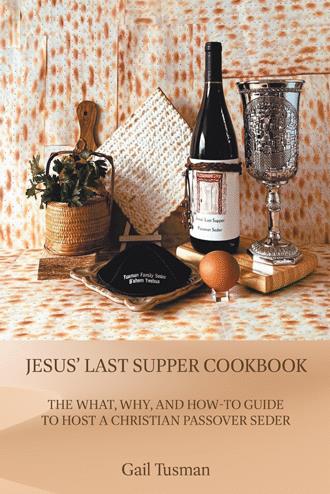
The only cookbook you’ll want to read cover to cover.
Here is the only resource you’ll need to host the ultimate simple Seder luncheon or complex Seder dinner feast. Family recipes, children’s activities, crafts, and suggestions to help you personalize your Seder. Essential ceremonial items are listed and explained. Timetables keep you organized and stress-free.
Gail Tusman folds New Testament Scripture and science over Old Testament history to reveal unexpected insights. As you track Jesus during his last week on earth in context with Passover events and practices, you will see him as the Passover Lamb, the chagigah lamb, and the First Fruits offering of Easter Sunday. Jewish concepts of gematria are introduced to explain why God sent ten plagues on the Egyptians and what they accomplished. You will discover the science of fractal geometry and its relationship to the Star of David and the burning bush stones on Mount Sinai.
The Christian Passover Seder Haggadah is Tusman’s companion publication that guides participants in eating the ceremonial bitter herbs and telling the story of the Exodus from Scripture. You will drink the four cups of wine and read Yeshua’s words during the Lord’s Supper Communion.
About the Author
Born again at age fourteen, Gail earned her BSEd from Northern Illinois University and trained as a Precept Ministries Bible Study Leader under Kay Arthur. As a gentile married to her completed Jewish husband, she brings a rare and authentic dual-tradition perspective to her writing with the warmth of a trusted teacher. With four decades of experience serving Seders to her own family and church groups, her passion for Passover continues to grow.