
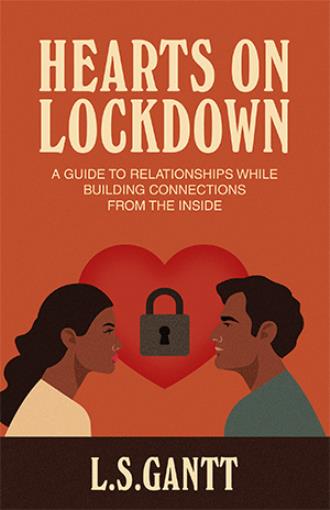
HEARTS ON LOCKDOWN
A Guide To Relationships While Building Connections From The Inside
by
Book Cover & Preview Text
CHAPTER 1: THE STIGMA OF MEN IN PRISON
For as long as I can remember, men in prison have carried a reputation for being manipulators who were only looking to find a woman to do time with them while they eloquently and persuasively told women what they wanted to hear. A pattern commonly referred to as “jail talk.” And while there is some truth to that, it’s a generalized statement that does not represent the entire prison population.
The men who operate under those false pretenses do not represent me, nor do I support any form of deception in these pages. But I will add this: we never truly know what motivates a man or woman to become grimy or vindictive. We all have triggers and impulses that can lead us into murky waters and perilous situations, sometimes willingly, sometimes not. A scorned relationship can easily pave a path of destruction toward yourself or others, and depending on whose lens you’re looking through, those actions may even appear justified.
In the grand scheme of things, most if not all experiences are shaped by perception. From my experience vibing with other men in prison and studying them closely, I can confidently say that almost 90% of men want a relationship built on trust and genuine love. They want to love and be loved. Yes, there are men and women behind bars who seek entertainment, but for every one of them, I know many sturdy, solid men who cherish their relationships deeply.
There are many of us trying to do right, and I’m certain most of us were not always moving like kings in previous relationships. But in life, when you go through hard times, you often come out stronger. When you can learn from your pain, you can work to avoid repeating mistakes. One thing about prison and what it can do to a person is, it will make you grow in appreciation. You begin to value the simple things most people take for granted, especially your woman. When you reach a stronger level of appreciation, you don’t want to diminish what you’ve grown to value.
We know we come flawed. We can be hardheaded, but we are corrigible. We love just as fiercely as the women who love us. The problem is that many men are weaker of heart than the women who stand by us. When we feel slighted, wronged, or hurt, we hold onto it and become vindictive. Sometimes a great woman can be right in front of us, yet we fail to honor her because of the damage done by someone from our past, damage that keeps us from being the great men we always had the potential to be.
When we were home, many of you women stayed because there was something in us you loved. Despite our flaws, you believed that if those parts of us were refined, the light you saw in us would shine through. So you hoped that time, love, and commitment would bring change. Sometimes it does; sometimes it doesn’t. And sometimes women stay in relationships for the wrong reasons, so when we become incarcerated, it becomes easier to detach because your heart had already checked out long before the handcuffs or sentencing.
My goal with this book is to eradicate the stigmas that have been attached to incarcerated men for decades. I hope through education and honest discourse, we can gain insight and overstanding into the dynamics of relationships involving people in prison, relationships that society has long frowned upon. Society can be insensitive and callous toward the incarcerated, and I don’t believe that is right.
Many of us were set up to fail from the beginning. Hardships were strategically created to push us toward paths designed to drug us, kill us, or incarcerate us. There is a sharp dichotomy between “us” and “them,” and it becomes even clearer when we witness leaders like the president of the United States aligning with ultra-aggressive supporters who, despite their misbehavior and criminal acts, are revered instead of condemned. It becomes a reminder of where society believes we belong.
Black and Brown people and even some poor whites are already prejudged and represented unfairly. Society’s persistent effort to ostracize Black men is still in full practice, and so is the unspoken commitment to separate us from our women. Let me be clear: writing this book is not an attempt to normalize criminal behavior or paint it as something admirable. It’s not. My aim is for men to get out and stay out. Prison is a horrible place, but it shouldn’t make families feel judged or ashamed for loving someone on the inside.
Most importantly, I want to be a vessel that is encouraging and a guidepost for anyone who has been, is, or may be in a relationship with someone incarcerated. I want the incarcerated brother or sister to be remembered, to receive love, and to cherish it, because they are worthy of being loved. Our mistakes should not define our entire existence. The incarcerated can be reformed, and having love next to you, being supportive and believing in you is not only encouraging, it is inspiring and can help motivate even the most afflicted.
Within all of us lies hope, and through rehabilitation and atonement, we can grow into the greatest versions of ourselves. Having support during that process doesn’t just give hope, it gives life. I know what it feels like to be inside and lose the love you walked in with. I know how it affects your mental state and can change the entire course of your day, sometimes leading to dramatic and destructive choices.
Being emotionally unstable and lacking the fortitude to block out the stresses of prison can strip away your sanity quickly. It’s an abnormal world where you can leave worse than you entered if you’re not careful. Prison is transformative: you will either ascend, regress, or remain the same, which is just as dangerous as declining. Feeling unwanted or unloved can drain a person’s hope and add pressure to an already heavy mental load.
I overstand that love is powerful. It can soften the most hardened and awaken the righteous in the corrupt. Despite the stereotypes, there are good-quality men doing time who were simply products of their environments, and the women who loved us, loved us in those moments for real. Don’t allow peers or society to dictate who you love or why you love them. Every situation is different, and I am not telling anyone to stand beside someone who was truly worthless and foul to them. There’s a difference between making mistakes and being a foul person, and that difference matters.
Often, women leave not because the love is gone but because survival requires it. And that’s why, when many men come home, the same women who left sometimes want to reconnect. Let’s get back to love, ladies, and cultivate it by staying steady. You have no idea the kind of man who can emerge from this process or how deeply he might honor you.
We hear plenty of stories about relationships that ended badly when a man came home, but not nearly enough about the ones that remained strong and flourished. My goal is to represent those thriving relationships and encourage the ones barely holding on. When it feels like your relationship is hanging by a thread, I hope this book becomes that extra rope that pulls you both back up together.
Formats

Book Details
About the Book
This book is about preserving the love dynamic between prisoners and their loved ones inspiring men whether incarcerated or not on how to start becoming better men by eradicating bad habits and developing new and positive habits that will help them traverse through their hardships while incarcerated and using that time learning the importance of being a man of your word as well as how to start moving like kings by appreciating and honoring the queens who stand by them and love them. After going through multiple relationships, and a divorce before meeting the love of his life, the author highlights his own shortcomings and faults and what brought him to his redemption and why he advocates for true love. From his experience he delineates how a lot of men and women have been misguided, and influenced by negative examples of individuals who encouraged unfaithful and disloyal habits toward one another. The writer is now trying to break that mold and mentality, through his own maturation and ascension he asserts that if you can remain steady with your person through the most challenging times there will emerge a person who will love, honor, and cherish you beyond what you could have ever imagined.
About the Author
Author, L.S. Gantt is a certified personal trainer, nutrition coach, loving father and husband who is now at the end of a 15 year sentence and now with his debut book has stepped away from his fitness grind by writing a masterful guide about love, redemption, and relationships.