
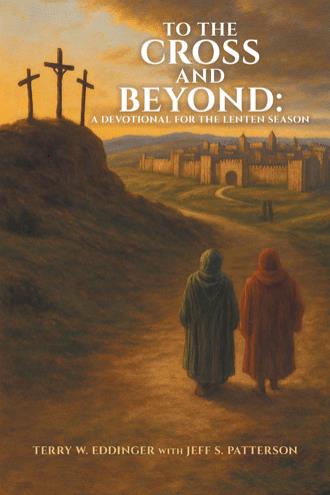
To the Cross and Beyond: A Devotional for the Lenten Season
by
Book Cover & Preview Text
1. Immanuel
Scripture Reading: Isaiah 7:10-16; Matthew 1:23
About seven hundred and fifty years before Christ’s birth, Isaiah, his son Shear-jashub, and Ahaz walked around the walls of Jerusalem inspecting them. Ahaz was the king of Judah, a small and militarily weak nation. He was preparing for an invasion from an enemy he could not defeat. Israel and Syria were about to attack and force Judah to join a coalition of nations against Assyria. However, their plan was not part of God’s plan. Speaking through the prophet Isaiah, God promised to deliver Judah from its enemies, and He gave Ahaz a sign to demonstrate His faithfulness to that promise. The sign came in the form of an ordinary child named Immanuel. His name means “God with us.” Before the boy could know to choose between good and evil the national threat would be gone. He symbolized God with them. The lad’s presence reassured them of God’s presence. A few years later Syria ceased to be a nation and Israel no longer posed a threat. Indeed, God WAS with them.
Hundreds of years after Isaiah wrote about the threat against Judah mentioned above, Matthew wrote about the birth of another Immanuel, Jesus of Nazareth. The way to the cross had a natural beginning, that is, through the birth of a child. But this was not just another birth nor was it an ordinary child. This one was conceived of the Holy Spirit and born of a virgin in the humblest of places, a stable. Matthew emphasized the importance of Jesus’ place here on earth through the meaning of his prophetic name, “God with us.” Think about that for a moment. “God” ... “with” ... “us.” God actually sent part of Himself in human form to correct a relationship that had long before gone bad, the relationship between God and people. This renewed relationship is not just for a few people but for all who want it. This correction required a journey to the executioner’s cross and beyond. The journey took about thirty-three earthly years, but the results are universally eternal. Jesus made a way for us to say, “God with us.” As you begin the Lenten season and as you read through this book, consider how Immanuel, “God with us,” is present in your life.
Notes:
39. Simon of Cyrene
Scripture Reading: Mark 15:21; Luke 23:26
The days of the festival were just beginning in Jerusalem when a stranger from out of town heard a great commotion. Curious as to what was happening, he wandered toward the sound and strained to see through the crowd. Down a narrow street came Roman soldiers escorting a badly beaten Man who carried a cross beam on His shoulders. He was walking to His place of execution by crucifixion. It was a walk of shame, reserved for the worst criminals. A crowd followed, led by the Jewish religious leaders, all seemingly mocking this poor Man. Simon looked on in shock as the parade approached him. Jesus, being too weak in His present condition, could carry the beam no more. The Roman soldiers, exercising their right to force someone temporarily into labor, grabbed Simon, and made him carry the beam, following behind Jesus.
Simon was from Cyrene, a place in Northern Africa in the modern country of Libya. Most likely, he was a Jew who had traveled to Jerusalem to celebrate the Passover. Mark identifies Alexander and Rufus as his sons, perhaps prominent Christians at the time of Mark’s writing (see Romans 16:13).
In this moment, Simon became the epitome of Jesus’ teachings. According to Matthew (16:24), Jesus said, “If anyone wishes to come after Me, he must deny himself, take up his cross, and follow Me.” And that’s what Simon did! Literally! He took up Jesus’ bloody crossbeam and followed Him. Can you image what Simon was thinking at the time? The humiliation? The horror? Can you imagine the impact this had on his life? Some scholars think Simon became a prominent leader in the early church. What a story he could tell! And evidently, according to tradition, he kept telling it. He figuratively continued to carry the cross the remainder of his life.
Do we take Jesus’ words seriously? Deny self (repent), take up our cross (work for the Kingdom), and follow Jesus (become His disciple)? Enduring the humiliation of carrying an object of execution, Simon had the honor of exemplifying true discipleship. He serves as a great example for us to emulate.
Notes:
Formats

Book Details
About the Book
To the Cross and Beyond is a Lenten devotional guide that offers fifty-seven daily readings, each rooted in Scripture, to help readers reflect on the life, death, resurrection, and ascension of Jesus Christ. The book is organized chronologically, covering Old Testament prophecies, the events of Passion Week, and the aftermath of the resurrection, with each devotion providing historical and cultural context for deeper understanding. It emphasizes the significance of Jesus’s sacrifice. Readers are encouraged to engage personally through reflection questions and note-taking, aiming to strengthen their faith and relationship with Christ. Authored by Terry W. Eddinger, a retired professor and U.S. Navy chaplain, and Jeff S. Patterson, an Anglican pastor and church leader, the book aims to inspire believers to live out the hope, grace, and mission of Christ in their own lives.
About the Author
Terry W. Eddinger is a retired Old Testament professor, Navy chaplain, and archaeologist with extensive ministry, academic, and military experience. He has published widely and participated in archaeological digs in Israel, Jordan, and Greece.
Jeff S. Patterson is an Anglican pastor, church leader, and teacher, passionate about Christian history and spiritual formation. He has led pilgrimages to Israel and Europe.