
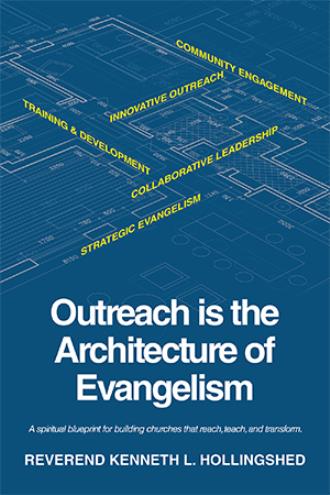
Outreach is the Architecture of Evangelism
A spiritual blueprint for building churches that reach, teach, and transform.
by
Book Cover & Preview Text
Preview: Chapter 2 – Repairing the Cracks of Evangelism Restores Spiritual Foundation "You can’t build a great building on a weak foundation. You must have a solid foundation if you’re going to have a strong superstructure." ~ Gordon B. Hinckley In Chapter One, I discussed my roots in Fort Valley, GA, and how my experience as a Boy Scout has shaped my worldview. In this chapter, I want to take it a step further, defining evangelism and reflecting on it as the cornerstone of our faith, carrying God’s message into the world—one person, one community, one story at a time. Throughout my 30-year journey as an Evangelism Director in both Texas and Georgia, I’ve often been asked, “What is evangelism?” I always welcome the question, because it allows me to share that evangelism is the act of proclaiming the Good News of Jesus Christ—His life, death, resurrection, and the salvation available through Him. Yet just as often, there’s a follow-up question: “But what does that mean for my church?” My answer is simple: evangelism is the outward expression of the Church’s inward transformation. When we truly encounter the Gospel, it brings hope, healing, and a sense of purpose that cannot be contained. As the prophet Jeremiah declared, “His word is in my heart like a fire, a fire shut up in my bones. I am weary of holding it in; indeed, I cannot” Jeremiah 20:9 NIV. Fire spreads. It ignites everything it comes into contact with. In the same way, the transformative power of the Gospel is meant to move through our words, our actions, and our witness. Cracks form, however, when evangelism is misunderstood or neglected. When evangelism loses its passion, it weakens the church’s core. And when the foundation is weak, the whole structure is in danger. A Crack on My First Day I was about twenty-seven years old when my bishop gave me a new assignment. I was young, energetic, and eager to shepherd God’s people. As I pulled up to the church on that first Sunday, I imagined the possibilities of ministry and the ways I might pour myself into this congregation. But before I could even step out of my car, an elderly gentleman stood waiting at the front of the church. His first words weren’t words of welcome—they were insults. “Oh, they sent a boy to do a man’s job,” he said sharply. “You’re too young to be here. I built this church. My mother and father helped lay its foundation.” I immediately decided to honor him, despite the sting of his words. I shook his hand, listened as he gave me a tour of the church, and noted his one disclaimer: “This table at the front belongs to me. My parents gave it, and it is not to be moved.” That morning during worship, I noticed the table was blocking the natural flow of the offertory procession. In a moment of youthful zeal for order and function, I asked the officers to move it. That decision lit a fire I was not prepared for. After service, the same gentleman stormed into my office, ninety-eight years old and furious. He grabbed me by the collar, slammed me against the wall, and shouted, “Boy, don’t you ever disobey me again!” As a military veteran, my reflexes kicked in. Startled, I quickly removed his hands from my collar. In that motion, he fell backward—not because I pushed him, but because his body gave way. He cried out that I had attacked him. Within moments, officers rushed in, helped him up, and assured me, “Pastor, we’re sorry this happened—this is your first day here!” I was stunned. I had heard threats before in ministry, but never had anyone put their hands on me. I sat there in shock, anger, and disbelief, asking myself, Lord, what kind of crack have I just stepped into? The next morning, my phone rang. It was him. To my surprise, his tone was different—softer, apologetic. “Come to my house,” he said. “We need to talk.” I went cautiously. On his front porch, he looked me in the eye and said, “I was wrong. I’ll never put my hands on you again. You’re the first pastor who ever stood up to me. You were the first to make it clear that you were going to lead this church, no matter what I said. And for that, I respect you. I think you’re the best thing that has ever happened to this church.” From that day forward, he became my strongest supporter, encouraging others to follow my leadership. That experience taught me something I have carried ever since: that cracks in the foundation of a congregation are not always in the walls or the finances, but rather in relationships. Sometimes those cracks show up as generational divides, power struggles, or unspoken history between members. As a young pastor, I learned the importance of addressing those cracks early, prayerfully, and with courage. Evangelism that is left unattended widens into fractures that can destabilize an entire church. But when handled with grace and reconciliation, even the deepest cracks can be repaired, restoring the foundation of trust and respect. The Call Back to Evangelism At its heart, evangelism is about sharing the Good News of Jesus Christ in ways that bring life, dignity, and hope to all people. The word evangelism comes from the Greek euangelion, meaning “good news” or “gospel.” But it is not just about words—it’s about being a witness. Evangelism in the Black Church is especially powerful because it is woven into our history of resilience, justice, and hope. From slavery experience through the Civil Rights Movement to today, the Black Church has been a beacon of hope, preaching the Gospel and living it through advocacy, service, and solidarity with the marginalized. When evangelism cracks, the church loses its fire. But when evangelism is strong, the church becomes a beacon of hope, both spiritually and socially. Just as a building with a repaired foundation can stand tall for generations, a church with restored evangelism can impact lives for eternity. Cracks are inevitable, but a building that collapses is not. Evangelism repairs what’s broken, restores what’s lost, and rebuilds what has shifted. If we are to be the Church that reflects the heart of Jesus, then our evangelism must speak not only to the soul but also to the struggles of our community. That is the foundation on which everything else must stand.
Formats

Book Details
About the Book
Outreach is the Architecture of Evangelism: A Spiritual Blueprint for Building Churches that Reach, Teach, and Transform What if building a thriving church is less about managing programs and more about constructing a living, Spirit-filled structure? In this groundbreaking book, Rev. Kenneth L. Hollingshed draws on more than forty years of pastoral leadership and his background in architectural design to present a fresh vision of evangelism as the structural framework and heartbeat of the Church. Through the metaphor of architecture, each chapter explores a vital element in God’s design—from the Blueprint of Scripture and the Foundation of Evangelism to the Framework of Collaborative Ministry, the Windows of Authentic Relationships, and the Roof of Radical Love and Justice. Weaving biblical insight, personal testimony, and practical ministry strategy, Rev. Hollingshed shows that evangelism is not just a program or seasonal emphasis, but the heartbeat that invigorates the entire Body of Christ. Readers encounter lessons drawn from rural, urban, and suburban congregations; cross-cultural mission work; and real challenges such as declining membership, gentrification, leadership fatigue, and financial strain. In every case, evangelism emerges not as an add-on, but as the means by which the Church remains alive, relevant, and faithful to its calling. Both personal and practical, Outreach Is the Architecture of Evangelism equips pastors, lay leaders, and congregations to rebuild with purpose, dedication, and hope. It is an invitation to reimagine the Church not simply as a building that stands, but as a living structure—inhabited by the Spirit, sustained by mission, and sent into the world to reach, teach, and transform lives for Christ.
About the Author
Reverend Kenneth L. Hollingshed has faithfully served the Christian Methodist Episcopal (CME) Church in two primary capacities: as a senior pastor for more than forty years and as Director of Evangelism at the local, regional, and state levels within the Eighth Episcopal District for more than thirty years. In his role as Director of Evangelism, he serves as a facilitator and trainer for both clergy and lay leaders, equipping them with practical tools and spiritual guidance to strengthen discipleship and expand the church’s reach. He is a servant leader, evangelist, disciple, and visionary who has committed his life and ministry to sharing the Gospel of Jesus Christ and transforming lives. His ministry is deeply rooted in the conviction that evangelism is the heartbeat of the church, and his leadership emphasizes Strategic Evangelism, Innovative Out-reach, Collaborative Leadership, Training and Development, and Community Engagement. A native of Fort Valley, Georgia, Reverend Hollingshed was nurtured by a strong faith community that instilled in him the values of leadership, service, and evangelism. Over the years, he has pastored many congregations in both inner-city and rural communities, always with a heart for evangelism, outreach, and discipleship. He is currently a candidate for General Secretary of Evangelism and Missions in the CME Church, seeking to empower both national and international congregations to reclaim their evangelistic mandate and impact communities worldwide. Reverend Hollingshed is a graduate of the United States Army Chaplain Center and School. He holds two bachelor’s degrees: one in theology and the other in architectural engineering, and two master’s degrees: one in business organization and another in design planning. Beyond the pulpit, he is a devoted husband, father, and mentor. Reverend Hollingshed has been married to Reverend Tanesha K. Hollingshed for twenty-six years, and they have two adult sons, Khaylen and Kingston.