
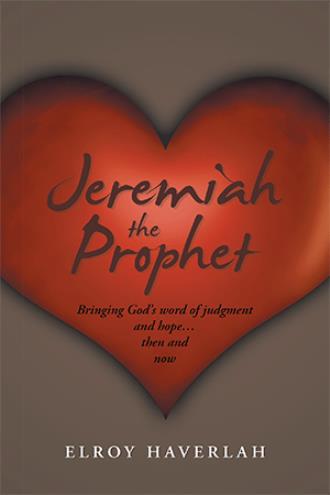
Jeremiah the Prophet
Bringing God’s word of judgment and hope…then and now
by
Book Cover & Preview Text
Boom! The optimism and hopes that were abundant in the summer of 588 B.C.E. vanished as the dreaded siege of Jerusalem resumed a few weeks after the Babylonians defeated the Egyptians. Boom! Like powerful thunderclaps, the enemy’s battering ram sent chills up the spine of every citizen as the relentless pounding against the city walls commenced. Boom! “Don’t worry,” mothers told their frightened children. “That ram will soon break into pieces. It’s no match for our mighty walls.” Boom! Rationing of food began. “We must settle in for what could be a long siege,” people were told. “Conserve firewood. Conserve water. Conserve everything.” Boom! Some frightened souls were already willing to surrender—as Jeremiah insisted. Anyone who was willing to stop and listen heard the prophet speaking as they walked past his place of confinement. Thus says the Lord: Behold, I set before you the way of life and the way of death. He who stays in this city shall die by the sword, by famine, and by pestilence; but he who goes out and surrenders to the Chaldeans [Babylonians] who are besieging you shall live. [Jer. 21:8-9] When some of the king’s officers and princes heard how Jeremiah was speaking to the people about surrendering, they met together and discussed what to do with this troublesome prophet. One of the princes named Malkiah spoke first. “You’ve all heard the treasonous words this man is spreading. I say he deserves death!” Others joined in. “That’s right. He’s telling people we should surrender to the enemy when we should be standing up to the enemy.” “He’s going against the wishes of King Zedekiah.” “He’s hurting the morale of our troops.” “If we don’t do something to stop him, he’ll cause the people to riot. Our nation needs to be united.” “It’s time for action, not words. Let’s do something, and I mean now!” “Shall we whisk him away secretly, or shall we go to the king and demand his execution?” After considerable discussion the mob decided to appeal to the king, but what should they recommend? “I say we should stone Jeremiah publicly.” “Let’s push him off the edge of a cliff or from the top of the temple.” “We should cut off his head, or saw him in two.” “No. All those things might stir up pity for him and result in him becoming a martyr.” “I know,” said Malkiah. “I have a pit where he could be left to die out of sight. But let’s talk to the king and see what he decides.” So the princes went to King Zedekiah and demanded that Jeremiah be executed because of his treasonous talk. Zedekiah gave in and handed Jeremiah over into their hands to do with as they craved. No one else was aware of this decision except for the servants who overheard the discussion from behind closed doors. The princes wasted no time. They found Jeremiah in the court of the guard and dragged him to a nearby pit. It resembled a shallow well with no standing water, but at the bottom was a thick layer of mud and muck. People would sometimes throw trash and even dead animals into the pit. The walls were steep and slippery. There was no possibility of escape. It was into this death pit that the princes lowered Jeremiah and left him there to die. The following day Zedekiah was seated at the Benjamin Gate to hear complaints and adjudicate cases brought to him. This gave opportunity for one of the palace servants to approach the king, which he was not so bold to do in the royal palace. When it came time for the servant’s turn to speak, his words were barely discernable. “My lord,” he said, “my name is Ebed-melek, your servant from Ethiopia.” “Oh, yes,” the king said, “the eunuch.” Ebed-melek closed his eyes and nodded. “Yes. That is correct.” “What is it you have to say?” He was about to lose his nerve and run off, but the thought of Jeremiah lying in the pit renewed his determination. “My lord, the prophet Jeremiah has been cast in the cistern in the court of the guard. He will surely die there if no one is allowed to help him. He has harmed no one.” “Very well. I command you to rescue the prophet and bring him to me where I may speak to him in private.” Ebed-melek thanked the king and took three men with him to the pit where Jeremiah lay in the mud and foul air. He was still alive when they found him. They threw down a rope and some old clothes for padding. They called down to him and told him to put the rope around his arms so they could pull him out. Then they pulled and pulled, finally able to lift him out of the pit and lay him on the ground, giving him some water and cleaning him so that he would be presentable when brought to the king. After a few minutes Jeremiah looked up at Ebed-melek and thanked him for saving his life. “No one deserves to be treated that way,” the servant said. Jeremiah figured that this man had experienced ill treatment himself and had the courage to intervene on Jeremiah’s behalf. His example steeled Jeremiah and restored his confidence to face the king. Ebed-melek finished cleaning Jeremiah and assisted him as he walked to the palace. Zedekiah was waiting. “I want to ask you a question,” the king said to Jeremiah. “Don’t hide anything from me.” “If you don’t like what I have to say, will you have me executed?” “I swear to you that I will not have you executed, and I will not hand you over into the hands of those who want to kill you. I simply want to know God’s plans for me and our nation.”
Formats

Book Details
About the Book
Have you ever tried to plow through all 52 chapters of the Old Testament book of Jeremiah and then became discouraged because of all the unfamiliar names and the disorganized fashion in which the book is assembled? If so, then “Jeremiah the Prophet” can help. is book untangles the complex accounts and presents the life of this greatest of prophets in chronological order as far as possible, from his childhood to his nal years in exile. What were the living conditions in Judah during the sixth century B.C.E., plunging it to its nal destruction? In this book we discover the daily routines of life in the city of Jerusalem, including the intrigues involving kings and priests. We learn of Jeremiah’s prophetic compulsion to judge the nation he loved and the resulting depression and violence he su ered. We hear about the rise and fall of neighboring world powers, such as Assyria, Babylonia, and Egypt, and their e ect on the tiny nation of Judah. We observe how Jeremiah stood up to the rulers of these countries, including his own kings and priests who broke God covenant. Most importantly, we discover God’s role in these events. Why was God’s judgment against Judah so severe, and what was their o ense? is book is not a history lesson. It is a message for our world today which desperately needs to hear God’s warning and God’s word of hope.
About the Author
Elroy Haverlah, an ordained minister since 1973, received his B.A. from Texas Lutheran College, majoring in eology, and his M.Div. from Luther Seminary in St. Paul, Minnesota. He served as pastor of four congregations across Texas and others since retirement. He currently enjoys writing historical ction novels.