
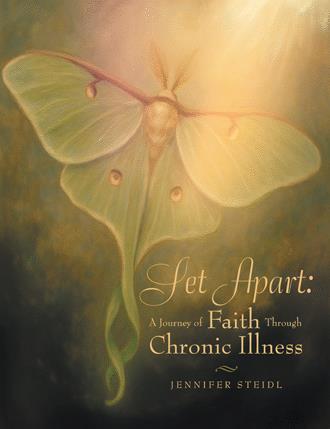
Set Apart: A Journey of Faith Through Chronic Illness
by
Book Cover & Preview Text
Chapter 2: The Identity Stripped Away
Opening Reflection
One of the hardest aspects of a long-term invisible illness is the slow, silent erosion of self — of who you used to be.
Chronic illness doesn't just affect the body — it reaches deeper. It pulls at the threads of your identity, slowly unraveling the tapestry of who you once believed yourself to be. Piece by piece, hope by hope, it begins to take.
You don't always notice it happening right away. For me, it crept in gradually. I managed my symptoms. I still tried to live normally. I still tried to fight. But inevitably, it was a little less energy, a little less motivation. Then fewer plans, fewer conversations, fewer reasons to try. The days blurred. The things you once did effortlessly became exhausting. The things that used to bring you joy felt out of reach — not just physically, but emotionally. Even thinking hurt.
You don't realize that who you are is changing — that illness is morphing you into a different human being, whether you mean it to or not.
I remember when I stopped really looking in the mirror — not quite literally, but at some point, I had stopped seeing. So it was a shock when one day I actually did see — and I didn't recognize myself. Gone was the girl from photos just a few years ago — and not just physically. That girl had things she enjoyed doing... people she wanted to spend time with... she had an inner passion for the things she loved, and so many hopes and dreams. I missed my personality. It was hard to recall who I was. I remember thinking that I would need to rediscover myself — and see what emerged, if and when the chrysalis of illness fell away.
There's a kind of grief in that — not just for what you can't do, but for who you no longer feel like you are. I remember the desperation to explain — to explain my weight gain, to explain my ineptitude in conversations and behavior. You want to be understood. You want others to see your pain — not for pity or empathy, but because something inside you is desperately crying, "You don't understand! This isn't who I am!" That part of you — the identity of intention and desire, and everything that makes you you — feels cocooned and hidden. And all you want is to take it back, to have others know that the person they see in this moment is not who you truly are.
Those parts of us — so interwoven with our sense of self — begin to fade, or fall away completely.
And suddenly, we're left asking questions we never thought we'd need to ask:
Who am I... if I'm not who I was?
What's left... when so much has been stripped away?
It's terrifying — and not many people talk about it.
The Struggle Unveiled
When illness becomes chronic, it doesn't just steal function — it distorts identity. You're not just tired, you feel lazy. You're not just in pain, you feel weak. You're not just isolated, you feel forgotten. Over time, the struggle stops being something you have and starts to feel like something you are.
That's where the real shift happens.
Because when you start confusing what you're experiencing with who you are, everything changes. You begin to see yourself through a lens of loss. Through limitation. Through shame. And once that becomes your filter, it's hard to remember what was true before the suffering began.
There were seasons I didn't feel like myself at all — not just physically, but emotionally... even spiritually. I questioned my worth, my place, my purpose. I knew I belonged to God, but I didn't always feel like I had anything valuable left to offer. I felt like the best parts of me were buried under fatigue and fog and a body I couldn't fix.
There were also years — whole stretches of life — that felt like living as a drone. Mindless activity. One foot in front of the other. Just getting by. The long-term dreams faded, and I stopped thinking about tomorrow. My world shrank to the task right in front of me, mustering only enough energy to survive the day. It was pure survival mode — one day bleeding into the next until, without realizing it, years had gone by. And in that slow blur, I could feel pieces of myself slipping away.
Looking back, I realize that drone mentality — that survival mode — was, beyond the physical fatigue and brain fog, in a way, the mind's protection against the pain of loss. If you stay numb, you don't notice the months and years passing. Sometimes my life felt like long seasons of numbing out, only to occasionally lift my head above water and try to feel again. But when I did, the pain was so raw and intense it was almost unbearable. So I'd put my head back down and retreat into the numbness — because sometimes that felt easier than feeling everything at once.
It's hard to feel valuable when you can't contribute.
It's hard to feel whole when your mind is scattered and your body unreliable.
It's hard to feel known when the illness is invisible — when people look at you and say, "You look fine," while inside you feel like you're slowly dying.
And when that happens — when the way you see yourself begins to dim — it becomes harder and harder to hope for healing, or even to pray for it with any real conviction. Because deep down, you're not sure there's enough of you left to restore.
And worst of all, the enemy speaks into this vulnerable space:
"You're not who you used to be. You're not useful. You're too broken to be loved. You're a burden. You've lost your worth."
This is where the lines between the spiritual and the physical blur, and it's hard to tell where illness ends and warfare begins. But even if you cannot define those lines, you can still hold onto truth.
Formats

Book Details
About the Book
Set Apart: A Journey of Faith Through Chronic Illness is written for the unseen ones — those who suffer quietly, carry invisible pain, and wonder if God still sees them.
Through honest reflections of faith and hope, the author invites readers into the sacred space of suffering — where silence feels heavy, hope feels fragile, and identity is stripped away. This perspective does not come from a distance, but from lived experience: the author has endured years of debilitating Lyme disease, wrestling with loss, isolation, and the relentless weight of illness.
Yet even in that darkness, a deeper truth was uncovered: that God meets us in weakness, and His presence is not diminished by our pain.
This book is about sustaining grace in the valley — a voice that says, you are not forgotten. With raw honesty and gentle encouragement,the author shares what it means to struggle and still discover God’s purpose, His love, and His sustaining grace.
For those living with chronic illness, or walking beside someone who is, Set Apart offers more than survival. It offers solidarity. It offers faith. It offers the unshakable hope that beauty can rise from ashes, joy can be found in sorrow, and the longest nights still end with light.
About the Author
The author has lived with chronic Lyme disease for many years, shaping a journey of faith through suffering. With honesty and compassion, she write’s to encourage others facing unseen illness, offering solidarity, resilience, and hope rooted in God’s presence.