
Genesis Modeled
The Catastrophic Case for a Young Earth
by
Book Cover & Preview Text
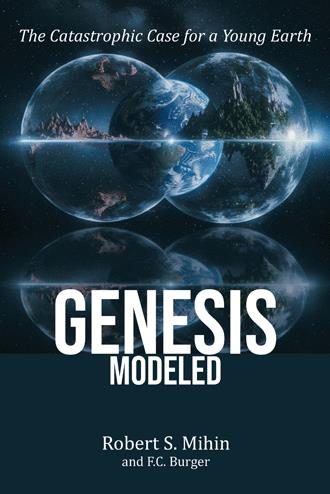
In the book of Genesis, it is recorded that God destroyed the Earth and that a global flood covered the entire planet. Did this happen as described? Is it simply an allegory or a myth? And, if it happened, when was it? Based on a literal interpretation of Genesis genealogies, the Flood occurred roughly 4,500 years ago and, according to the Bible, Earth itself is not much older.
Yet modern science insists that Earth is more than four billion years old. Can the Biblical timeline and science be reconciled? Can a person be intellectually rigorous and still believe in the Biblical accounts of Creation and the Flood? Is there a single correct explanation? And why, ultimately, does any of it matter?
This study proposes that it does matter and that there is one correct explanation.
In seeking to reconcile science, the Bible, and faith, I returned to something I had studied in college—modern physics, and more specifically, the power of scientific models. Famous theoretical physicists, such as Albert Einstein, Stephen Hawking, and Leonard Susskind, have emphasized that good models are how we can unlock truth. Models must follow strict rules that explain observations with elegance, consistency, and predictive power. That insight became my “Aha” moment.
What if I could apply the same scientific modeling rigor to Earth’s geological history? Could our current geological model be tested and confirmed or refuted using the very principles that uphold modern science? Yes, it can. This has been my journey for the last decade. This study uses the rules of scientific modeling to evaluate the accepted 4.5-billion-year-old Earth.
We will first study the current geological model, its origins, and its characteristics. We will then learn about scientific modeling, how to construct a model, and how to apply the principles to test if it is a good or unviable model.
Then we will survey the remnant physical evidence as collected and verified over the past centuries. We will then evaluate this evidence using the rules of modeling.
Finally, we will do a deep dive into the Young Earth Model. We will also examine the emotional and human factors that go into accepting or rejecting a new hypothesis.
One of the powerful tools guiding this entire study comes from physicist Richard Feynman. His famous learning technique, paraphrased here, says: if you believe you understand a concept, you should be able to explain it in plain language as if teaching a bright twelve-year-old. If you can’t explain it plainly, without convoluted jargon, you don’t truly understand it. I’ve applied this principle while reading scripture, at work, and while listening and discerning others who profess to teach.
That principle forced me to strip this study of complexity, expose knowledge gaps, weak assumptions, and favor straightforward explanations throughout. It’s the same rigor that drives good modeling—clarity over confusion.
Why am I so invested in this? Well, along the way, something happened. I grew up, got married, had children, and then grandchildren. And their questions made demands on me. Why is the sky blue? Did dinosaurs really exist? What does God look like? How best to answer this?
Many of us grow up in a world where God and His Word are often treated as myth or legend, rather than as truth. Today, many scientists reject the idea of a creator, preferring natural causes to explain the cosmos, the Earth, and even human life. But, interestingly, a growing number of scientists are returning to belief in God, because they see an unmistakable elegance in nature.
A bit of science distances one from God, but much science nears one to Him. The more I study nature, the more I stand amazed at the work of the Creator.—Louis Pasteur (French chemist, pharmacist, and microbiologist, 1822–1895)
Pasteur, famed for his discoveries in pasteurization and vaccines, understood this fault, and so do many others today. God is not at odds with science. In fact, science, when rightly understood, affirms His Word.
I invite you to come along on this journey as this study of Earth’s history is presented to a hypothetical classroom over a long weekend. You are a key part of this audience, and like those students, I encourage you to write down your questions. I hope to answer them.
This study ultimately shows that when a key geological assumption is revised, a young-Earth model emerges naturally. The creation and global flood account in Genesis are not just poetic narratives; they are real historical events, and they are now affirmed by science.
Walk this path with me, from science to faith. Together, we’ll evaluate what we've long been taught and explore what the evidence truly shows. Your faith, I believe, will be rewarded.
Formats

Book Details
About the Book
Genesis Modeled: The Catastrophic Case for a Young Earth invites exploration of Earth’s ancient narrative through the framework of scientific modeling. Physicists use modeling as a scientific tool to validate a theory. Scientific models aren’t swayed by reputation or worldview; instead, they adhere to strict, impartial standards that bypass entrenched doctrines and challenge deeply rooted convictions. Renowned physicist Stephen Hawking championed a model-dependent view of reality, urging us to favor testable frameworks over sensory perceptions or historical norms. If a model withstands scrutiny, we must embrace it, regardless of our prior suppositions. The establishment of the Standard Model of Physics highlights this principle. Drawing from this insight, author Robert Mihin tests two competing models: the prevailing 4.5-billion-year paradigm, rooted in gradual processes and radiometric timelines, and the Catastrophic and Abrupt model—often termed the Genesis Model. And the outcome is clear: the Genesis Model prevails, while the traditional framework collapses under a wave of internal inconsistencies. In its pursuit of truth, academia has inadvertently undermined its own foundational narrative. This book transcends mere rhetoric and mass acceptance; it’s a call to let modeling principles rigorously interrogate the scientific worldview we’ve long accepted. Deeply ingrained views are stubbornly held—it’s often said that “Science advances one funeral at a time.” But applying the Hawking method to the science of creation can help us overcome our stubbornness and deepen our understanding of creation. We can now scientifically verify the timeless truths in Genesis.
About the Author
Robert Mihin has spent the last decade researching the latest developments in earth sciences. He is focused on blending his background in physics and chemistry with natural history to reveal how superior science affirms the creation and flood accounts in the Bible. The discipline of scientific modeling unlocks this truth.