
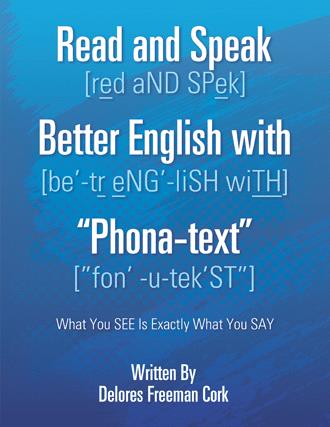
Read and Speak Better English with “Phona-text”
What You SEE Is Exactly What You SAY
by
Book Cover & Preview Text
As we have said before, reciting the alphabet perfectly does NOT guarantee that readers will know all the SOUNDS they will need for reading. However, learning the alphabet IS important for several reasons: (1) We will always have to SPELL with alphabet letters. (2) ORDER is part of our culture. We have many occasions to put things into alphabetical (A, B, C) order. We look things up in reference books because someone else put that list into alphabetical order. (3) VOWELS and CONSONANTS come from the alphabet. The “vowels” are letters “a,” “e,” “i,” “o,” “u,” and sometimes “y.” The “consonants” include any letter that is NOT a “vowel: (b, c, d, f, g, h, j, k, l, m, n, p, q, r, s, w, v, w, x, y, and z). In “Phona-text,” letter “y” is considered a “consonant” because when “y” is a vowel, it is heard as long “i” [ i ] (as in the word “shy” [SHi] or long “e” [e] (found at the end of the word “happy” [ha’-pe].) Even the sound of the much-used little words that we call “articles” (“a,” “an,” and “the”) are determined by whether a vowel or consonant SOUND follows them. If the very next word after an article starts with a “vowel SOUND,” we will use “an” or the pronunciation of “the” [THe] before those words. For example, we would say “an apple” or “the [THe] apple.” But if the next word starts with a consonant SOUND we would say “a [u] ball” and the [THu] ball.” It is not determined by the LETTER, but by the consonant or vowel SOUND. Because the “h” is silent in the word “hour,” we would not say “the [THu] hour,” we would correctly say “the [THe] hour [ao’-wr] was noon, so the [THu] hands on the [THu] clock [KLok] are both on 12. Friends are coming in “an” hour.” The terminology “long vowel” means that it sounds the SAME way that you hear it when reciting the alphabet. Beyond that, each vowel produces many different sounds that you heard while talking about the pictures that demonstrated the Key Words of the previous story “Saturday Outside.” Here are some of the Key Words that can be heard with various vowel sounds or used as “silent letters”: A/a: day, apple, eat, head, bat, ball, hair, hear, card, mailbox, grapes, yard, what, snake, zigzag, measure, and practice. E/e: eat, get, head, legs, measure, she, ten, ice, apple, number, grapes, snake, shoes, and practice. I/i: ice, into, coil, bird, hair, right, mailbox, high, pick, fish, this, swing, voices, child, zigzag, kick, quick, and practice. O/o: O.K., not, noon, into, book, coil, out, door, mailbox, dog, throw, voices, windows, shoes, and box. U/u: up, out, number, jump, measure, and quick. Plus, the [u] sound can take the place of ALL vowels in unstressed vowel situations. In reciting the alphabet, just to say a letter’s name, we hear different vowel sounds: We hear long [a] to pronounce letters A, H, J, and K. We hear long [e] to pronounce letters B, C, D, E, G, P, T, and Z. We hear long [i] to pronounce letters I and Y. We hear long [o] to pronounce letter O. We hear long [u] to pronounce letters U and W. We hear short [e] to pronounce letters F, L, S, and X. We hear short [i] to pronounce letters M and N. We hear short [o] to pronounce letter R. Remember: the “long” vowel sounds are the same as you hear when reciting the alphabet. The alphabet letters are for SPELLING while the “Phona-text” symbols are for “SOUNDING-OUT” words while you read. Let’s review the chart of the “Phona-text” symbols with the story’s Key Words now: “Phona-text” Sound Symbols (with Key Words from the story and grouped to sing to the tune of “Ten Indians”) _______________________________________________________________________________ Group 1: Long Vowels (underlined) a e i o u day eat ice O.K. noon Group 2: Short Vowels (no extra marks) a e i o u apple head into not up Group 3: Vowel Pairs ,AW, ,UU, oe and ao ball book coil out Group 4: “r” Combos r ar ir or or bird hair hear card door Group 5: Bumps r n m and h right number mailbox high Group 6: Sticks & Circles l b d and p legs bat and ball dog sitting watching pick Group 7: Cross Bars t f TH and TH ten fish throw this Group 8: Tails & Blends j g GR and NG jump get grapes swing Group 9: Points v w y and HW voices windows yard what Group 10: Curves and Zigzags CH s SH z ZH child snake she / shoes zigzag measure Group 11 “k” Cousins k x=KS q=KW and c=k/s kick box quick practice Vowels Also Help Us to Read by Syllables A “syllable” is a single uninterrupted sound that forms one piece of a word. Thanks to syllables, we do not have to fear long words. It might sound trite, but you can only eat an elephant “bite by bite.” In whole words, each one of those smaller “bites” is called a “syllable.” Syllables help us to treat long words like a group of short words sitting side-by-side. Use a pencil with a clean eraser to put a dot under each vowel that appears alone between two consonants in the regular spelling of a word. (Syllables ten and eleven of the sample word prove that there are exceptions to every rule because both “I” and “a” are separate syllables.) We also put only one dot under each cluster of two or three vowels that are sitting side-by-side (such as the “-iou” before the last letter “s”) in the sample word that we are about to use. After you put dots under the vowels of the following fun word from the Mary Poppins musical, let the “Phona-text” symbols help you to read this very long word by syllables. We have put hyphens between syllables to make it easier to read. supercalifragilisticexpialidocious [su’-pr-ka-lu-FRa’-ju-lis-tik-eKS’-pe-a- lu-do-SHus] (and it means “extraordinary.”)
Formats

Book Details
About the Book
Families suff er when the breadwinner cannot read well enough to work a job that fully supports his or her family or to absorb the lessons within the scriptures to develop a relationship with God. It aff ects their health, marriage, and self-esteem, and diminishes the respect they deserve from their family and community. In short, low reading scores rob people of living to their full potential. In a how-to guide for those struggling with the English language and its multiple sounds for each letter plus an abundance of silent letters, seasoned educator Delores Freeman Cork teaches the sounds of words by superimposing symbols onto colorful pictures of key words found in a short story about items in nature. Additionally, she teaches number words and shows items that can be counted, the Dolch words that are in seventy-fi ve percent of everything we read, and many of the consonant blends, vowel pairs, homophones, irregular verbs, and pronouns as well as comprehension methods. Included are fi fty much-loved Bible passages (plus books of the Bible) that help readers better absorb and understand scripture. Read and Speak Better English with “Phona-text” is a practical guide for those who want to improve their reading and speaking skills with dependable language.
About the Author
Delores Freeman Cork grew up in Birmingham, but has lived in Montgomery, Alabama, for most of her life. She was already a literacy volunteer when she earned a BA at Judson College and a Master of Arts in Teaching (MAT) from Troy University. Cork has used “phona-text” as a tool for teaching G.E.D., reading, ESL, and college English for students from at least seventy-fi ve countries. This is her eleventh book.