
My Journey
South Africa to North America
by
Book Cover & Preview Text
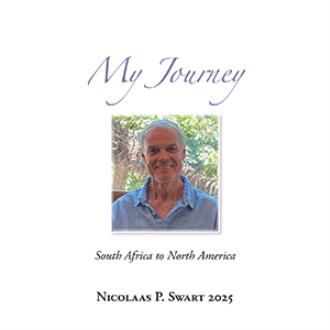
The author, Nicolaas Philippus Swart, was born in Worcester South Africa, a town about 70 miles northeast of Cape Town. Growing up with his older brother and sister he never thought that his life journey would take him from South Africa to Canada and ultimately to the USA where he would eventually retire.
The story starts with connecting his history with his ancestors from the Netherlands of which the first Swart came to South Africa in 1691 as an employee of the Dutch East India Company. The Cape as it was known in those days, along the southern tip of Africa, was used by the company as a refreshment post to provide ships with fresh produce on their trade route between the Netherlands and the Far East. The first Swart worked as a “Comforter of the Ill”. As with all company employees stationed at the Cape, he was given a house in Stellenbosch, 30 miles from Cape Town, by the then Dutch Governor of the Cape, Simon Van Der Stel. The house, now a national monument, still stands today and serves as a restaurant for the Stellenbosch Hotel later built behind it.
The author spent his first 14 years in Worcester after which he moved with his parents to George when his dad retired. The years that followed included high school education, military service and studying at the University of Pretoria eventually to become a Civil Engineer. This is also where he met his wife, Adre. Shortly after, they moved back to Cape Town where both worked in the professional engineering field and where they started their family. The author captured many stories and experiences of his years growing up and family memories with their three children, Nico, Marli and Alida.
It was during the early nineties that South Africa went through political changes and the economic future of the country started to look uncertain. The author describes some of the political conflicts that played out in the streets of Cape Town between the different cultural groups. Many young families started to look for work prospects abroad and he reached out to the Canadian Embassy for potential opportunities. One decision led to the next and in early 1994 they were confronted with the final decision whether to emigrate to Canada.
In early September of 1994 he and his family arrived in Vancouver, Canada and started a new beginning far from home. The author tells the stories of the adjustments for him and his wife to a new work environment. They started to attend the Dutch Reformed Church and he describes the exceptional hospitality of the church members welcoming them in their new country. Many of the seniors in their congregation could still speak Dutch which provided a connection to their Afrikaans heritage. For the children it was more challenging, they had to adjust to the new school environment and also a new language. While South Africa has a dual medium education system, English and Afrikaans which is close to Dutch, the kids were very young when they took on this move and their exposure to English had been somewhat limited at the time. Their experience of this language shock is part of the Canadian stories in the book.
Towards the end of 1997 another career opportunity opened up. A friend from the University of Pretoria, now also working in Phoenix, Arizona notified the author of a position which became available in the Traffic Engineering Department of Maricopa County. Again, one decision led to the next and in early 1998 he and his family moved to Phoenix. Another cultural adjustment lay ahead.
The author describes his and his family’s experiences in Phoenix between 1998 and 2025 and how he and his wife both progressed in their careers. He became the Division Manager for the Transportation Systems Management Division at Maricopa County, a position that he held until his retirement in 2021. His wife started her own consulting firm and became known for her expertise in major airport expansion projects.
The stories during their time in Phoenix include some funny experiences such as their first visit to Las Vegas where their vehicle got stuck in the parking garage, their unintended crossing of the border into Mexico and their return back into the US. They also had the opportunity of visiting South Africa every few years and taking their kids’ spouses exposing them to the country.
There was also the sad side to their time in Phoenix. His wife was diagnosed with cancer in 2005. After treatment she was in remission until 2013. Ultimately cancer took her life soon after her 60th birthday in 2015. She only knew four of the nine grandkids and the author includes memories in the book that tell of her love and care for her children and grandkids.
Early 2021 Nicolaas remarried. His second wife, Cato, is also originally from South Africa and she moved to the USA early 1991. They met through South African connections in Phoenix and they happen to share the same language and customs. The book will tell the story of the ancestral connection between her and his late wife which was only discovered when they started dating. There was an artistic linage which connected them to their shared great-grandparents.
It was on a cruise of the Mediterranean in 2024 when they visited the island of Crete and they observed the Cretan way of life. This experience inspired his thoughts on freedom and how American culture, while originated from the same Europe as the author’s ancestors, turned out to be so different. These thoughts are captured in the last segments of the book.
Formats

Book Details
About the Book
The book tells the story of the author’s experiences growing up in South Africa as a child and later as a family with his wife and young children. It gives insight into the decision to leave South Africa and move to North America. The book also connects his story with his ancestors and the first Swart who went from the Netherlands to South Africa in 1691 as an employee of the Dutch East India Company. His journey in South Africa and from there to North America covers many stories and experiences. While the stories are mainly on the lighter side, there are also the more serious and sad moments. He lost his wife in 2015. In 2017 he met Cato, also originally from South Africa, who he married in 2021. The book gives the reader some insight into the unexpected challenges that come with moving a family halfway around the world. Some of these experiences are told through the eyes of their kids. The book concludes with a few observations on the differences in culture between North America and his country of origin given his ancestors are from the same Europe.
About the Author
The author was born, and grew up in South Africa. He graduated in Civil Engineering and worked for a consulting firm in Cape Town between 1982 and 1994. It was during the political changes in South Africa in the early nineties, that he and his wife, who was a cost engineer, decided to explore work opportunities abroad. Towards the end of 1994 he and his family moved to Vancouver, Canada where both he and his wife worked in the engineering profession. With an opportunity that came about in 1998 in the USA, the family moved again and settled in Phoenix, Arizona where he retired in 2021.