
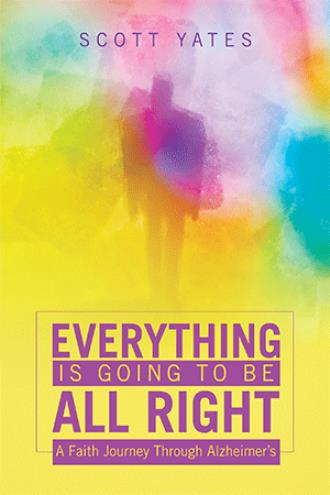
Everything Is Going to Be All Right
A Faith Journey Through Alzheimer’s
by
Book Cover & Preview Text
Introduction: Why this book? “I Believe. Help My Unbelief.” Listening to Christian music in her room in the nursing home, I turned to my wife, “Isn’t it going to be amazing when we see Jesus face-to-face?” She smiled, leaned forward to look directly into my eyes. She told me, “Everything is going to be all right.” Crystal clear. In a season when almost all words are garbled and incoherent, Nell assured me. She comforted me with confident contentment, followed by a smile and laughter. Jesus assured us both with peace in the depths of our souls. “Praise God,” I said. We both smiled and laughed. “We know everything will be all right. We follow Jesus.” Nell is in the last stages of Alzheimer’s. Only faith can carry us on this caregiver’s journey through terrible storms of sorrow and loss. Caring for someone with a devastating disease called “the long goodbye” leads us to seek God’s strength for peace and comfort. We see blessings, many times in hindsight, as we learn to live in constant gratitude and trust for tomorrow. Roaring thunder of worry will rattle our bones. Billowing waves of sorrow will suffocate our souls, relentlessly crashing over us many times each day. Times will come when we are drained, poured out as an offering. Reaching the end of our strength, we are led to plead for supernatural strength. Strength beyond understanding as we watch mind and memory slowly erode year by year, month by month, day by day, and hour by hour. We will thirst, wither in shadows of loss as we become a stranger to our wife who can no longer talk. Our Lord told us that we will have trouble and trials in this sin-cursed world. We will grumble and groan under the burden of being a caregiver. We will be blinded by determination founded on our love. We will believe all burdens are ours alone. God understands. He knows our hearts. Moses shared many marvelous, inspiring prayers as he led God’s people through the wilderness in the Exodus from Egypt. As caregivers, we are lost in the wilderness of Alzheimer’s. We know the frustration deep in our bones that Moses battled as he spoke what is perhaps the most selfish prayer in scripture. Even as a man of great faith, God understood his human frailties and struggles. God provided and blessed Moses, and the people he was caring for. Moses said to the LORD, “Why have you dealt ill with your servant? And why have I not found favor in your sight, that you lay the burden of all this people on me? Did I conceive all this people? Did I give them birth, that you should say to me, ‘Carry them in your bosom, as a nurse carries a nursing child,’ to the land that you swore to give their fathers? Where am I to get meat to give to all this people? For they weep before me and say, ‘Give us meat, that we may eat.’ I am not able to carry all this people alone; the burden is too heavy for me. (Numbers 11:11-14) Moses was exasperated and drained, and the exodus from Egypt in the wilderness had only just begun. He learned, and continued to relearn, to trust God. He was taught again to trust the creator of all to provide and guide his steps. Our own best efforts as caregivers will eventually fall short until we draw upon Christ living within us. Until we realize strength to persevere is only through Him. Moses knew God was with him and the nation of those he was leading. Moses just witnessed the miracles through the plagues in Egypt and God’s rescue of his people. He led the people to follow God’s commands and live through the Passover by painting blood from slain lamb on the doorpost. By the power of God, he parted the Red Sea so the people could walk through before the army of Egypt was destroyed. Even great men of faith have times of weakness and frustration. Moses was feeling sorry for himself with burdens that were humanly impossible to carry. Moses was merely human trying to serve God’s will, easily discouraged by what appeared to be an impossible task commanded by God, ready to give up. Yet, in his weakness, God used him to accomplish his will. Even with his shuddering, broken prayer of weakness and despair, Moses learns yet again to rely on God. Seeking spiritual support through Jesus is the foundation. The cornerstone of caregiving. Arranging physical support is also crucial. Some friends, and even family, will fade. Many fade simply because they don’t know what to do to help and justify choices because life is too busy for them to ask. Friends who draw closer out of love and compassion continue to ask. A caregiver agency provided someone to stay with Nell at home in four-hour blocks of time. A concierge doctor was available for questions and guidance any time. A pharmacy that delivers helped with medication. All were partners in the solution that God provided in the wilderness to help us. In hindsight, I wish I had called hospice earlier to help while we remained at home. Slogging nimbly from task to task, hundreds and thousands of times each day, will cause us to slip into prideful sacrifice. We will learn that what we deem strength and determination is ultimately frailty and helplessness shrouded by unwillingness to surrender to the true source of strength and peace. Like Moses in the wilderness, we cannot do this alone. We cannot save ourselves. We need a savior. Revealed truth is often viewed in hindsight as we look back in gratitude at His work in our lives, and the life of our loved one afflicted with Alzheimer’s. We shine His light for all to see when we serve our suffering loved one in need.
Formats

Book Details
About the Book
Alzheimer’s caregivers are being led closer to Jesus. Learning to trust in His love brings blessings when spiritual eyes are open. Two newspaper reporters blessed with marriage and a son. The journey with Alzheimer’s started even before diagnosis in 2016. Blinding storms of worry with waves of fear and sorrow drown caregivers who believe burdens are ours alone. Writing this book between nursing home visits, my plan was to care for Nell at home. Drained of all strength as her abilities rapidly vanished, pleading prayers led me to know that the nursing home was His answer. Blessed to learn it is not our strength that carries us through the storm. We surrender in love. Jesus invites us to share the burden. Blessings guide each day with divine strength and peace. Led on a faith journey of understanding Biblical truth, we were drawn to a church founded on the authority of Scripture. His Word is truth. Truth sets us free. In the last stages of Alzheimer’s, Nell is bedbound. Words are mostly incoherent. Peace remains strong in Nell’s heart, often sparking smiles breaking into laughter. God is glorified. Contentment even while the storm still rages. Living in gratitude, peace fills our hearts with confident trust that everything will be all right.
About the Author
Scott and Eleanor “Nell” Yates met as veteran newspaper reporters at the Fayetteville Observer. Married in 1992, their son Lee was born in 1994. Scott founded OnPoint Communications Group in 2013 providing public relations services. Nell wrote for many university, state and national publications. Nell was diagnosed with Alzheimer’s in 2016. Both lifelong members of the Methodist Church until leaving to follow Jesus and His Word, they are members of the North Raleigh Church of Christ. Scott is a founding member and chairman of the board for Grace Ministries USA, a non-profit, non-denominational ministry including small group Bible studies, leading people to a growing relationship with Jesus. Scott leads a Bible study in the nursing home sharing God’s Word as Nell holds Scott’s hand shining smiles with peace in her heart.