
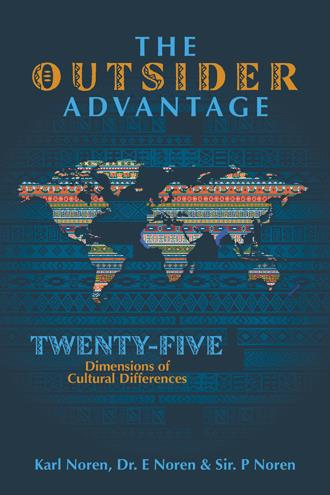
The Outsider Advantage
Twenty-five Dimensions of Cultural Differences
by
Book Cover & Preview Text
2.2 Cultures are more different than you think. Just because you think you understand how animals think does not mean you understand how plants think. For thousands of years, people have known that some animals are more like humans in their thinking than others are. Parrots can learn to use human speech and even can talk to people to express some basic needs and wants. Dogs can see problems, respond to commands, and act on their own in ways that emulate the values of the people around them. We even know that lizards and worms sense the world around them, remember events, and respond in ways that can only be described as thinking. Microscopic animals have nerves that work like our brains. So, although we are very different, we do actually think by some of the same biological mechanisms. Many cultures are like these other animals. Humans and elephants may think differently, but many people who work with elephants can begin to predict their actions by understanding how they think. This is like a Congolese working with a Kenyan. They may use different languages, but there are lots of similarities and both can quickly adapt to predicting some of each other’s thoughts, actions, and needs. Some cultures are very different. Some cultures seem to be as different from each other as how plants and animals are different. Leaves, roots, and flowers are obviously different from eyes, stomachs, and legs. These differences are obvious. Most people don’t even believe that plants can think. Certainly, plants do not think the way animals do, but they know when seasons are changing, they can be trained, remember events, and they respond differently when the environment around them changes. They even communicate with each other over distances and coordinate their activities. Plants can even release chemicals into the air to synchronize changes in fruiting, defense, growth, and nutrient sharing behavior. The problem is they are so different from us that we don’t know how to perceive and categorize their thinking. We make similar mistakes about many other cultures. We often don’t know how they think differently from us, or we can’t even recognize that certain features of their culture exist. Since we can’t see it, we assume it must not exist. By being aware of several kinds of dimensions that exist in various cultures, we can become more alert to unseen features in our own culture or the other cultures which we visit or in which we reside. This unseen level of differences between people groups means that there are deep differences not only between the cultures on different continents, but also between the various ethnicities found on those continents. There are hundreds of ‘tribes’ of ‘white people’ in Europe who may seem to be all the same to an African. There are hundreds of African tribes that are close neighbors that seem all the same to Europeans. There are also tribes and clans in Japan, China, and Korea that may seem identical to an American, but in fact they are quite different in thousands of ways. While it is often true that neighboring tribes will share some seen and some unseen similarities, it is also true that they will differ from one another in very important and dangerous ways. These differences are dangerous because they are clear points of distinction that make that people unique and special compared to their neighbors. If an outsider assumes these tribes are similar and if the outsider acts the same way or says the same polite thing in both cultures, then they could find themselves in deep trouble for violating a point of pride or cultural identity that is taboo or sacred to one or both of those cultures. For example, if you were to offer a drink of water to a Quechua man and a Cofan man (both are Ecuadorian tribes in South America), then you would be doing something polite to one and something extremely offensive to the other. Although any foreigner can be forgiven for not seeing a physical difference between the two and for not knowing the cultural differences, it still remains that the Cofan don’t drink plain water. “People drink juice, animals drink water” is a key distinction between being an animal and a human in Cofan culture. Almost all cultures have strong, but invisible, lines that separate ‘us’ from ‘them’ and ‘human’ from ‘animal’. In fact, many languages’ names for their people group are properly translated as ‘the people’. To emphasize the point, they are not ‘a people’ but ‘THE PEOPLE’. This is an example of ethnocentricity, which is view that one’s own ethnic group and way of life is normal and other groups are the ones that are ‘not normal’. Ethnocentricity tends to be a common feature of most societies although they may express it differently. Every society considers its own worldviews, values, attitudes, and behaviors as ‘normal’ and ‘natural’. ‘Common sense’ is only common to those within the group and what is sensible in one context may be madness in another. We should not judge cultures for being ethnocentric. They are just following normal patterns of human behavior as they recognize what is familiar and contrast it with the foreign. However, an educated and culturally aware person should recognize that various forms of in-group-bias will always need to watch out for and humbly discuss with appropriate deference to the ways of others – especially if we are in their spaces.
Formats

Book Details
About the Book
Cultures are equal in the sense that they are simply the different ways people live together in their context. Cultures differ in how they accomplish the task of empowering people to prosper together in their physical and historical environments. In a reference manual for global travelers or those encountering different cultures closer to home, Karl Noren provides diverse points of view that are essential to attaining a more complete understanding of people, cultures, and why things don’t work the same way in different places. While reminding of the historical and sociological complexities of cultures that are multifaceted, contextually adaptive, and continually changing, Noren explores insider and outsider advantages; a variety of cultures including Eastern, Western, Imperialistic, and people-oriented; fatalist and possibilist worldviews; patriarchal and matriarchal societies; the most important cultural dimensions; and much more. The Outsider Advantage promotes cross-cultural understanding for those who want to learn more about the beauty of diverse people and ways of living.
About the Author
Karl Noren is the academic director at Rainforest International School in Yaoundé Cameroon. He holds degrees in biology, international studies, and park management and conservation. He has been a safari guide in numerous countries, and has taught sciences and humanities in secondary schools and universities. This is his second book. Dr. Erik Noren is a professor of History, History Department Chair, and General Education Curriculum Director at Tabor College in Hillsboro, Kansas. He has traveled and studied extensively in Africa, Europe, and the Caribbean. Sir Paul Noren was knighted in Zaire for his life of sacrificial service to the Congolese people. He is a cultural anthropologist by training, one of the world’s most prominent experts on tropical agroforestry and agricultural development, and a renowned ethnobotanist and expert on native flora and fauna of Central Africa.