
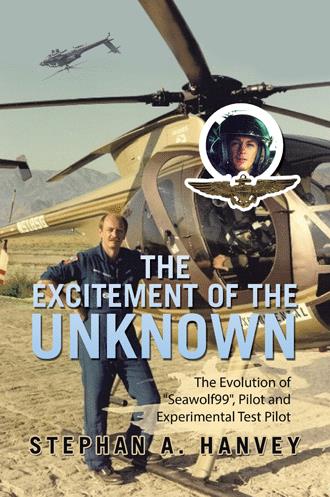
The Excitement of the Unknown
The Evolution of "Seawolf99", Pilot and Experimental Test Pilot
by
Book Cover & Preview Text
I had discussed the flight with air traffic control and basically had their approval for an unrestricted climb to 30,000 feet (about 9.14 km) or, as high as we could go. This is kind of an unusual request for a helicopter for an unrestricted climb, normally reserved just for high performance aircraft. We did this so that we would not have any change in direction or change in clearance which could take even a few seconds off our climb record attempt. Everything went very smoothly from takeoff through 3000 meters and as we had briefed when the high frequency vibration came in about 14,000 feet, I told my ground crew that I was continuing as planned. I did not know the exact time during the climb, as I was concentrating on maintaining the very best climb rate and precise airspeed.
The next three minutes of the flight continued with the high frequency vibration remaining constant. I had just passed 6000 meters (about 3.73 mi) and was climbing between 20-21,000 feet when I felt a tremendous change in the high frequency vibration level, saw that the VHF radio had been ripped out of the screws (or Zeus fasteners as we call them) from the instrument panel and was hanging out about halfway, as was the transponder which reported our position and altitude to air traffic control. I immediately started reducing the power but had to do it very gradually, as we had discussed in the original risk conversation. I began a 180 degree turn back to our takeoff airfield and started to accelerate to the best range speed. The vibration became much worse even with an additional 5 knots of airspeed, so I stayed at the best climb speed. This also meant it would take longer to get to the ground. Lights were still on the transponder, even hanging out from the instrument panel, and I hoped it was still working. I reached down since I realized I had no communications with the ground and put the squawk on the transponder to 7700 indicating an emergency, and then set it to 7600 which showed air traffic control that I had no communications capability.
I began the minimum power descent from slightly above 20,000 feet and at approximately 18,000 feet the engine quit; I could hear a reduction in the engine noise and saw the loss of power in my engine instruments. I was now in an engine out autorotation. At this point although I had the parachute on, the main rotor looked very stable over my head, so I did not try to jump out and use the parachute. I had long ago decided that I would only use a parachute if I thought I was going to die, if I did not jump and use the parachute. At this point I also had no idea what had caused the engine to quit or the vibration level to go so high.
I had taken off with a very slight tailwind so with the same airspeed, and now a headwind as I descended, I realized I would not make it back to the airfield. The good news was there were one square mile agricultural plots below me, so I lined up to land in one of the one square mile areas. As I turned the helicopter slightly the vibration level once again increased, so I very gradually kept it in a level attitude going straight ahead. As I got closer to the ground and aimed for the middle of the one square mile area, I realized that I was going to be very close to the far end of the field that ended in a concrete irrigation ditch which was about 10 feet deep. Fortunately, I was able to bring the aircraft to a stop with a very slight ground slide of a few feet, just short of the drainage ditch. I knew I needed to be careful on how rapidly I decelerated, but I needed to keep the nose of the helicopter up to stop my forward airspeed and avoid hitting the tail rotor on the ground with any sudden and erratic movement.
The initial climb to 21,000 feet (about 6.4 km) resulted in breaking the helicopter world Class E.1.b records to three thousand (3000) meters in 3 minutes and 15 seconds and six thousand (6000 meters) in 6 minutes and 34 seconds. This is a very high rate of climb for a lightweight small helicopter. The total climb time had been about 7 minutes, but it took an additional 11 minutes to descend to the ground due to a lower rate of descent airspeed because of the vibration level; and therefore, it took 4 minutes longer. During the entire climb and descent test flight, I only felt the normal excitement of a flight like on an experimental test flight where things sometimes happen that are unexpected. It wasn't until I climbed out of the helicopter, once I was on the ground, that it hit me - this was an exciting early morning flight. My knees felt weak, and I went down on them and kissed the dirt in the field.
I then got up and went around the aircraft to see what had happened, and it turned out the two engine cowling doors in the back of the fuselage were open. My first thought was that I couldn't believe the engine doors had popped open and caused all that problem. After a few minutes on the ground, it occurred to me that my ground crew had no idea where I was. I found out later that the last words they heard from me when I called and told them I was aborting the flight was, “I’m abor…” and nothing else. My flight engineer had jumped into our test support station wagon and headed in the direction that he thought would be the best way to find me. At that point, since they had heard nothing further from me ….
Formats

Book Details
About the Book
In The Excitement of the Unknown, author Steve Hanvey, Seawolf99, shares family, faith, pilots’ camaraderie, leadership insights, aerospace technology advancements, and lessons learned flying diverse aircraft under extreme conditions. His exciting and often humorous journey exemplifies the importance of accountability, teamwork, problem-solving, and professional excellence in leadership. Hanvey’s story demonstrates adaptability, responsibility, and innovation and can serve as a blueprint for aspiring pilots, test pilots, and leaders. He also includes numerous pictures documenting key moments in his career, aircraft he flew, and significant historical events related to his journey. This personal narrative is both an autobiography and a tribute to military and test pilots, offering a personal and technical perspective on the aviation world. It highlights leadership qualities required to succeed in high-risk environments, inspiring future pilots and leaders to develop the same commitment to excellence, service, and innovation. Young people can experience the steps to become a pilot, pilots can experience the steps to become an experimental test pilot, and innovative leaders can better understand fifteen key leadership insights through Hanvey’s journey of flying, family, and faith.
About the Author
Stephan A. Hanvey is a USMC Naval Aviator and aerospace executive with 512 combat missions, experimental flight test, and leadership experience. He reflects on camaraderie among pilots, family, and faith with anecdotes, humor, and perspectives and shares the excitement of high-risk, unexpected, extreme situations that influenced his life’s journey as a pilot and leader. He currently lives in South Carolina.