
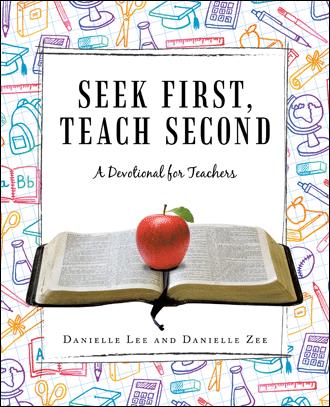
Seek First, Teach Second
A Devotional for Teachers
by
Book Cover & Preview Text
Day 6: Encouragement Thought Question: What does Holy Spirit inspired encouragement look like? I was challenged this summer to consider Barnabas and whether I display the Spirit of encouragement that he did. All believers are called to “prophetic encouragement” in order to help move people to the greatest purpose that God has called them to. I struggle to think of myself as having or being “prophetic” anything, however, the definition given by Kelvin Walker resounded with my purpose for teaching. Kelvin preached that prophetic encouragement recognizes people for who they are but sees them as they CAN be. Prophetic encouragement calls out the “more” that is asleep in people and champions them to the next level. This is what teachers do. I hope that our aim is to see our students through the eyes of their creator. When we do that, we expect more from them than they often think is fair, because they have yet to see the gifting, calling, purpose and potential that God has given them. Our belief, determination to excellence, discipline and encouragement are prophetic when we pour into the students that do not yet “get it”. Our God is good. We do not serve a God who created our children to flunk out, do and deal drugs, spend years in prison or wind up pregnant out of wedlock. We serve a God who created our children to succeed, have hope, a future, stable families and bring Him honor and glory. We have to stop looking at our students as whatever the world has labeled them as. We have to stop looking at our students as the consequences of choices they’re making with no love, support, security or understanding. We have to stop looking at our children as statistics. In Acts 9, we see the conversion of Saul. He was known as the greatest Christian hater and persecutor in his day, but he had an encounter with the Lord. Saul’s reputation proceeded him where ere he went. Christians everywhere were terrified of him and rightly so. When the Lord spoke to Ananias and told him to go to Saul, lay hands on him and restore Saul’s sight, Ananias was hesitant. “I have heard many reports about this man and all the harm he has done to your saints in Jerusalem. And he has come here with authority from the chief priests to arrest all who call on your name.” (vs. 13) The Lord responds telling Ananias that Saul is His chosen instrument to carry the gospel to the gentiles and people of Israel. The Lord also tells Ananias, in essence, it isn’t Ananias’s job to determine what is right and fair regarding Saul. He assures Ananias that he will deal justly with Saul’s persecution of believers. If you jump down in the story, around verse 20, we see that Saul has gained a lot of power and is convincing many that Jesus is the Christ. The Jews are not happy about this and begin to plot to kill him. The believers in the area know about the threat to Saul’s life, but do not trust that Saul is genuinely one of them. Enter Barnabas. In verse 27, Barnabas is mentioned, almost in passing. “But Barnabas took him and brought him to the apostles. He told them how Saul on his journey had seen the Lord and that the Lord had spoken to him, and how in Damascus he had preached fearlessly in the name of Jesus.” If it weren’t for the prophetic encouragement and belief of Barnabas in Saul, the Christian community may not have accepted and protected him. Without the ministry of Saul who later became Paul, the gentiles’ ability to become part of the family of God would look drastically different. “There is always one.” This statement needs no explanation in the teaching community. It is in fact true that there is always going to be one: one who tests your patience, one who can’t seem to understand, one who is always in trouble, one who does the unthinkable, one who you wish you didn’t see on your roster at the beginning of the year, one you’ve been warned about, one that is easy to give up on. Don’t. Do not give up on ANY of the ones that God has called you to influence in this season. He can use EVERY one of those children to change the world by using them as instruments to spread His name. I think He might even take pleasure in using the ones that require the most obedient faith from us. Obedient faith that blesses and does not curse. Obedient faith that lifts up and doesn’t tear down. Obedient faith that believes in and doesn’t doubt. Obedient faith that is grace-filled and not harsh. Obedient faith that calls out the best in our students, even when they are displaying the worst in themselves. Reflection Question: Am I displaying the Barnabas spirit of “prophetic encouragement” in my classroom and school? What are some practical ways I can encourage my kids daily?
Formats

Book Details
About the Book
Very few things are more frustrating in the world of education than attending professional development events run or written by individuals so far removed from the classroom that the practicality of what they’re presenting is largely useless. Seek First, Teach Second is a five-week devotional full of real-life stories based on real classroom experience as well as motherhood, showcasing how educators can put their faith into practice in a professional setting.
However, more than sharing a collection of heartwarming and sometimes heartbreaking tales, the overarching goal is to give teachers, specifically those serving in a public-school setting, a resource to help validate the work of their calling, reflect on their effectiveness from an eternal perspective, encourage them to capitalize on the power of prayer, and rightly prioritize their faith, their family, and the high demands of their profession.
Christian programs in public schools such as Fellowship of Christian Athletes and See You at the Pole solely focus on student leadership. While it is often assumed and expected that the adult sponsors of said programs are believers, where are they getting their Biblical leadership training? If the Church does not encourage and equip the soldiers on the front lines of the battlefield of the classroom, it’s a missed opportunity to stand in the gap and intercede on behalf of these children.
About the Author
Danielles Lee and Zee are passionate about equipping teachers to become powerful and effective prayer warriors. With more than two decades of experience between them, there isn’t much they haven’t seen. They understand the eternal impact teachers have when their profession is approached as a ministry first and job second.