
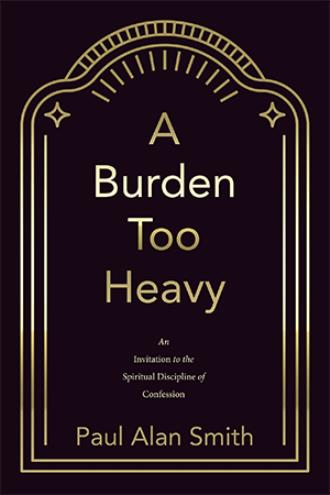
A Burden Too Heavy
An Invitation to the Spiritual Discipline of Confession
by
Book Cover & Preview Text
A confessional theology is a theology that has the ability to admit its own failings. Confession praises God’s perfection and simultaneously acknowledges human weakness. No movement has ever been perfect, and the history of Christ’s body on earth is a record of recurring human failure and spiritual revival. A confessional theology owns the successes and failures of God’s Church and endeavors to become stronger through learning from those failures. A confessional theology is conscious of the past but always looks to God’s inbreaking action in the future. A confessional theology is firm in a conviction that as long as the Church exists, God will work through his Spirit to redeem human failure. Next, a systemic change of an individual, congregation, or group of congregations can occur only by changing the core beliefs of that individual, congregation, or group of congregations. For the heirs of the Stone-Campbell Movement this means that individuals or congregations will be unable to achieve foundational spiritual renewal by impulsively tweaking worship or leadership styles simply to accommodate the external features of a postmodern culture. Faced with a declining membership, many congregations of the Churches of Christ are abandoning centuries-old practices in the hope that such modifications will encourage growth or at least stem the number of defections. Regardless of whether the membership numbers stabilize, incidental changes cannot create spiritual growth. Permanent renewal can only occur at the level of the heart. A confessional theology addresses this fact by continually measuring human behavior against the standard of God’s will as revealed in the narratives, poems, commands, and judgments recorded in the Bible. A confessional theology does not exclude the incidental elements of congregational practices, but it is a theology focused on the nature of God. A confessional theology interprets matters of congregational worship and leadership as derivative aspects of how God has chosen to bless, discipline, and ultimately redeem his people. Every component of a confessional theology, and therefore of confessional practices (such as the reading of Scripture and the practice of using a spiritual director), is designed to draw the disciple deeper into the heart of God.
Formats

Book Details
About the Book
What comes to your mind when you hear the word “confession”? Is confession a dreary command to be slavishly followed or a liberating grace to cherish? How much do you know about your faith and why you believe what you believe? Consider this your invitation to examine your faith and experience the spiritual discipline of confession. Study guide included.
About the Author
Paul Alan Smith is a devoted advocate of the plea of the American Restoration Movement, a 19th century call to unite all disciples of Jesus under simple apostolic teachings. He has served congregations of the Churches of Christ for over thirty years in several capacities, including instructing in the Religion Program at Eastern New Mexico University, Portales, N.M. He received bachelor’s and master’s degrees from Abilene Christian University, (Abilene, TX), and holds the Doctor of Ministry degree from Fuller Theological Seminary (Pasadena, CA).