
Ignoring the Evidence:
Glyphosate, Deer and the Abuse of Power
by
Book Cover & Preview Text
She further explains “When the system breaks down and employees point out the failure, there is a belief their voices will be heard, the problem investigated, and action taken if warranted. When, instead, their concerns are dismissed and they are retaliated against for speaking out, a deep sense of betrayal sets in, and the initial harm is magnified, resulting in significant physical, emotional, and professional derailment.” I was not surprised to read that in institutional bullying and betrayal, at the far end of the spectrum reports are ignored, the whistle blower comes under increasing attacks and they are now labeled as the aggressor. This flipping of scripts is a common tactic in workplace abuse (Harsey & Freyd, 2020) – and one I witnessed first hand. You can imagine my frustration and humiliation when, despite all our evidence that the toxic environment came from ridiculous decisions and inaction on serious concerns; despite being backed by data, law and insurance - the college suggested I was (and I quote) “a disruptive and destructive force at the college” - Is that what the evidence suggests? Let’s not bother with the evidence that there is a man responsible for investigating any infraction of the college’s harassment policy by a supervisor abusing his power, placing instructors at liable, and further, harassing faculty by forcing them to do things that jeopardizes their employment. What does the ED with decades of experience do about this? Absolutely nothing. And the majority of our faculty shared the frustration. After a week of no word to the second-year class, I sent a follow-up e-mail to Tim trying to get him to acknowledge just how chaotic my classroom was as a result of their undermining our authority and changing the student handbook rules mid-term. I ask him for help, specifically me and the chaos I was experiencing…… crickets once again. Thankfully, I had maneuvered through Gareth’s most recent attempt to pigeon hole us on winter camp, and Phil and I were on our way to the picturesque Fundy National Park, enveloped in a winter blanket of snow. It made for a Christmas card picture as we bused our wildlife students through the peaceful scenery and 400-year-old spruce trees that lined the rugged coast of Fundy. We dropped the students at base camp, a tiny little village of rustic log cabins at our bear outfitter’s camps at the top of a mountain just east of the park. Students were responding to Phil’s instructions as they safely unloaded skidoos, tent poles and food for the camp’s week-long activities. I took other students to help unload the white-tail deer roadkills I had obtained from rangers at DNR for our paunching exercise, and unloaded the barrels of Aviation fuel at the front of the camp kitchen. In several short days I would once again be climbing into a Jet Ranger helicopter as I had done for over the past 25 years, only this time I’d have four young recruits joining me in the adventure. It had been thirty-three years since I had taken that first flight test for FPL to become a pointer pilot and had watched the ground unfold before me. The thrill and excitement had never waned over all these years, and in no time, I was once again fitting my head into the ear muffs and microphone of the chopper’s communication system. Once all students were buckled in, I gave the thumbs up to our pilot and he responded with a nod. He took firm grasp of the controls between his legs and turned the thrust for the chopper higher. As the whisp of the blades above our head cut through the air we could hear the thumping increase in speed while in response, the snow around the chopper blew away from under the struts. As the chopper lifted, we watched the ground in front of the cook shack drop away beneath us. The pilot turned the chopper to the south, and we were now looking down the steep ravine in front of base camp to the tiny village of Alma. Smoke rose from the tiny chimney’s that dotted the snow-covered scenery as the chopper raced down the ravine. Just like a roller coaster, the ravine seemed to swallow the chopper as we raced down the side of the mountain. Then, just as quickly as we slid down the mountain, the chopper smoothly lifted as we cleared the trees at the bottom of the gully. As we climbed higher into the crisp winter day, sunshine pierced the cockpit and lit up the waters in the Bay of Fundy that was now unfolding in front of us. With a gentle push on the joy stick, the chopper responded and slowly turned to the west and headed into the park. I instructed the students to prepare their tablets and paperwork, and then pointed out several vehicles below us to use as scale for roughly the size and shape of a moose. They needed what we call a “sight image” to train their minds on exactly what they would be looking for between the trees below us to survey for moose. As we flew above the treetops headed to the far reaches of the park, I was taken back to my days in the big spruce across from our home in Mayfield looking out over the town of St. Stephen. I loved being here – high above the ground taking in a bird’s eye view of the world around me. God had blessed me with an incredible career and plenty of opportunities to use my gifts to impact the wildlife world in the province. As I thought back through my 22 years at DNR, a feeling of contentment welled up inside of me. I had never worked a day in my life, doing everything I was created to do. And now I had the incredible opportunity to pass along years of knowledge and experience to the next generation of Forest Rangers.
Formats

Book Details
About the Book
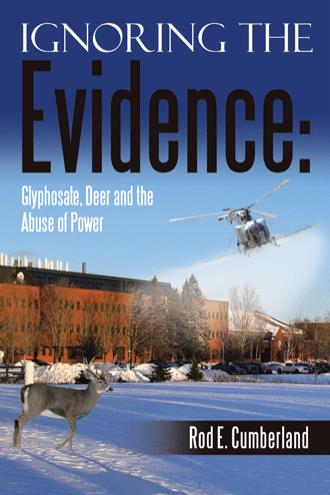
Ignoring the Evidence highlights the journey of Rod Cumberland growing up as the son of a renowned deer hunter in Charlotte County, NB and how he fell in love with both the outdoors, and the white-tailed deer in his younger days. It follows his colorful life growing up in small town NB, the experiences that strengthened him into a person of principle standing up to injustice, following him all the way through his travails through university enroute to becoming the province’s deer specialist. The book uncovers his investigation into dwindling deer numbers across Crown Land in the Province during his tenure at NBDNR. Convinced by the growing evidence that glyphosate spraying was causing dramatic declines in deer food, he embarked on a mission to educate colleagues, government officials and politicians as to the negative impacts, only to become the target of the forestry oligarchy in the province that was highly dependant on the economic benefits from glyphosate use. Rod became embroiled in the battle for the Conservation Forest in the province and watched as political pressure began to impact the debate, and the careers of colleagues and other professionals in the province. As his career shifted to employment at a forestry college, influence from the powerful forest industry affected management at the college and would cause not only a decline of the college programs, but eventually the career of a well-intentioned professional sticking to his morals, values and evidence. “Part memoir, part expose – Cumberland lays out a twisted tale of how power and politics and corrupted science endanger our natural world, and how hard it is to fight back.” – Carey Gillam, investigative journalist and author.
About the Author
Rod Cumberland is a Certified Wildlife Biologist and was the Provincial Deer Management Biologist for the NB Department of Natural Resources and Energy from 1997-2012. He taught Forestry and wildlife courses at the Maritime College of Forest Technology from 2012-2019 before being wrongfully dismissed by the college.