
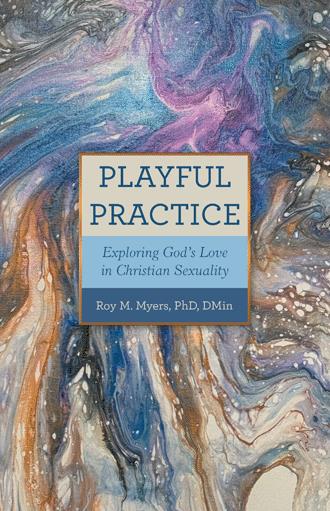
Playful Practice
Exploring God’s Love in Christian Sexuality
by
Book Cover & Preview Text
Participation in God’s Love
God is the originator of Christian sexuality. God’s love extends from the Trinity in power and as a revelatory substance. From the Divine perspective, God’s love, like His Word, will always accomplish God’s intent in this world, even when that seems so far from the reality of this life. God proclaimed through the prophet Isaiah, “My purpose will be established, and I will accomplish my good pleasure” (Isaiah 46:10b). God knows Himself and His nature perfectly. Lined with actual omnipotence, God guarantees His plan will always accomplish God’s purposes. In the broad scope of time, God’s love is actualized as flourishing through the outworking of God's design. Human partners, however, cannot automatically actualize God's love. For us, becoming a part of God’s design is not given. Knowing and living in God’s love is always something we learn and grow into. Where God is, Humans are becoming. This reality stands at the center of God’s design and frames Christian sexuality, as it also frames Christian formation in general. This reality suggests there is much space for Christian couples to learn God’s love and flourish in their sexual relationship. To this end, God invites Christian partners to explore God’s love within the bond of their Christian sexuality.
Participants in my research project saw God’s love as a bond, and they found much space in God’s love; immensity was the more crucial feature for them. Immensity spoke to the magnitude of God’s love more than its moral scope. God’s love seemed able to fully accommodate all their experiences, even the ones that traditional religion might not accept. Love was expansive. For these couples, love existed beyond their understanding and included space for diverse experiences and conclusions about love. Love was beyond their knowledge, partly because they saw love as coming from God/Divine. Participants often assumed God’s love was beyond their ability to know.
These couples described love as spacious, including space for relationships to emerge. Immense love was invitational. It invited partners and couples to locate themselves and find their unique identities in God’s love. Love did not define them as much as they sought to discover who they were within God’s love. However, love was not morally obtuse for most of the couples I interviewed. These couples rejected the idea that God’s love was unlimited, as some contemporary authors suggest. Jacqueline Bussie, for example, proposes a radically unlimited love that “must push back against culture’s definition and instead align with Jesus’ own … must mushroom to include all God’s children. No asterisks, disclaimers, clauses, provisions, or exceptions. Period” (Bussie 2022, 138). While attractive to some partners, this absolute acceptance did not provide my participants with a sufficiently defined space. Unconditionality tended to mean no structure. God’s love, for most partners, was substantial – what I’ve suggested is an ethical-relational structure. By exploring sexuality within the structure – the bond of Christian sexuality – Christian partners can discover themselves and find their way home to God.
Exploration is vital because of the way God created people. Humans are complicated in ways that God is not. Humans live at the intersection of freedom and finitude. Each sexual partner knows some things about themselves, God’s love, God, and sex. Likewise, partners can act on their knowledge in specific ways. Reinhold Niebuhr, pastor and theologian, names this capacity to know “consciousness,” which “represents a degree of transcendence” (Niebuhr 1996, 14). Humans can know and act in the world as agents. Humans have the freedom to interact with other beings, have relationships with them, and find flourishing as we live within the framework of God’s love. Christian sexuality asserts that each Christian partner is conscious and has the “capacity of surveying the world, of forming general concepts and analyzing the order of the world” (Niebuhr 1996, 14). Christian sexual partners can know themselves and share God’s love in ways that approximate the perfect love shared within the Trinity.
Approximation is necessary because humans cannot know or even touch God’s love in its ultimate form. Instead, Love comes to us as though through a prism. White light appears as a rainbow of colors, red to blue, when passed through a prism. The different aspects of light are separated. It is hard to see how the refracted reds and blues could magically combine to create white light, yet we know they do. Humans may not understand how light can be whole – ultimate white light – and be differentiated colors simultaneously. Neither can humans comprehend nor manipulate the internal realities of God’s ultimate love. Instead, God makes his love accessible to complicated beings by complicating it. God does this by extending love in its differentiated forms. In the case of Christian sexuality, God refracts his love into spirituality and sensuality so that we can access love in smaller, more digestible parts. God’s design infuses refracted love into Divine-human relationships so complicated beings can understand love and respond to it. In Christian sexuality, God comes alongside Christian partners, enabling them to work together to respond to God’s love. This can lead to human flourishing.
Every human response to God’s love is complicated because every human is complicated. While we can see God’s love in its parts, the unity and power of ultimate love remain beyond human capacity. All humans are complex because they are caught in the tension between what is known and what is unknown or unknowable. Niebuhr describes humans as having “finite individuality” (Niebuhr 1996, 170). Humans are still creatures and limited. As far as we know, our knowledge of ourselves, God, and God’s love remains incomplete. This human complexity means humans can only partially apprehend God’s love. Humans can know God’s love in its parts, as spirituality and sensuality. Integrating God’s love back into the pure, undiminished love is impossible. Incompleteness or finitude is not the same as sin. God created humanity as conscious and finite beings. Finitude means that humans will never fully comprehend the richness of God’s ultimate love. This is what I suggested that human partners strive to approximate experiences of God’s love.
Humans can know some things as conscious beings, but that knowledge will always be limited. There are things humans cannot know, things they cannot know yet, and things that lie just a short stretch away. Niebuhr explains, “Salvation never means the destruction of (our) creatureliness (or) absorption into the divine” (Niebuhr 1996, 170). Being finite means we will always have aspects of our person that are yet to be realized. God designed humans to live and learn as beings who can freely know and express God’s love to some extent. Growing in God’s love does not induce a human transcendence into something Divine. Instead, God’s love allows complicated humans to know God and others through His love, a love that will never be actualized in human experience.
Approximation of God’s love always occurs in a relationship with the One who knows integrated and ultimate love. Living an abiding relationship with Jesus in God’s love is “the conscious synthesis of limited and unlimited … which can only be realized in relation to God” (Niebuhr 1996, 171). For many reasons, living at the intersection of freedom and finitude complicates huma
Formats

Book Details
About the Book
Between social stigma and personal shame, it’s often difficult to come to terms with humankind’s more base desires, particularly for those in the Christian faith. In his first book, Roy M. Myers, PhD, DMin, examines how we can redefine those expectations—to help couples improve intimacy in marriage as a means to start being more spiritual.
Playful Practice: Exploring God’s Love in Christian Sexuality posits that, far from opposing forces, spirituality and sexuality are inextricable from one another. Passionate and fulfilling sex lives can (and should) coexist with one’s faith. Whether you’re working to learn the Bible’s teachings together or experimenting behind closed doors, experiencing God as a couple strengthens both your beliefs and your bond.
Drawing from biblical theology, interviews with husbands and wives, and his own pastoral experience, Myers proposes ways to explore love and sexual intimacy with your partner. This guide aims to heal taboos by encouraging open dialogue, and embracing how relationships make us grow with each other and with God.
“Sexuality is part of God’s design for human flourishing,” Myers explains. And there is no room for shame in the divine.
About the Author
Dr. Roy M. Myers, Ph.D., D.Min. invites Christian couples to live in the tension between sacrificial love and indulgent love. Playful Practice is an adaptation of his research, his extensive experience in spiritual care, and his journey in Christian sexuality with his wife of over thirty-seven years. He earned a Ph.D. in practical theology and a Doctor of Ministry in spiritual care assessments. He is also a board-certified chaplain, certified educator, and an ordained pastor.