
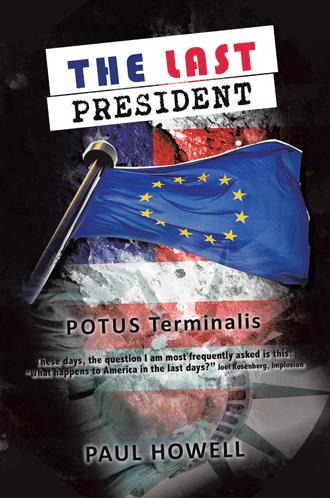
THE LAST PRESIDENT
POTUS Terminalis
by
Book Cover & Preview Text
CIA Director David Weissmeyer sat at his desk, at least the one assigned to him in the situation room, considering all that had happened in the last five hours. The room was silent but for the droning of a television on the far wall scrolling with breaking news about the assassination attempt on the President. Not since the attempt on Ronald Reagan’s life had there been an incident like this. And not since JFK had the nation and the world been stunned by seeing a gunshot wound to the head of an American president, while the images were being beamed around the globe.
The two marksmen had both found their target, one bullet entering the president’s upper right chest, the other deeply gashing the right side of his skull. The President’s immediate collapse, as well as a head wound visible through the assassin’s scope, gave the impression that the job had been successful and the bullets had fatally wounded the target. The images were so gruesome that he wanted to look away even as he was drawn to them again and again. The clean hole. The lack of blood. The surreal scene of a man collapsing and pulling the security of a nation down with him.
Those images in David’s head were followed next by more pictures. Secret Service personnel quickly moving in to form a physical barrier between the President and any further gunfire. On the ground behind the human wall lay the President, the clean hole in his shirt replaced by a rapidly growing pool of blood. Members of the press and TV reporters immediately reported everything they had seen—or thought they saw—merging fact with panic-laced perceptions that formed a glob that was one part truth and one part conjecture. That led to mass speculation and talk of succession.
As the President was whisked away to Johns Hopkins University Hospital to a waiting surgical suite, there was near hysteria as the Baltimore crowd crammed into Carroll Park on Washington Boulevard watched in disbelief. Questions flying on television echoed those in the bunker: The swearing in ceremony of the Vice President. Who would pay the price for this? How did the Vice President’s minor squabbles over domestic and foreign issues impact current legislation?
David considered the group and the implications of what was happening. The attempted assassination of President David Lee had initially been thought to be the work of some right-wing extremist group, dissidents akin to the Wagner Group, who attempted to take out Putin's regime in 2023. Not the Klan, but more likely ‘Christian’ zealots organized into a militia who saw it as their God-ordained mission to rid America of those they blamed for her “demise.” David thought again about the Oklahoma City bombing, the Branch Davidian Raid, the DC Shooter and Columbine. America had her share of home-grown terrorists, men of the ilk of Timothy McVeigh. The news coming now was quite different, and the implications chilled him. The war was no longer with nations—that was all 20th century battles. The past few decades had been about changing everything we knew about warfare and the location of America’s enemies.
“Let’s regroup,” the Secretary of State said, commanding control of the room once again, while casting a wary look at David. Higher in the line of succession than Director Weissmeyer, Shirley wanted the whole room to remember it.
All of the media speculation on right-wing conspiracies had ceased when Al Jazeera aired a breaking news story that an Iranian terrorist organization, Askar Mahdi, or Army of the Mahdi, had claimed responsibility for the attack on the President.
Her fellow cabinet members sat around the semi-circle, their faces reflecting the panic she’d felt at the news. The Secretary of State was wrapping up a conversation with the security detail guarding the President.
“Madam Secretary,” said Rufus McCarthy, senior security agent on the President’s detail, “the President is out of surgery and out of danger.”
The room seemed to let out a collective exhale. Even the Secretary of Homeland Security and the National Security Advisor relaxed a little, but not enough to let their guard down. Heads would roll over this—of that they could be certain. They would be most concerned with keeping theirs.
President Lee had just opened a monument dedicated to the millions of African slaves who had been cruelly and forcefully brought to the United States and elsewhere in the Americas. Ironic! During a moment lamenting man’s inhumanity to man that such an act of savagery should be perpetrated upon the one trying to heal the wounds of centuries past.
“Thank you, Agent McCarthy, for the update. Keep us posted of all changes,” Secretary of State Shirley Huntington said before she hung up the phone.
“We need to make plans for—” David started, but Secretary Huntington silenced him with a look. He’d rarely disliked her as much as he did right now. The panic in this room, the President’s attack. All could have been averted if she’d listened to what he’d warned her about months ago.
“I am aware of your opinion,” she continued, using a tone that was a sweet slap across his face. She had a way of commanding a room and demanding submission, from her fellow countrymen at least. Her success on the international stage left David with some doubt. As the only person who understood these conflicts better than the State Department, David’s role as head of the CIA had made him uniquely aware of America’s vulnerability and lack of status in the world.
She hung up and began walking to the main room. Everyone seemed unfazed by her summary of the talk with Israel but there really wasn’t anything new. She gave out assignments and deadlines before heading back to her office. There was no longer the fear of a second attack yet there was so much more to be done.
It was to be a night of little sleep for those who worked on the Hill.
Formats

Book Details
About the Book
British-born JOHN BLACK has always had his eyes on the American presidency. He is linked to a European-based secret society committed to the goal of a Euro-centrist New World Order. The group is comprised of influential leaders from around the world. They have unlimited resources. The requirement for presidential candidates to be American-born has been repealed. American ascendancy can be undone subversively. CIA Agent ADAM ZUGGERWELDT has been covertly investigating rumors about Black being linked to a secret society. Having already survived being their hostage, he is reassigned to the case at the behest of the incumbent Democrat president. Zuggerweldt and another agent are drawn into an intriguing, secretive plan to resurrect the worship the pagan gods of ancient Rome. KEN CALHOUN SR, is a well-known Christian TV host. His son, KEN CALHOUN JR., is a threat to Black's aspirations. Black becomes aware of an indiscretion, causing the 'religious right' to lose confidence in his rival, clearing the way for Black to take the GOP nomination. Meanwhile, Calhoun Sr., aware of America's absence in any Bible prophecy, ponders the implications of this. Acknowledging that something must happen to America in the last days to remove her power, if not sovereignty, the Calhouns find themselves arriving at the same conclusion as the CIA: Congressman Black may be part of a subversive plot to undermine American sovereignty! The only question is: Can anyone prove this theory before the Presidential election…before America is set on a course to her ultimate demise?
About the Author
Paul Howell became a Christian in 1983, and began studying Bible prophecy in 1987. Having met Dave Hunt, Randall Price and Mark Hitchcock, and read many of their texts, he has a solid grounding in Bible prophecy. He has traveled through the US, Europe and Israel. Alma Mater: UNE