
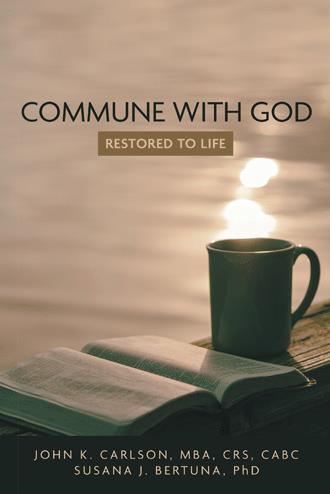
COMMUNE WITH GOD
RESTORED TO LIFE
by
Book Cover & Preview Text
Testimony of John Carlson and the birth of ministry Transformation to Recovery
How it all started . . . communing with God.
The hidden true dialogue behind the birth of Transformation to Recovery (TTR) does not start as a face-to-face communication nor as the strategic communication in the development of a ministry, but with the intrinsic testimony of John Carlson’s one-on-one with God. John Carlson lived the raw experience coming from severe addiction, yet it was the very plan God had for him. He describes it this way “in order to break me down prideless to nothing to use me as a vessel to
bring the light of the Gospel to the darkness of addiction.” John Carlson describes his testimony as a descent into nothingness, of his own rebirth and transformation.
John Carlson’s thoughts and heart were shared when he found himself in an addiction rehabilitation ministry called America Keswick in 2013. This was a four-month program and when he completed his second month, he was awarded a position as a Peer Leader. As a Peer Leader, he was responsible for mentoring five men. This mentoring took place in his room, and it consisted of a Bible study geared towards ministering those who struggle with addiction. The Colony of Mercy (America’s Keswick addiction rehabilitation ministry residence) hosted twenty-one individuals, with a weekly meeting on Thursdays. John Carlson was responsible to
host his five assigned men using the Bible to minister and teach addiction support through the Word of God. Here is the realization that the communication was his intrinsic value through Christ. He was being fed and strengthened to be able to perform the assigned task of ministering on addiction in a professional way. God was teaching him and strengthening him through the reflection of his own mistakes and trials. Using the Bible on Thursday nights with the five assigned men, John Carlson reflected on his own past of how these men were in the same place he once had been in addiction. By God’s mercy and grace, he was now their leader, mentor, and disciple.
John Carlson reminisces how he would talk to these men, cry with them, and teach them through Biblical principles from the Word of God while attesting how he himself was getting stronger in his walk, all while TTR, this ministry, was being developed in his heart and soul. It was in his small room with two beds, the tables as desks where they performed their studies. To the right of his own desk, on the wall was a small 2ʹx2ʹ framed pin corkboard for essential notes, memos, and reminders. He remembers writing on a piece of paper “Combat for God Ministries”
and pinning that on the board. Unbeknownst to him, this revelation was the beginning and raw inception of what is known today as TTR.
John Carlson successfully graduated from the Colony of Mercy and upon graduation moved to South Philadelphia. It was at this location that God gave him the strength to continue ministering through meetings in his home. The communication between God and John Carlson gave him the clarity to listen to his innate consciousness which guided him to continue this type of ministering through meetings because people were in need in Philadelphia.
John Carlson then meets Joe, someone who believed in this ministry’s vision and mission. Together they meditated, prayed, and talked about the ministry and as a result developed these meetings, essentially brainstorming to come up with ways of reaching out to people in their church one-on-one, taking people to lunch, and letting everybody know that there was this ministry every Friday night. The communications were very raw he attests, but it worked because God was leading them to the people. It came to the point where they were communicating with the pastor of the church where they attended at the time, and these meetings were approved as an addiction ministry for the congregation. It was advertised through the pastor and word of mouth to the vessel of a congregation of fellowship called Calvary Fellowship in South Philadelphia.
The time came and they had their first meeting at John Carlson’s home in South Philadelphia. As mentioned prior, it was to be called “Combat for God Ministries”, but the fruit from counseling between John Carlson and Joe, who was John’s original partner in the addiction meeting’s ministry, had God leading them to a new name. John Carlson is not sure strategically how this name came to be, but it was a divine planting in their souls that the new name should be Transformation to Recovery.
TTR, an addiction ministry was born, and its first meeting was scheduled on a Friday night, while four people attended. The four people were met by Joe, Bob, Maria, and John Carlson. Preparing for this crucial meeting, John Carlson had the sermon/study ready, and the first meeting took place with the guidance of the Holy Spirit. John Carlson concludes that intrinsically with God, he was led by the Holy Spirit, a few people who were the ones who were chosen to be the students, and the ones who were chosen to help partner to start this organization is how lives today are truly transformed to recovery.
Based on the MAPCID© model the recommendation to Transformation to Recovery is accentuated by a research study because of the great importance in providing an alternative option to prevent, as well as rehabilitate, individuals who have the potential to and/or engage in addiction vices. Recommending MAPCID© as a concept for the background workings and foundation for the analysis of potential conflict in development is appropriate, as well using it as a research tool for the publishing of a book, compiling a manual, and creating a pilot model to duplicate Transformation to Recovery. This leads to recreating faith-based rehabilitation programs to deal with the social crisis in communities throughout the United States and
ultimately deterring crime, addiction, and recidivism.
Therefore, the MAPCID© model is recommended as an interpretive, instrumental tool to be used as a basis for future research in developing community, faith-based rehabilitation programs. The model’s usefulness to the development of these programs would similarly follow the process as described here:
Formats

Book Details
About the Book
The hidden true dialogue behind the birth ministry of Transformation to Recover does not start as a face-to-face communication nor as the strategic communication in the development of a ministry, but with the intrinsic testimony of John Carlson’s one-on-one with God. John Carlson lived the raw experience coming from severe addiction, yet it was the very plan God had for him. He describes it this way “in order to break me down prideless to nothing to use me as a vessel to bring the light of the Gospel to the darkness of addiction.” John Carlson describes his testimony as a descent into nothingness, of his own rebirth and transformation.
Based on the MAPCID© model the recommendation to Transformation to Recovery is accentuated by a research study because of the great importance in providing an alternative option to prevent, as well as rehabilitate, individuals who have the potential to and/or engage in addiction vices. Recommending MAPCID© as a concept for the background workings and foundation for the analysis of potential conflict in development is appropriate, as well using it as a research tool for the publishing of a book, compiling a manual, and creating a pilot model to duplicate Transformation to Recovery. This leads to recreating faith-based rehabilitation programs to deal with the social crisis in communities throughout the United States and ultimately deterring crime, addiction, and recidivism. Therefore, the MAPCID© model is recommended as an interpretive, instrumental tool to be used as a basis for future research in developing community, faith-based rehabilitation programs.
About the Author
JOHN K. CARLSON, MBA, CRS, CABC
He has firsthand experience with addiction and a powerful story of transformation through faith. Now a Biblical counselor, he serves as the co-founder and executive director of Transformation to Recovery, guiding individuals in addiction recovery and mentoring others to establish
community centers and recovery houses. All Glory to God!
SUSANA J. BERTUNA, PhD
She refers to herself as a hybrid of many learned behaviors, a colorful and flavorful combination of a free-spirited human being. Her motto summarized thus: “as she gingerly plants seeds of hope everyday walking through this earthly journey called life, her passion continues.” All because with God everything is possible.