
Apostle of Grace, Apostle of Love
The Transformation of Peter and John in the Light of Israel’s Messiah
by
Book Cover & Preview Text
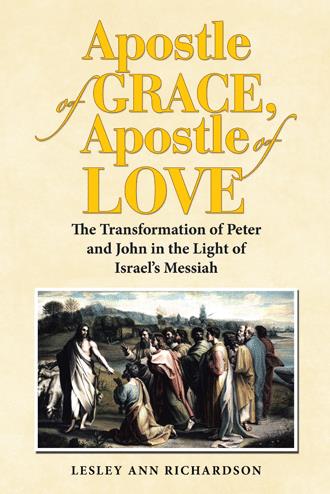
From the Introduction: Jesus commenced His ministry in Galilee, and it was there He chose those He wished to be with Him and take part in His mission. Two of these disciples, Peter and John, were called from their fishing boats on the Sea of Galilee, and since then have achieved everlasting fame through their association with Him. In the present book I have traced their journey as disciples of Jesus through the Gospel narratives, from the first sunny days of the encounter at the Jordan, to the final great drama of the cross and resurrection. They had the unutterable privilege of following the Master closely during His earthly sojourn, and I have tried to illuminate the challenges, perplexities and wonderment through which they passed on their pilgrimage with Him. The close friendship between Peter and John as it appears in the Gospels is quite remarkable. It commenced perhaps even from childhood, but certainly from the time when they were partners in the fishing trade on the sea. After they became disciples of Jesus they were admitted to the inner circle of the Apostles, sharing such significant moments as the raising of Jairus’ daughter, the Transfiguration and the Agony in the Garden. Thereafter we find them both present at the tomb of Jesus, and then at the final meetings with the Risen Lord at Tiberias and Olivet. And it was of course impossible for those who were in close company with Jesus not to be changed at the most fundamental level of their being, in ways they could not possibly expect. The theme that emerges most prominently in the book is therefore transformation of character. When the list of Apostles is given in the Gospels, Peter’s name is invariably the first; his warmth of heart, generosity of spirit and capacity for action gave him this foremost place. And yet Peter was for far too long like the sand rather than the rock for which Jesus named him. So often he spoke with a rash self-confidence that thrust him into places of spiritual peril, so many times he was willing to venture more than he could possibly accomplish. And yet, under the teaching and example of his Master, and through the endless measures of grace meted out to him, his native strength of personality was gradually refashioned, until a pure and deathless love for Christ became the abiding principle of his life. In the Gospel of Mark, John appears as Boanerges, a Son of Thunder, which was the name given to him by Jesus. This conveys the idea of fiery temper and strength of character; at the same time he had a mind that was extraordinarily mystical and imaginative. He absorbed the deepest sayings of Christ which escaped the attention of others and pondered them in his heart till the Holy Spirit opened to him their fathomless depth and richness. John was always symbolized by an eagle in the beautiful illustrated manuscripts of his Gospel, for he was the one who saw most deeply into the heart of his Lord. The insights John has granted us in his writings into the mystery of Christ's Person, together with the revelation of the fellowship of agape existing within the Godhead, are his great bequest to the world. The best way to describe the chapters that follow is as “sermon-essays,” each of which can stand alone, though their themes are deeply interwoven. It will be evident also that I accept the traditional testimony of the church concerning John, the son of Zebedee: that he is the author of the Fourth Gospel that bears his name. Peter and John were actual historical characters, and the events in which they were caught up truly happened. And there is another “character” that appears in the book: the evocative landscape of Israel which forms the backdrop to so many of the stories. This seems imbued with a kind of shimmering presence, an echo of the biblical drama once played out in those places, that still seems to inhere in the blue sky and sparkling sea, in each rocky hill and gentle plain in the land. Sometimes in our commentaries we also forget the sheer literary beauty of God’s word, its ability to speak not just to the mind, but also to the heart and imagination. That is why I have called upon the artists and poets to help illuminate the narratives, to shed a light on some of the dazzling facets we might otherwise overlook. For there are many truths that cannot be fully grasped by the intellect; the Gospels and the other writings will only reveal themselves in their fullness of luminous meaning to those who love them. That is the key that can unfold for us the deep things of the Spirit, and help us discover new rooms in the Father’s heavenly palace, filled with divine treasures of wisdom. And that is how the narratives in the Gospels slowly disclose their secrets, until we come at last to understand the way in which the Son of Thunder was transfigured into the Apostle of Love, and how Simon, son of Jonas, passed through his shattering trials until he became the Rockman, strong and steadfast in character, a pillar on which the early church might be built. And as we are caught up in these marvelous stories concerning our great forebears in the faith, it is my prayer that we ourselves encounter the Saviour once again, in new and life-transforming ways.
Formats


Book Details
About the Book
Peter and John stand forth in vivid color in the New Testament, and by any reckoning, are the greatest and most charismatic figures amongst the twelve Apostles. This book traces their journey as disciples of Jesus through the Gospel accounts, from the first sunny days of the encounter at Jordan, to the final great drama of the cross and resurrection. They were privileged to follow the Master closely during His earthly sojourn, and each chapter illuminates the challenges, perplexities, and wonderment through which they passed on their pilgrimage with Him.
The Gospel narratives slowly unfold their secrets, until we come at last to understand the way in which their characters were transformed. We see John, whom Jesus called the Son of Thunder, become transfigured into the Apostle of Love. We also journey with Simon Peter, whose latent capacity for greatness Jesus discerned from the beginning. As he endures his shattering trials, he finally becomes the "Rockman," strong and steadfast in character, a pillar on which the early church might be built.
Praise for the Author’s Work:
“A captivating Christian commentary based upon a Hebraic foundation, colored by an imagination steeped in a lifetime of classical literature. In this volume, Lesley Ann Richardson transports readers to the landscapes of ancient Israel, while enlarging previous understandings of Jesus, Peter, and John. Her insights make it seem as if she has actually met this holy trio.”
On “Rendezvous on the Crystal Sea”: “The boat is His throne. Galilee is His crystal Sea. The majestic hills the halo. If a manger can be His cradle, the boat can be His throne and the cross our salvation. The poetry by all the greats - Vaughan, Heber, Whittier and Richardson - all lift up in the same direction as Lesley’s ideas and vocabulary. This is so creative, such a unique and profound understanding. This is written by someone in the King’s inner courts, who has walked where He has walked.”
- Carrie Franke, PhD.
About the Author
Lesley Ann Richardson, originally from Australia, lived many years in Jerusalem, Israel, and presently makes her home on Vancouver Island. In her biblical writings she draws upon literature and theology, and focuses on “the Love that moves the sun and all the stars.” This is her fourth book.