
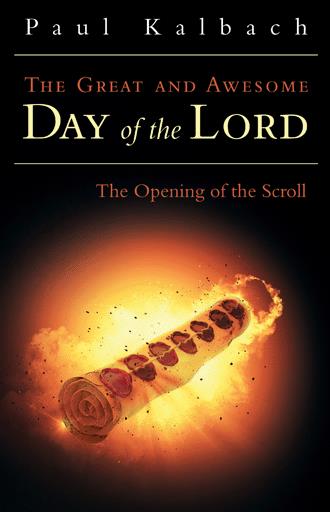
The Great and Awesome Day of the Lord
The Opening of the Scroll
by
Book Cover & Preview Text
Summary of our Thesis for Opening the Seven Seals Before we get into all the details of the opening of the seals, we should set out our big picture thesis so that we can place the pieces within this framework. Here is our thesis: The seven seals of the scroll represent, precisely, the six out of seven principle that God gave us beginning from the creation in Genesis all the way through Scripture. Six seals belong to man, the seventh belongs to God! The seven sealed scroll will exactly reflect that principle, including the timing, and it will exactly fulfill Daniel’s 70th shabua (week). There are six days of a week of seven days, and there are six years out of a seven year shabua. As it has been declared from the beginning, these six years, at the consummation of the age, will fully belong to man, and we will see that during the first six seals, man, represented by Satan’s man: the Antichrist, and his false prophet; but also joined by the evil men on this earth, will be let loose to do all kinds of evil. This will help give us a perspective on just what the meaning of opening the first six seals is. Then we will see that the seventh seal represents God’s holy day (and year). It is why the prophets called it the day of the Lord. It is the last shemitah of the last shabua! It is the Lord’s Day! I believe this thesis is not commonly taught in prophetic writings, in fact, I am not aware of any writing that emphasizes this teaching regarding the seven sealed scroll. As we move through these next chapters, you will be amazed to see how exactly this works out. A White Horse with a Rider – The Beginning As the first seal is opened, John is shown a white horse with a rider with a bow and a crown. Each of these elements has symbolic meaning, which we will try to discern. A white horse was used in ancient times to carry a conquering king who would ride into a city that was conquered. In order to discern who or what is riding on this white horse, we must look at the full context for this passage. There are at least five passages, and a principle, that will help give us this context: (1) Matthew 24:5. In order to see how this is context, we need to understand that the beginning verses of the Olivet Discourse are about the same events and time frame as the first four seals of Revelation 6, and the four horsemen. Many prophecy writers agree with this idea. I showed this comparison in my previous book on page 41. In fact, in Appendix I of this book, we show that the opening of all seven seals have a direct correspondence with Jesus’ teaching in the Olivet Discourse. As Jesus begins the Olivet Discourse, the first situation He warns about involves false Christs: “For many will come in my name, saying, ‘I am the Christ’, and will mislead many”. So we have the first clue that the rider on the white horse represents a false Christ or includes many false Christs. Since Jesus, the one who knows all, mentions many coming to try to deceive, we must start there. The very fact that there are many false Christs will create the confusion necessary to obscure the true Antichrist until he is revealed at the midpoint of the last shabua (Matt. 24:15; 2 Thess. 2:3-4; Dan. 9:27) Since all of these four horses are symbolic (we should not expect to see an actual rider on a white horse), it should not surprise us that it represents both the true Antichrist and many other false Christs. We will see as we continue that the horses and riders represent, not real horses and riders, but spirits of something that are allowed to influence the whole world. Now let us look at a second passage. (2) Daniel 7:7-8, 20-21, 24-26. In this seventh chapter of Daniel, we saw that the context was associated with what we see in the opening of the seals. What we can observe, is the meaning of the fourth beast empire and the little horn that comes out of the ten horns. It is well recognized that this little horn that comes out of the ten horned beast is the Antichrist. To show this correlation even more, it will make sense at this point to look at the table we referenced in the last entry in Table 04. What we find in the Daniel 7 account and the Revelation 13 account, is a symbolic picture of God’s enemies in the final shabua (God’s enemies are also Jesus’ enemies, and the believer’s enemies; also see chapters 25-28 of this book). This will help us determine what is happening in the opening of the seals.
Formats


Book Details
About the Book
What will happen during the end times continues to perplex scholars, split churches, and befuddle laypeople. In fact, many churchgoers have become so disillusioned by the topic that they have concluded that there are no solid answers, so we should not go there.
Paul Kalbach, who has spent many years studying and teaching about end-times prophecy, disagrees – and he sheds light on important questions such as:
• Are prophecies from the Bible too complex to explain or understand?
• What is the purpose of the prophecies contained in the Bible?
• What do we know about the timing of the events foretold in the Bible?
Other topics include the timing of antichrist’s arrival, who will be in the great tribulation and how long it will last, and how long the Lord’s wrath will last.
In teaching about these times, Jesus warned about being misled – and He delved into the dire consequences of refusing to believe the truth. It’s clear that His second coming is approaching fast, and we must understand what God has planned.
About the Author
Paul Kalbach has a background in electronics, math, and computers. He has spent many years studying and teaching end-times prophecy, relying on Scripture. In this book, he shares a fresh view of difficult passages and comes to some surprising conclusions.