
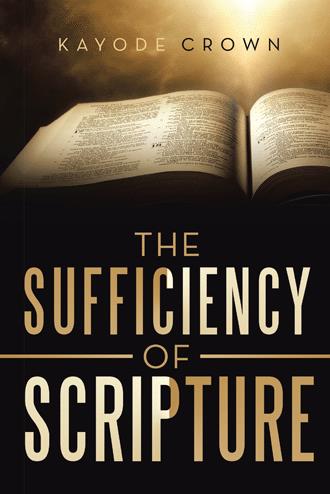
The Sufficiency of Scripture
by
Book Cover & Preview Text
Chapter 1: God Is the Originator of Scripture Scripture is the standard for judging truth from error, not anyone's perception, feelings, ideas, or tradition. The Scriptures are the 66 books of the Bible. And why 66 books and not 65 or 67? The answer is that we depend on what the people of God have recognized as Scripture—holy writings—over the centuries. Those who came before us struggled with that question, and we can trust the outcome of their struggle, as they too had the Spirit of God. We can affirm that the Holy Spirit's operation did not start with us. We don’t need to reformulate the Scriptures. Those who have come before us have done the work, and we are supposed to eat the fruit of what they planted. God Came Down Let's start when God descended on Mount Sinai and directly instructed that something be written down as the truth, as words of the covenant between Him and Israel. Exodus 34:27: The Lord said to Moses, "Write down these words, for in accordance with these words I have made a covenant with you and with Israel." When God descended on Mount Sinai and gave Israel the law, He laid down the standard for what’s true—something that can be verified thousands of years later and remains unchanging. It was something that God had instructed to be written down and called the law scroll. Joshua 1:8: This law scroll must not leave your lips. You must memorize it day and night so you can carefully obey all that is written in it. Then you will prosper and be successful. As this verse emphasizes, the key was that it was written down. This means the message won't be distorted over time as it’s passed along from generation to generation. What I mean is that Scripture exists on its own and isn’t dependent on human memory. Because it’s written, we have something stable and dependable. God wanted His truth preserved that way. This written preservation was especially important because when God came down, the people couldn’t stand it, and they said Moses should be the go-between. Exodus 20:18-21: All the people were experiencing the thunder and lightning, the sound of the horn, and the mountain smoking—and when the people saw it, they trembled with fear and kept their distance. They said to Moses, "You speak to us and we will listen, but do not let God speak with us, lest we die." Moses said to the people, "Do not fear, for God has come to test you, so that the fear of him may be before you so that you do not sin." The people kept their distance, but Moses drew near the thick darkness where God was. Now Moses is long gone, but the truth remains in what he wrote down, as God instructed him to do. When many things changed for Israel—they went from having no king to having kings; from being one kingdom to becoming a divided kingdom; from obeying the word to not obeying the word; from following Yahweh to following idols; from going to the promised land to being in the promised land and then to dispersion and then restoration back to the land in trickles; from domination by one outside kingdom to another—there was one thing that never changed: the law scroll by Moses and additions from the prophets, psalms, and historical retellings. This isn’t by accident. If there’s something that you can be guaranteed is from God, it’s the Scriptures that you can hold in your hands. James would later say in Acts 15:21: "Moses has had those who proclaim him in every town from ancient times, because he is read aloud in the synagogues every Sabbath." That was thousands of years after God came down on Mount Sinai. With everything changing—languages, political systems, the temple being present one time and demolished another, the social order changing—one thing was stable: the written word. It's what connected generations of Israel, whether they were in the land of promise or in foreign nations. Jesus later said that "the Scripture cannot be broken" (John 10:35), meaning it’s trustworthy in its assertions. He came against the religious leaders for their hypocrisy and against the people for following Him because of food (John 6:26-27), but He never came against Scripture; on the contrary, He affirmed it. Matthew 5:17-18: "Do not think that I have come to abolish the law or the prophets. I have not come to abolish but to fulfill. I tell you the truth, until heaven and earth pass away, not the smallest letter or stroke of a letter will pass from the law until everything takes place." He consistently upheld the prestige of Scripture throughout His ministry, demonstrating its divine origin and enduring relevance. Moses said anyone coming several months, years, decades, or centuries after, appealing to the people that they should stray away from the foundation God laid on Mount Sinai, must be dealt with to the maximum degree.
Formats

Book Details
About the Book
This book lays out the case for the Sufficiency of Scripture, arguing that it is enough to define the life and practice of Christians and the church. It pushes back against both subtle and blatant violations of this tenet, including Tradition, Imagination, Divination, Emotion, Revelations, and Visions (TIDER).
Join the author as he explains:
Passages that prohibit adding to or removing from God’s word.
Scripture has a special quality that sets it apart from anything else that has ever been written or will ever be written.
The need for humility so that we can separate our biases from the truth.
There are consequences for either adding to or removing from God’s word.
How Jesus and Paul argued for the Sufficiency of Scripture.
How the devil is the enemy of the Sufficiency of Scripture, and humans willingly cooperate with him for different reasons.
How, “The Scriptures, as a fixed set of documents, is a shared body of agreed reference that defines the contours of truth,” and not the preacher’s charisma or eloquence.
Holding to the Sufficiency of Scripture one day doesn’t mean the preacher will always do so, hence the call for carefulness.
Why it’s wrong to pit one passage of Scripture against another.
That “humans have been building up reasonings apart from and against the light of God’s truth for centuries.”
Take the journey to deepen your understanding and appreciation for the Sufficiency of Scripture.
About the Author
Kayode Crown is the founder of Christ is King Publications and Ministries. He is passionate about helping everyone know and live by the truth, releasing monthly books, verse-by-verse Bible commentaries, and weekly broadcasts. He also organizes ministers conferences and runs a three-month spiritual development school.