
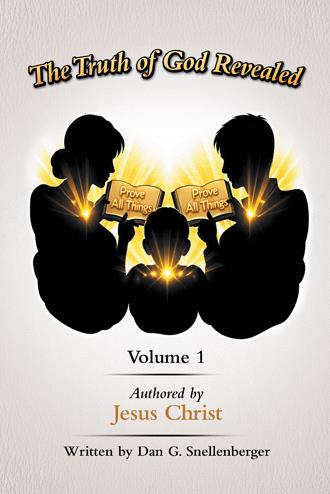
The Truth of God Revealed
Volume 1 Authored by Jesus Christ
by
Book Cover & Preview Text
As a young boy I often pondered: can I ever really know what the truth of the Bible is? For that matter can anyone? After many years and a steadfast thirst for the truth I can now tell you quite honestly, the answer is yes.
Finding the truth can be divided into two main categories:
First, the Bible teaches us 1) what we are not to believe. It also teaches us 2) what we are to believe. Adhering to this very simple recipe gives us the sole and absolute truth of the Bible for ourselves. It’s simple and yet it’s anything but easy.
What we are not supposed to believe!
Revelation 22:19 says “And if any man shall take away from the words of the book of this prophecy, God shall take away his part out of the book of life, and out of the holy city, and from the things which are written in this book.
As you can see, we are not to believe anything outside the Bible. If we believe anything other than that, we are either adding or taking away from what the Bible says, which is strictly forbidden. However, there are those that would argue, saying: this passage refers to the book of Revelation, not the entire Bible. Nonetheless this message can be found in other areas of the Bible. For instance…
Deuteronomy 4:2 Ye shall not add unto the word which I command you, neither shall ye diminish ought from it, that ye may keep the commandments of the LORD your God which I command you.
This says we are not allowed to add or subtract anything from the entire Bible not just the book of Revelation. Which means we are to believe only what the Bible says, not what we think it says. Another way of putting it is: we are not allowed to use philosophy “which is our thoughts” to interpret the Bible. Why? Without scriptural proof, it’s merely speculation. Which is also why philosophy can be so dangerous.
Colossians 2:8 Beware lest any man spoil you through philosophy and vain deceit, after the tradition of men, after the rudiments of the world, and not after Christ.
We must be very, very careful (“Beware”). Why? Because we can and probably would endure personal damage if we are not very careful. And in this case the damage we incur is to our eternity. As you can see, those who seek to do harm to us accomplish their task using two different methods: philosophy and vain deceit.
Philosophy is no more than a personal opinion. It may be true or it may not be true. Vain deceit on the other hand are the lies people purposely tell. Since a pre-determined lie is almost always used for selfish gain, then these people either don’t care if we have a price to pay for their deceit, or they just don’t believe there is an ultimate price to pay. In essence they have their own agenda, and nothing is going to get in their way, especially the truth.
Philosophy on the other hand is a totally different animal altogether. Yes, it can be used by some of the most hateful and scandalous individuals ever to live, but it can also be used by some of the most well-meaning and loving individuals, who simply believe they are telling us the truth when in fact they are not.
Even though these people may have the best intentions, notice our plight remains the same. Just because they have the right intentions doesn’t mean those intentions can or will save us or lead us to the point of salvation.
So, which is worse, philosophy or the lies people share?
My guess would be the philosophy of others. The reason is they are usually delivered to us by the very ones we love and trust the most.
There are two methods Colossian 2:8 says people use in order to sell us on their lies and/or philosophy. They do it through “tradition” and/or the “rudiments of the world”. Tradition makes it very easy for people to deceive us because tradition is so incredibly comforting and feels so inviting. It’s also something that is repeated over and over again in our daily lives. This is why it’s so engaging and compels us to believe. They are generally taught to us by our spouses, brothers, sisters, parents, co-workers, friends and even the many churches we may attend. I believe this is why we accept their teachings as true even though the Bible doesn’t specifically say they are true. I guess in their minds if it sounds true and feels right, it must be right…right? Wrong!
“Rudiments of the world” on the other hand is when the vast majority of a populous believes something to be true, whether it’s true or not. I know how easy it is to yield to this kind of peer pressure. Though trusting in others can be easier than studying the Bible for ourselves, it doesn’t guarantee us that we will receive the truth.
Many of us also have a basic fear of failure. We tend to think if we don’t try, we won’t fail, therefore won’t be held liable. Or will we? It’s often easier to blame someone else than to admit personal failure. It’s even plausible to feel others are better equipped to understand the Bible than we are.
I, too, as a young Christian fell for their theories and lies. The same theories and lies they told me were facts, yet were not.
Why wouldn’t Jesus let us use our thoughts to unravel the true meaning behind His word?
Isaiah 55:8 For my thoughts are not your thoughts, neither are your ways my ways, saith the LORD.
Formats

Book Details
About the Book
Discover how to navigate Scripture with peace of mind, clarity, and confidence. The Truth of God Revealed invites you on a solitary, deeply rewarding quest to “prove all things.” Dan G. Snellenberger draws on his vast expertise of God’s word to lead readers on a quest that guarantees finding the truth, accomplishing goals by studying the Bible Jesus’ way that’s through the “breast meat”. He also considers questions such as: What if everything we were taught about the Bible isn’t the absolute truth? How can we overcome spiritual confusion and discontentment we sometimes feel? Is it possible to overcome denominational contradictions? At the heart of the book is a sincere question: How can identical scriptures yield such divergent doctrines? Disillusioned by doctrinal conflicts, the author turned to the Bible for raw, unfiltered insight. What followed was a revelation: Truth isn’t discovered in comfort or conformity, but through consistency, humility, and a relentless love of God’s Word. Whether you’re just beginning your spiritual journey or have walked in faith for decades, this book will rekindle your passion for Scripture and challenge you to dig deeper.
About the Author
Dan G. Snellenberger draws on his vast expertise of God’s word to lead readers on a quest that guarantees they can and will find the truth, accomplishing their goals by studying the Bible Jesus’ way through the “breast meat”.