
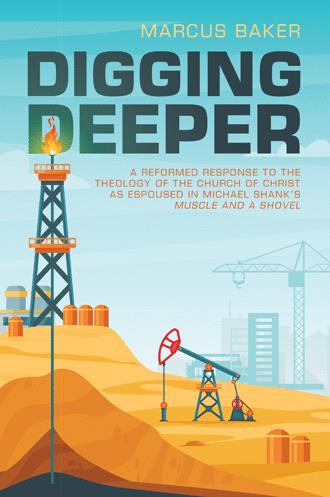
Digging Deeper
A Reformed Response to the Theology of the Church of Christ as Espoused in Michael Shank’s Muscle and a Shovel
by
Book Cover & Preview Text
Introduction There is a common experience today in America. Thanks to the religious freedoms enshrined in the First Amendment of our Constitution, it is a part of everyday life to pass any number of churches on the street, each with a sign bearing its name and each with its peculiarities. This is so ordinary to us that we may walk past or drive by and hardly notice them, let alone spend much time thinking about what makes one particular church different from the others. How much does the name on the church sign convey to the average passerby? Some names are so commonplace and familiar that they are expected to be there: “First Baptist Church of...” so-and-so, “Grace Presbyterian Church,” “St. Paul’s Lutheran Church,” etc. The names indicate that these are churches which adhere—or at least once adhered—to the doctrines of particular Protestant denominations. Some churches have names that are more creative or catchy than they are descriptive: “Hope Community Church,” “On Fire Church,” “Mt. Zion Church.” These are typically more charismatic churches to one degree or another (although it is not impossible for Protestant churches to use a catchy name); these are the kind one might refer to as “Bapti-costal” if trying to nail down something of what it teaches. Although one church may lean more heavily toward the Baptist view or to the Pentecostal position than its neighbor, this is something they would likely not admit to, as these churches often claim to be “non-denominational.” We might call them post-Protestant. There are non-Protestant churches as well: Roman Catholic, Eastern Orthodox, etc. These necessarily stand out as different from the others. It is obvious when you see them, especially from the inside. There is one church, however, which gathers under a very specific name and, to the person driving by, may seem to be just another of the Protestant denominations or another form of the “non- denominational,” post-Protestant denomination. But no, this church, the Church of Christ, is unique. You might not realize that by touring the facilities, but if you sit down and pay attention to the evangelist in the pulpit, or listen to the congregation conduct a mid-week Bible study, or meet up with a member for lunch and conversation, you will likely soon be confronted with the fact that the Church of Christ is decidedly not your generic or familiar denominational church. Like the post-Protestant churches, it denies being a denomination. Like the Protestant churches, it places a strong emphasis on the authority of Scripture—though, as I will show, not in the same way. Like Roman Catholic and Eastern Orthodox churches, its members identify themselves as the one, true church of Christ founded in the first century, even as they hold to a different gospel than what Christ and the apostles taught. To some readers, this last point may sound arrogant. Who am I to say a whole church believes in a false gospel? After all, the gospel is the central message of Christianity. Why do I have the right to make such an accusation? I should note at the outset that I am aware there are members of local Church of Christ congregations—and even whole congregations using that name—who do not align with the mainline Church of Christ on every doctrine. I do not intend to lump them all together as if those differences are unimportant. I intend to deal specifically with the presentation given in Michael Shank’s book Muscle and a Shovel (hereafter M&S). All references to the Church of Christ in this book should be understood with this in mind. Having said that, the Church of Christ, as presented in M&S, self-consciously denies that any other church has the true gospel, and so my claim should not be considered any more arrogant than what we read there. This is to say, because all contradictory claims to truth are necessarily exclusive, it is proper—even if it is not politically correct—for those who hold contested views to say to one another, “I am right, and you are wrong.” We live in a time when many people hold to a postmodern worldview, believing truth is subjective. I have my truth, you have your truth, but no one has the truth. Postmodern thought flies in the face of Christ’s claim to be “the way, the truth, and the life” (John 14:6 English Standard Version). Clearly, Mr. Shank is opposed to postmodernism. He believes in objective truth, which I respect. This allows for honest discourse and a willingness to say, “No, you are wrong.” As he writes, he understands he is telling people they are wrong about some of their deepest held beliefs. He anticipates the reactions this can incur. He realizes the importance of being right about the gospel. He was under no illusions as to the potential for controversy his book might generate. He remarks, “Many will hate me for what I have shared with you in this book. Many denominational preachers will seek to purge this book from society, and many who love their respective denominations will work to discredit, silence, and bury this work.”1 I want it to be known that I do not hate Mr. Shank and have no intention of speaking falsely of him and his experience. I am only able to speak emphatically based upon what he has written. It is not my goal to attack him personally, rather, I want to examine his book in light of biblical revelation. If the theology M&S teaches is not in line with the truth God has revealed, then it, and the churches which profess it, ought to be rejected. 1 Michael J. Shank, Muscle and a Shovel, 10th ed. (Colorado Springs, CO: Michael Shank Ministries, LLC, 2011), 388-389.
Formats

Book Details
About the Book
How would you answer the man who told you that if you have not been baptized into the church he belongs to, then you are not really a Christian? What if he had Bible verses to prove it? “There is one body and one Spirit—just as you were called to the one hope that belongs to your call— one Lord, one faith, one baptism” (Ephesians 4:4-5). “And now why do you wait? Rise and be baptized and wash away your sins, calling on his name” (Acts 22:16). This is what Michael Shank argues in his book, Muscle and a Shovel. He describes the Church of Christ in these words: “Plain Bible teaching with no human opinions. Allowing the Bible to speak where it speaks. A people who desire book, chapter, and verse for every belief and practice potentially prescribed to. Anything not found in the Word would be thrown aside as insufficient.” Sounds convincing, right?
However, a proper understanding of Scripture goes beyond the surface-level excavation presented in Muscle and a Shovel. Digging Deeper examines Mr. Shank’s bold assertions in light of God’s Word. It will equip you to recognize the faulty interpretive methods which lead him to teach contrary to the message of the Bible. Digging Deeper also serves as an introduction to important theological categories. Biblical definitions of key terms are provided and explored, revealing the majesty of the true gospel—salvation by faith alone—while exposing a false, works-based gospel for its inability to save sinners.
About the Author
Marcus Baker is a member of the Orthodox Presbyterian Church. After discovering that the Bible teaches salvation is by grace alone, through faith alone in Christ alone, he became passionate about sharing the gospel—especially with false converts.