
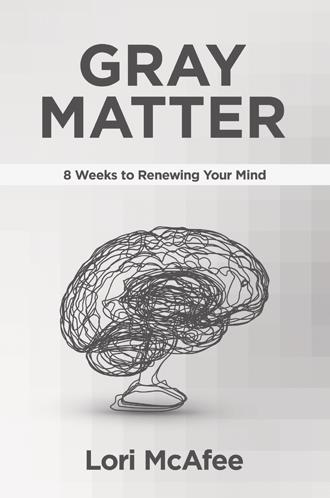
Gray Matter
8 Weeks to Renewing Your Mind
by
Book Cover & Preview Text
Chapter One: Understanding the Call to Transformation “Do not conform to the pattern of this world, but be transformed by the renewing of your mind. Then you will be able to test and approve what God’s will is—his good, pleasing and perfect will.” — Romans 12:2 Maybe it was always like this. Maybe, (since there’s nothing new under the sun, after all) even in ancient Jerusalem, the fishermen who would eventually become Christ’s disciples were flooded with the pressure to do, to live, to be a particular way—to wrap their feet in sandals that aligned them with the fashions of the time and to keep up with the popular gladiatorial competitors in the Roman arenas. They needed something to talk about on the fishing boat in the morning. Maybe it’s just human nature to want to create a world, a life, a value system, around the popular opinion—Lydia was, after all, able to make a comfortable living as a seller of purple, the “dealer in purple cloth.” Purple was, at that time, a color only valued for the enormous amount of resources it took to make it, and therefore, the flashy wealth of those able to afford it and food for their families. Perhaps human culture just is a culture built around dictating each other’s values and pressing other humans to adapt to them. People are creatures who thrive in packs, and there’s a reason that even Paul, 2,000 years ago, devoted precious real estate in one of his most impactful letters to the concept. I wasn’t alive 2,000 years ago. So I can’t tell you firsthand. But I do know that in today’s world, Paul’s reflection remains all too relevant. Just as much now, if not even more so, we are bombarded with the desire, the message, the pressure: to conform. We are surrounded by vessels that tell us, at every hour of every day, how to think, how to dress, how to befriend, how to argue, how to act—basically, how to live. Whether through social media or advertising or simple societal pressure, (something that is, in truth, far from simple) the pressure to conform can be overwhelming. More than that, it can seem…desirable. Easy. Because in so many ways, it is. There is no denying that there is power in conformity; otherwise, we wouldn’t do it. There’s social capital to gain! A great position at work, friendship, simplicity. A shedding of the struggle. What’s that old saying? You only have the world to gain? I suppose that’s true. And Paul knew it when he wrote his letter to the Romans. He knew how easy a trap it was to fall into—and how seductive the bait. So, he cautioned his friends in the Roman church not to bite. That’s easy enough to see as a standalone sentence, and too often, we take scripture as just that—a sentence here, a verse there. We forget that many of these books were originally written as letters, intended to be read as a whole, within the context of the letter itself, and in some ways, the context of the people to which they were written. Persons and cultures change over time, but human nature doesn’t. Because of this, I think it’s often key to remember that chapter and verse divisions were given to us as study tools. But many of the books of the New Testament were written as letters, as pleas, and like in an e-mail from a friend of a colleague, to truly understand one verse, one sentence, we need to remind ourselves of the subject line itself, or be willing to hop back a few paragraphs before the signature line.
Formats

Book Details
About the Book
There can be incredible transformation when we align ourselves with God’s truth. Although change can be scary, it moves us forward and allows us to be the people we were meant to be. In a powerful eight-week study of Romans 12:2, Lori McAfee challenges believers to look beyond surface-level change and instead, dive into their heart and mind to live out their truths, renew their minds, and embrace the purpose God has for them. Within a simple format that builds on the foundation of scripture, prayer, personal reflections, and deep dives into the spiritual meat of each concept, McAfee introduces a new step in the spiritual journey each week that nudges believers into realizing real, permanent transformation. Included are appendices that provide resources on quotes, scriptural references and ideas, further insights, and a step-by-step action plan for renewal. Gray Matter is an eight-week study of Romans 12:2 that shares scripture, prayers, and other insights to help believers attain mental renewal and transform into who God created them to be.
About the Author
Lori McAfee is a bestselling author, speaker, and the owner of McRay & Co. She is a personality with a passion for helping people know and love the person God created them to be. With an unwavering faith in Jesus, Lori is intentionally devoted to making a positive difference in people’s lives with her encouraging words of wisdom and uplifting spirit through her custom T-shirt company, books, and speaking engagements.