
From Eden to Bethlehem
What the Bible Teaches about Messiah’s First Advent
by
Book Cover & Preview Text
MARY ~ MOTHER OF MESSIAH, THE SAVIOR OF HUMANKIND. Mary was in the culmination of the Messianic prophecies regarding His birth, which spanned much of world history. She was a virgin at the time of her impregnation by the Holy Spirit (Isa. 7:14; Matt. 1:18). She delivered Messiah in Bethlehem in accordance with Micah’s prophecy (Micah 5:2). Yet she was primarily a resident of Nazareth that Messiah might be called a Nazarene (Matt. 2:23). She was the wife of Joseph through whom by adoption Jesus would have the legal right to David’s throne. She was a relative of John the Baptist (Luke 1:36). Surely, she was chosen by God to be Messiah’s human mother before the foundation of the world. When Mary encountered the angel Gabriel, she was betrothed but not yet wedded to Joseph, a Galilean carpenter. As explained by Gabriel (see chapter 1) she would be impregnated by the Holy Spirit. While the Bible does not say, most likely her unique pregnancy would have prompted much small-town gossip and the condemning assumptions that went along with it. What she may have endured in this regard is not recorded but can be imagined. The only explicit reference to this situation is provided for Joseph himself. In fact, he initially concludes that Mary’s child is of some other human father and that the best course of action would be a quiet divorce, which is required for legal separation in a Jewish betrothal (Matt.1:18-19). However, God intervenes through an angel in Joseph’s dream in which he is told of God’s plan—and Mary’s innocence—and that he should not hesitate to keep Mary as his wife (Matt. 1:20-21). He complies. In a few key recorded incidents Mary reveals much of her character and disposition. In their encounters with the angel Gabriel, both Zacharias (John the Baptist’s priestly father) and Mary were said to be “troubled” in the NKJV. For Zacharias the Greek word used means stirred up, inward turmoil, and it resulted in fear (Luke 1:12). For Mary the Greek word used means greatly perplexed, and it resulted in thoughtful contemplation (Luke 1:29). Although Gabriel tells Mary not to be afraid, there is no separate indication of fear in the recorded text. In response to the angel’s life-changing story she is a compliant servant of God, and she tells Gabriel, “Behold the maidservant of the Lord! Let it be to me according to your word” (Luke 1:38). When encountering her now-pregnant cousin Elizabeth, Mary shows her humility in the face of her great God (Luke 1:48), whom she recognizes as her Savior (Luke 1:46-47). Finally, when the Bethlehem shepherds arrive on Jesus’ birth scene and marvel at what has just unfolded, Mary is storing up her experiences, sifting them through her faith, again contemplative (Luke 2:19). Mary showed strong faith in her God from the beginning of her biblical record. Eve understood the LORD from His very presence and audible words. Mary understood and knew the Lord from past history of herself and her people, e.g., “He has filled the hungry with good things” (Luke 1:53), and from His written words, e.g., “As He spoke to our Fathers” (Luke 1:55). Eve would have seen and perhaps even touched God’s pre-incarnate manifestation in the Garden. Mary knew God in the unseen ground of her heart in a world fallen thousands of years. She is a wonderful example of the Lord’s declaration to Thomas, “Blessed are those who have not seen and yet have believed” (John 20:29). Perhaps Mary’s most winsome and helpful personality feature was her obedience, which she shared with Joseph. Her obedience to the God-directed announcement from Gabriel got her to Elizabeth and the unborn John the Baptist. Joseph’s and her obedience to Roman law got her to Bethlehem—and the shepherds and the magi. Joseph’s and her obedience to Jewish law got her to the Temple—and Simeon and Anna. Joseph’s and her obedience to angelic warnings got her safely to Egypt and back to Nazareth. She is indeed the Lord’s “maidservant” (Luke 1:38,48).
Formats

Book Details
About the Book
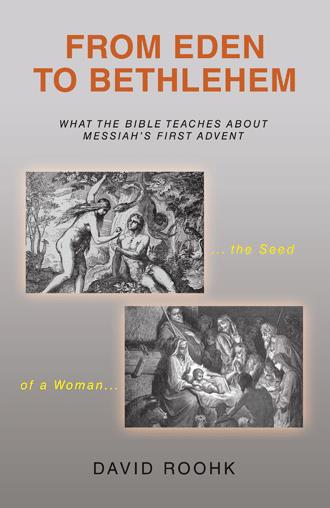
Four thousand years passed from humankind’s fall in the Garden of Eden to the birth of the Messiah (Christ). God’s plan was to provide salvation and world leadership to humankind. From Genesis to the Gospel accounts, God progressively revealed who the Savior / Ruler would be and what struggles were involved, in human terms, to progress from Eden to Bethlehem. Although God’s plans never failed, He often accomplished them through fragile, flawed human beings.
In a chronological account of the events leading to the birth of Jesus Christ, David Roohk relies on comprehensive study notes gathered from over forty years of leading Bible studies and Sunday School classes to reveal the entire Christmas story as told in the Bible. He recounts the progressive revelation of Messiah’s genealogy and the unrelenting opposition to God from Satan. He includes a sampling of well-known women who passed the biological seed and supplies discussion of Messiah’s two purposes, advents, and natures. Throughout his chronology, Roohk provides a broader, deeper context in which to better appreciate and understand the traditional Christmas story, possibly in ways never before encountered!
From Eden to Bethlehem provides inspirational insights into the four-thousand-year history and events that unfolded from the Garden of Eden to the birth of Christ.
About the Author
David Roohk has led Bible studies and adult Sunday school classes for over forty years, accumulating hundreds of pages of study notes, many on the birth of Jesus. He resides with his wife, Cathie, in northern Nevada. David’s first book, From Eden to Bethlehem, was three decades in the making.