
STATISTICALLY SIGNIFICANT
The Science of Jesus as the Son of God
by
Book Cover & Preview Text
PART ONE of this book reviews how the biblical text has been passed down to us. It includes a discussion of Iranaeus, Polycarp, and the Codex Sinaiticus. Ancient scribes' precise methods of creating copies of ancient documents are compelling evidence that the text has been accurately copied. In the scientific world, this is an extremely careful and exact handling of data. Further, the data were verified by other people (i.e., Rabbis). This care is impressive. The Codex Sinaiticus, dating from 300 to 399 A.D., is amazingly close to the King James Version, dating from 1611 A.D. It is a telling example of how the New Testament has been handed down from generation to generation. Outside data sources affirm Jesus' crucifixion and death and concur with Polycarp and Irenaeus.
PART TWO reviews archeological data related to Jesus' life. Archeological findings confirm the existence of Caiaphas, Pontius Pilate, James the brother of Jesus, and four Roman Emperors mentioned in the New Testament. Ancient cities mentioned in the New Testament have been found such as Bethlehem, Capernaum, Caesarea Philippi, Ephesus, Laodicea, and Smyrna. Archeologists confirmed that the Pool of Siloam and Jacob's Well have been found. Archeologists also discovered the Temple of Artemis and the Theatre of Ephesus that are mentioned in the Bible. They may have found Apostle Peter's stone house.
PART THREE shows that Jesus was brutally tortured and died, most likely from a heart attack caused by hypovolemic shock. It documents an actual earthquake when Jesus died and proves that the darkness was not an ordinary solar eclipse. A Roman soldier ensured that Jesus was dead by piercing him with a spear, probably in the heart. The pericardial sac (or the pleural sac) ruptured, causing clear plasma and blood to drain from the wound. There is evidence for the earthquake described in the Bible. The sky went dark for hours. It is astronomically impossible for it to have been a standard solar eclipse. The guards who guarded the tomb did not dare fall asleep for fear of execution. No Jew would unwrap Jesus' dead body and remove it from the tomb because it was sacrilegious to do so.
PART FOUR presents evidence that Jesus rose from the dead and the citizens of Jerusalem weren't fooled by an 'imposter Jesus.' For Jesus to live through the crucifixion, he must have been so wholly unconscious that he never groaned or moved once while he was wrapped with linen and the resins applied. The wrapping, and especially the resins, would have stung as they touched his wounds. Jesus was carried to the tomb, and He was sealed shut in it for three days without food and water. His body would have craved water…remember, "I thirst." At the end of those three days, we are now supposed to believe that this man's body healed itself so much that he regained consciousness, somehow unwrapped himself, and walked out without aid. The hand, foot, and spear wounds were still there but somehow not bleeding anymore. This goes against all that we know about medicine and the human body. Jesus died.
The Apostles wrote that Jesus appeared to more than 500 people for over a month after He rose from the dead. First, Jesus appeared to more than 500 people for 40 days. The appearances were inside, outside on a road, on the shore, and in a small and large group. No one claimed this person wasn't Jesus. Jesus appeared to his half-brother James, who would have recognized if it wasn't Jesus.
The Apostles' behavior totally changed from timidity to fearlessness after the resurrection. All Apostles except John were executed for their beliefs and some of the executions were brutal. None recanted. Hundreds of early Christians were persecuted for their beliefs and none recanted. This is persuasive evidence. Collectively, these data affirm the New Testament account that Jesus rose from the dead.
PART FIVE lists 25 Old Testament prophecies that Jesus fulfilled. Examining 25 prophesies is a random experiment with only two possible outcomes: 1) The prophecy wasn't fulfilled by Jesus but was fulfilled by other events, or 2) The prophecy was fulfilled in Jesus. Our null hypothesis is that all 25 prophesies were fulfilled by other events (such as random chance, nature, etc.) and none through Jesus. Saying that 25 of 25 prophesies were fulfilled by other events is the same as getting 25 Heads when you flip a coin 25 times. There is a less than one in 33 million chance that all 25 prophecies were fulfilled by other events. This minuscule probability means those prophecies were fulfilled by Jesus instead of other events. He is the Son of God.
PART SIX recommends what to do next as a new Christian, such as how to choose a Bible, pick a good church, and why the Bible doesn't need to be modernized. The dangers are discussed of worshipping a false god, in believing Prosperity Theology, and in Self Worship. This part also describes the differences between the body, the soul, and the spirit.
Formats

Book Details
About the Book
"I could not stop reading it. It is excellent." John R. Johnson, Church Planter & Pastor.
What if I told you that Jesus fulfilled 25 Old Testament Prophecies and the probability is less than 1 in 33 million of that occurring by chance?
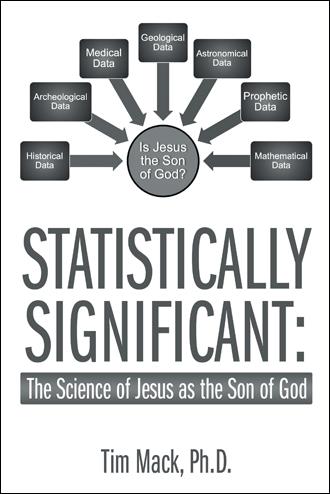
It's true! This book examines historical, archeological, medical, geological, astronomical, prophetic, and even mathematical data about Jesus' life, death, and resurrection. The science says that Jesus is the Son of God.
In "STATISTICALLY SIGNIFICANT: The Science of Jesus as the Son of God,” you can read about those prophecies and that:
• Archeological discoveries confirm people and places in the New Testament.
• Jesus was brutally tortured and died, most likely from hypovolemic shock.
• An actual earthquake occurred when Jesus died; the darkness was not an ordinary solar eclipse.
Tim Mack, Ph.D., is a former university researcher and Academic Dean. This is a state-of-the-art book with over 100 references to current information. It is easy to read and highly organized.
About the Author
Tim Mack has a B.A. in Biology from Colgate University and a M.S. and Ph.D. in Entomology from The Pennsylvania State University. He was an assistant professor, associate professor and professor at Auburn University; Department Head, Director, Assistant Dean, and Associate Dean at Virginia Tech; Graduate Dean at Georgia Southern University; and Graduate Dean & later Dean of Extended Studies at Indiana University of Pennsylvania. Tim is retired and trying to live up to his name, which means 'honoring God' in Greek.
Tim has won two national teaching awards and is in Who’s Who Among America’s Teachers. Tim taught more than 4,000 students, with more than 2,500 in 100% online classes. Tim published more than 240 refereed and non-refereed publications, including refereed journal articles, book chapters, symposia proceedings, Extension publications, and newspaper articles. He was awarded an Honorary Professorship from Beijing Agricultural University, China. Tim also participated in international agriculture projects in Mali and Cameroon.
Tim’s has given sermons at his church in his Pastor’s absence. This book came about because of one of Tim’s sermons. People listened to his sermon and encouraged Tim to author a book.
Tim is retired and trying to live up to his name, which means 'honoring God' in Greek.